(EN)
(EN)
 (ES)
(ES)
 (IT)
(IT)

The Memory of the Heart
Saint Josemaría Escrivá, the Saint of the Ordinary Who Won Hearts with His Madness of Divine Love
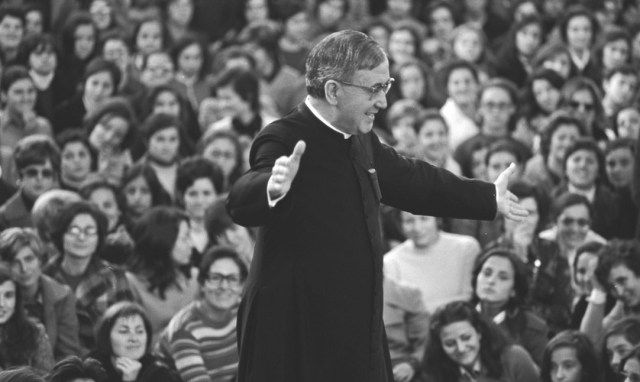

José María Escrivá de Balaguer, a Spanish jurist, theologian, and Catholic priest, was born on January 9, 1902, in Barbastro (Huesca). He founded Opus Dei in 1928 and died on June 26, 1975. (Source: Wikipedia)
On May 17, 1992, Saint John Paul II beatified Josemaría Escrivá de Balaguer. He proclaimed him a saint ten years later, on October 6, 2002, in St. Peter’s Square, Rome, before a large crowd. “Following in his footsteps,” the Pope said in his homily on that occasion, “spread throughout society, without distinction of race, class, culture, or age, the awareness that we are all called to holiness.”
The call to holiness in ordinary life shook me the day I met Him in 1972. He was a hurricane of love for God, wanting to spread his passion to everyone. He opened up a horizon for me that would only end in heaven. His passion captivated my mind and heart; my entire project took concrete form with my name, from all eternity. His passion of divine love was the garment that made me feel like “the queen of my own party”; I clearly visualized my destiny, the path, and the tools I needed for that journey.
I said yes, without hesitation, to love and to pain. I said yes to a love crucified for me. “Love is repaid with love.”
I learned that faithfulness is neither rigid nor static, that God’s love does not change and does not depend on my merits, but on the heart I offer in every battle, even if I lose it.
Every day I thread the needle with the thread that God grants me, and I look at Him with the hope that my knots will not cause anyone walking beside me to stumble.
I learned that only by living in love with Love am I able to keep smiling and my gaze fixed on destiny. Everything in my life makes sense. The pieces fit together and fall apart easily, but in His love and with Him, everything finds its place.
My professional work takes on a dimension of eternity; my heart is tempered and surrendered along the way; the wounds of that body, in which nothing is healthy, are a refuge of purification, learning to ask for forgiveness and to forgive, which I am only capable of doing with his help. I learned to make all this concrete; I learned to materialize it, thanks to Saint Josemaría.
I remember his words: “Authentic holiness, without palliatives, without euphemisms, that goes to the last consequences; without half measures, in the fullness of a vocation lived to the fullest” (Meditation 19-III-1960)
He constantly taught us that “to be holy is to be like Christ, more like Christ, more holy” (Tertulia 16-XI-1972)
Today is a day for gratitude. Ultimately, it all comes down to not looking away: “No eye has seen, no ear has heard what God has prepared for those who love him” (1 Corinthians 2:9).
Today, January 9, 2026, also marks two years since my husband suffered a stroke, and thanks to Saint Josemaría, who took him in his hands, helping him through the air and overcoming difficulty after difficulty, he is still by my side today. It was a Tuesday, and the following week he was already home without serious aftereffects.
Five heart attacks and a stroke riding on the back of God’s mercy.
And, as I said in an article in December, “Today, at my age, my heart longs for the eternal embrace, and that when I arrive, He will recognize me and smile upon me. That hope sustains me and impels me not to live on borrowed time… I have understood that there is no safer path than to let myself be recognized by Him, because His gaze is never lost, even though mine, at times, may wander.”
Thank you, sorry
And help me more!

Exaudi Staff
What is Exaudi News? Exaudi News is an international Catholic media outlet that informs, shapes, and transforms daily in Spanish, English, and Italian. Through news, analytical articles, and live broadcasts of the Pope's events, Exaudi seeks to strengthen Christian unity and contribute to the evangelization of the world, always guided by the Church's social doctrine. We work to bring Christian truth and values to every corner of the planet. Help us transform the world with Exaudi! At Exaudi, we believe that evangelization and quality information can change lives. To continue our mission and expand our reach, we need your help. In addition, we are looking for committed people to join our team. With your support, we will reach more people, spread the message of Christ, and strengthen Christian unity. Will you join our mission? For more information on how to collaborate, visit Exaudi.org or contact us directly: [email protected] Exaudi: Informs, educates, and transforms.