(EN)
(EN)
 (ES)
(ES)
 (IT)
(IT)

Elias, a priestly vocation for Tanzania
Elias Emmanuel Mniko, a young seminarian from Tanzania who is training in Spain to return as a priest to serve his people
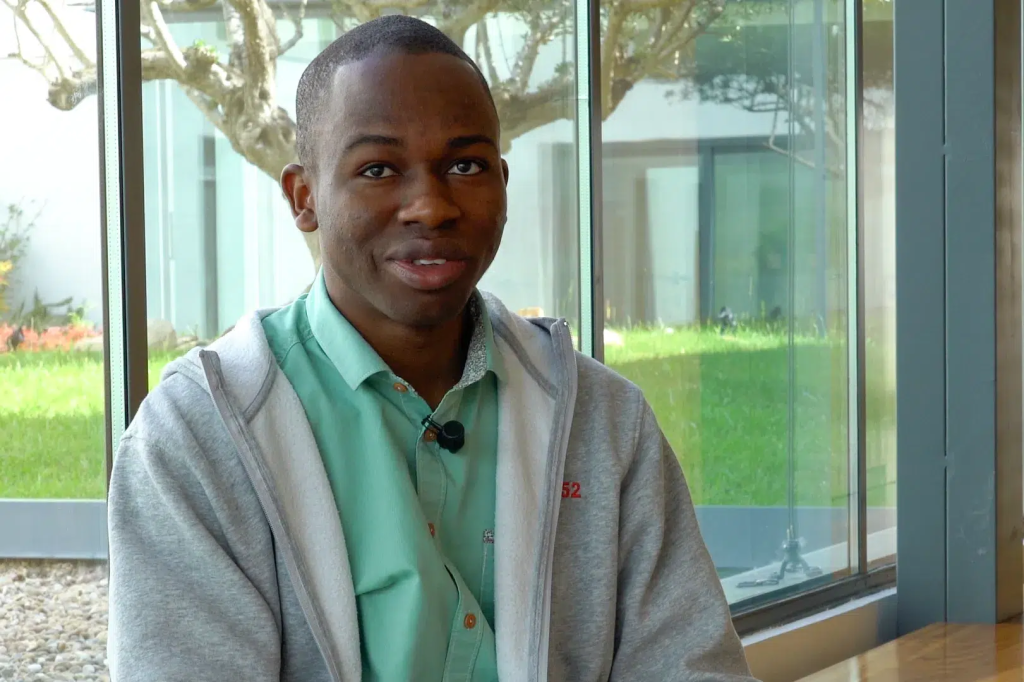

Elías, a seminarian vocation for Tanzania, is living his training in Spain with enthusiasm, hope, and commitment, which he will forge as a priest when he returns to his country.
Elías Emmanuel Mniko is 22 years old and has a gaze that exudes peace and conviction. He was born in the Mwanza region of northern Tanzania, on the shores of Lake Victoria. He grew up in a home filled with harmony and faith, where his father Emmanuel and his mother Miluga lovingly raised their four children.
A vocation that the Lord placed in his heart
From high school on, he began to feel a deep desire: to be a priest. He couldn’t quite explain it, but something inside him ignited every time he saw the priests at school: dedicated, serene, and approachable. He was fascinated by the seminarians with their elegant, discreet white cassocks. “It was a desire the Lord placed in my heart,” he now says simply.
Although he did not enter the minor seminary, Elías was not discouraged. He spent a year of formation at the St. John Paul II Vocational House in his home diocese. There, in the silence of prayer and the joy of service, his vocation matured. He understood that, in Tanzania, being a priest is not just a life choice: it is an urgent necessity.
The community is growing and there are few priests
The diocese of Mwanza, to which Elias belongs, faces great challenges. Although Catholics represent nearly 30% of the population—some 1.2 million people—priests are scarce and communities are growing rapidly. In many villages, Mass is celebrated only once a month, and some faithful walk more than 10 kilometres to attend. Priestly vocations are a blessing desired with hope and faith by the entire population.
Despite everything, the Church in Mwanza is alive. The faithful are enthusiastic, the young people are proud of their faith, and the diocese is working hard to promote educational and healthcare projects. Many schools and hospitals are run by the Church. There, amidst the simplicity and, at times, precariousness, hope is sown every day.
“I’m having a wonderful experience.”
Elías currently resides at the Bidasoa International Seminary in Pamplona. He has completed his first year of Philosophy studies , and his face reflects awe and gratitude. “I’m living a wonderful and fraternal experience,” he says. He is excited to share daily life with seminarians from all continents, learn from the formations, and experience other cultures.
“Europe is teaching me many things,” she says. “Europeans are very loving. But I also think that your Europeans can learn from us Africans about the importance of family life.”
The life of a priest demands sacrifices
Elías speaks calmly, but his every word is charged with inner fire. He knows that priestly life demands sacrifices. He knows that, when he returns to Tanzania, a demanding mission awaits him: caring for many souls, accompanying scattered communities, comforting the suffering, and being the living presence of Christ among his people.
Sometimes he thinks of his family, his homeland, the joyful songs of Mass, and the ground corn that accompanies almost every meal. He also remembers his friends, the catechists at his parish, and the bishop who encouraged him not to be afraid to say yes to God.
Life at the Bidasoa International Seminary feels like a gift to him. There are times for prayer, study, sports, service, and also celebration. “Here we learn to be brothers,” he explains. Although he struggled to adapt at first—the cold of Navarre, the language, the food—now he feels at home. His Spanish improves day by day, and when he smiles, it is with that warmth typical of Africa.
“Young people in Tanzania have a lot of hope.”
Elías is not naive. He knows the problems of the Church, both in Europe and Africa. In his country, in addition to the shortage of priests, there are social challenges: poverty, lack of access to education in rural areas, and the risk of religious syncretism. But he also knows there is a fire that never goes out. “Young people in Tanzania have great hope. They know they are the future of the Church. That’s why they want to be well-educated, serve with joy, and give their lives if necessary.”
Mwanza, his diocese, has seen vocations like his emerge. The local major seminary cannot cope with training all the candidates, so the diocese sends some, like Elías, to training centres outside the country. It’s a courageous investment, with the hope that these young people will bear fruit again.
Return to your country to serve
Elías looks to the future without fear. “I want to return to my country and serve my people. I want to be a good shepherd, like Jesus. And, if I can, I want to help other young people hear the voice of God.” He says this with a moving piece, because there is nothing stronger than a devoted heart.
His story, like that of many African seminarians, is a song of hope for the entire Church. In a world where faith sometimes seems to be fading, voices like his reminder us that the Gospel is still alive, sowing its seeds in fertile lands like Tanzania.
Fundación CARF
Trabajamos para llevar la sonrisa de Dios a todos los rincones del mundo a través de los sacerdotes y ayudando a su formación. Gracias a nuestros benefactores, ayudamos a la formación de los sacerdotes, difundimos su buen nombre y rezamos por su fidelidad y las vocaciones. Trabajamos para servir a la Iglesia y que ninguna vocación se pierda y luego ellos puedan transmitir en su labor pastoral toda la luz, ciencia y doctrina recibida. Académico Las licenciaturas, programas de especialización o doctorados, otorgan a cada candidato una formación específica en Teología, Filosofía, Derecho Canónico o Comunicación Social Institucional. Espiritual Los seminaristas y sacerdotes complementan su formación académica y humana con la espiritual, ya que deben estar preparados para seguir su vocación y prestar su cuerpo y su espíritu al Señor. Humano A través del ambiente de familia y de preparación, se consigue el desarrollo de actitudes, capacidades y valores que impactan en el crecimiento personal y social de los sacerdotes.
Related
“A new fervor of faith is emerging in Venezuela”
Fundación CARF
02 March, 2026
4 min

Living Confirmation Every Day
Miguel Morales Gabriel
26 February, 2026
1 min

Catholics Must Be More Courageous
Se Buscan Rebeldes
24 February, 2026
5 min
The Sacred Rite of Confirmation
Miguel Morales Gabriel
19 February, 2026
1 min