 (EN)
(EN)
 (ES)
(ES)
 (IT)
(IT)

Catholics Must Be More Courageous
María San Gil: A Life Marked by Terrorism, Consistency, and a Late but Radical Conversion


In this interview from the Rebeldes podcast , María San Gil, former president of the PP in the Basque Country and current collaborator at the Catholic Association of Propagandists (ACdP) and the CEU San Pablo University, shares her journey with disarming sincerity: an apparently normal childhood in San Sebastián in the 1960s, the suffocating weight of ETA terrorism, the assassination of Gregorio Ordóñez a meter away, years of bodyguards and constant fear, and a transformative encounter with God through the Emmaus Exercises in 2016-2017.
Childhood in a Basque Country subjugated by hatred and fanaticism
María was born in 1965 into a well-to-do middle-class family in San Sebastián. She remembers a happy childhood: a large house by the beach, three brothers, a dog, a secular French school, and a strict but loving upbringing. Her mother was a woman of deep faith who never missed Mass; her father, an intellectual and a great conversationalist, decided in his youth that he had “already attended all the necessary Masses.” At home, they prayed before meals, everyone was baptized and had received First Communion, but faith didn’t occupy a central place in their lives.
However, ETA terrorism permeated everything. Demonstrations outside her father’s family factory, kidnappings of close friends, murders that led the family to take to the streets in protest. “Being born in the Basque Country during those years shapes your character,” she says. That society, “defeated, subjugated, intimidated, and cowed,” awakened in her a rebellion against the normalization of the abnormal: “This isn’t a way of life. We’ve normalized what isn’t normal.”
The assassination of Gregorio Ordóñez: the trauma that propelled her into politics
In 1995, María was chief of staff to Gregorio Ordóñez, deputy mayor and spokesperson for the People’s Party (PP) in San Sebastián. Gregorio was a courageous, honest, hardworking, and devout politician who staunchly defended freedom in a society where being a constitutionalist was almost tantamount to being a second-class Basque. During an informal lunch at a bar in the Old Town, an ETA gunman shot him in the back of the head. María was sitting across from him.
The post-traumatic shock was devastating: months of showering without closing the curtain for fear someone would enter, moving back in with her parents, living in constant terror. Despite the pain, she agreed to run for office after the assassination. From Gregorio, she learned the true meaning of politics: service, consistency, honesty, and tireless work. “Politics is a privilege: you are serving the society in which you live.”
The slow path to God: from attending Mass out of habit to “falling off the horse” at Emmaus
For decades, Maria went to Mass on Sundays “because my husband went,” but without a heart truly open to God. She felt arrogant: “I didn’t need to.” When she was diagnosed with breast cancer in 2007 (they were living under constant threat and with a security detail), her husband suggested going to Lourdes to pray. She refused and became angry: “It seemed like the worst thing to do.” He went alone.
The turning point came after her mother’s death in 2016. A friend invited her to the Emmaus retreat without her knowing exactly what it was. There she discovered the “God of love,” merciful and forgiving, very different from the authoritarian God she remembered from her catechism classes. “I had a profound awakening, like Saint Paul,” she confesses. Since then, everything has changed: the need for daily Mass, marital prayer, spiritual direction, and a deepening of her faith.
The decisive influence of Monsignor José Ignacio Munilla, then Bishop of San Sebastián, stands out. His homilies were like a gentle rain: without you even realizing it, they opened your heart and generated a hunger for something more.
Forgiveness, memory and justice: the path to inner reconciliation
He never felt hatred or a desire for revenge toward “Txapote,” Ordóñez’s murderer. But in Emmaus, the question of true forgiveness arose. His spiritual director asked him to pray for him: “Not to have coffee together, but to ask him to acknowledge the harm he caused.” He insists: forgiveness and memory are not opposed. “Forgetting is dangerous; the memory of the victims, along with truth and justice, helps bring about real forgiveness.” He recalls that more than 350 murders remain unsolved and that many victims cannot find closure because they don’t know who killed their loved one.
Faith in the public sphere: courage, consistency, and the social doctrine of the Church
Today he works at CEU and ACdP, where faith is lived openly in the public sphere. He criticizes the secularization that relegates faith to the private sphere: “If you’re a Real Madrid fan, you talk about it all the time; if you’re a God fan, why be silent?” He defends the Church’s social doctrine as a guide for social life: the dignity of the person, the common good, solidarity, and subsidiarity. “We must vote according to our conscience, not based on strategy or tactics.”
He doesn’t rule out Catholic participation in politics, but prioritizes civil society: “Awakening consciences, not staying home protesting on the radio.” He recommends that young people pursue intellectual and spiritual formation, join associations, NGOs, or the ACdP itself, and serve from the ground up without seeking positions of power.
Second parts are never good… and God directs life
María left politics in 2008 after disagreements with Mariano Rajoy, going from being proposed as the party’s number two candidate to working at the unemployment office (with bodyguards). Today she sees it as providential: she gained time with her children, discovered the fullness of motherhood, and, years later, a profound encounter with God.
“I wouldn’t go back into politics. Second chances are never good,” she declares. But she does encourage people to live their faith without fear, with courage and authenticity: “God loves you and wants you to be happy.”

Se Buscan Rebeldes
“Se Buscan Rebeldes” es un canal de evangelización católico que busca saciar la sed que tienes de felicidad y responder a tus preguntas con el poder transformador del amor de Dios revelado en Jesucristo.
Related

Reflection by Monsignor Enrique Díaz: The second son changed his mind and went
Enrique Díaz
27 September, 2026
6 min

He changed his mind and went: Commentary by Fr. Jorge Miró
Jorge Miró
26 September, 2026
3 min
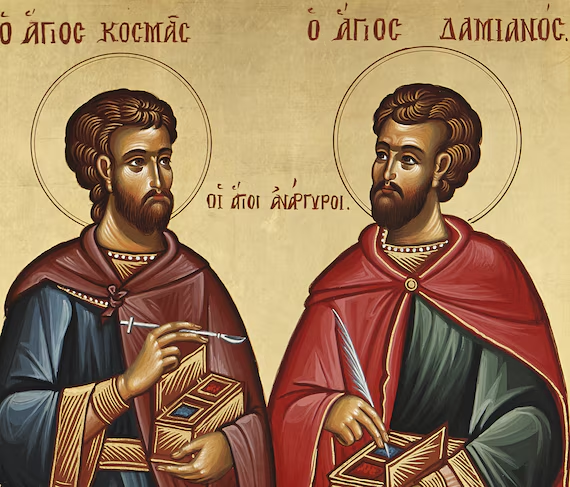
Saints Cosmas and Damian, September 26
Exaudi Staff
26 September, 2026
2 min

From the Stage to Eternal Truth: The Fascinating Conversion of Sir Alec Guinness
Sonia Clara del Campo
25 September, 2026
4 min