 (EN)
(EN)
 (ES)
(ES)
 (IT)
(IT)

Karol Wojtyla: “I lived here”
Prime Minister Meloni visits a memorial site for John Paul II in the Polish College in Rome


Not everyone knows that Cardinal Karol Wojtyla had his home in Rome, a small apartment in the Pontifical Polish College on the Aventine Hill. Whenever he came to Rome to fulfill his duties at the Vatican, he stayed here; on September 14, he left for the second conclave of 1978, never to return—or, to be more precise, to return a year later for a papal visit. His clothes, documents, writings, and various belongings remained here.
In recent years, an old school building was in need of renovation, but the work was slow. Cardinal Stanislaw Dziwisz, John Paul II’s secretary for many years, recently met with Italian Prime Minister Giorgia Meloni and discussed, among other things, the challenges of renovating the school and the rooms that Cardinal Wojtyla used for so many years. Meloni offered to collaborate on the renovation of the school and the creation of a monument to John Paul II in Rome to commemorate the Holy Year 2025. Thus, a small but unique museum dedicated to the man who served as Bishop of Rome for almost 27 years has been established in the capital.
On Christmas Eve, December 22, Prime Minister Giorgia Meloni visited this museum dedicated to Pope John Paul II, accompanied by the Undersecretary of the Presidency of the Council of Ministers, Alfredo Mantovano. Meloni was received by Cardinal Stanisław Dziwisz, Archbishop Emeritus of Kraków and John Paul II’s personal secretary; Monsignor Rino Fisichella, Pro-Prefect of the Dicastery for Evangelization; Monsignor Jan Główczyk, Rector of the Pontifical Polish College in Rome; and Monsignor Paweł Ptasznik, Rector of St. Stanislaus and President of the Vatican John Paul II Foundation.

“This museum is a treasure of faith, spirituality, and love. Here are imprinted the footprints of an ordinary yet exceptional man, a man who marked my life and to whom I entrusted my journey. I will cherish the emotion of this visit, a balm for the soul and heart,” wrote President Meloni in the guestbook of the Pontifical Polish College at the end of his visit.
Polish institutions in papal Rome
The first Polish institution in papal Rome was the church and hospice dedicated to Saint Saviour and Saint Stanislaus, bishop and martyr, on the Via delle Botteghe Oscure. It was established in 1578 at the initiative of the Prince-Bishop of Warmia, Cardinal Stanislaus Hozjusz, and was solemnly consecrated after his death in 1591. Cardinal Hozjusz’s successor and the church’s first rector was Father Stanislaus Reszka, a priest, diplomat, and humanist. It was Father Reszka himself, with great ingenuity, who sought to organize another refuge for fellow Polish citizens wishing to continue their studies in Rome. He attempted to connect the Polish college with the Oratory of Philip Neri at the Church of Santa Maria in Vallicella, approved as a Congregation by Pope Gregory XIII Buoncompagni in 1575. It is worth noting that Philip Neri was involved in the education and studies of young people from Rome, but also from other nations, particularly English and Polish. In 1583, Philip Neri, with the spiritual and financial support of the Pope himself, began the foundation of a college for Poles, but it was short-lived: it closed in 1586. In 1653, King John II Casimir Vasa unsuccessfully attempted to reopen the college. It was not until 1866 that the current college was formally inaugurated thanks to the efforts of the Congregation of the Resurrection of Our Lord Jesus Christ (Resurrectionist Fathers), who raised the initial funds from Princess Odescalchi, Pope Pius IX, and other benefactors. In 1936 the school moved to its current location on the Aventine hill (Piazza Remuria).
The Polish College of the Aventine
The Pontifical Polish College became a house of formation for student priests sent by their bishops to Rome for specialized studies at various ecclesiastical universities. After World War II, the Jesuits assumed administration of the College. Since 1959, the College has been directly under the Polish Episcopal Conference. In 2017, the bishops decided to reorganize the Polish College in Rome and undertake renovations, which began in 2020. Currently, the College is closed for renovations.
Karol Wojtyla and the Polish College
Karol Wojtyła, the future Pope, had deep ties to the Pontifical Polish College. He stayed there during his visits to Rome before his election as Pope. The last time Cardinal Wojtyła resided at the College was when he arrived in Rome for the conclave following the death of Pope John Paul I. From this house he departed for the conclave in the Vatican and remained there after his election as Pope.
It is not surprising that he wanted to visit this place as Pope: he first did so a year after his election, on October 17, 1979. On that occasion, he gave an impromptu speech that was recorded by Monsignor Jozef Michalik, then rector of the College. Excerpts from that speech follow.
I am deeply attached to this Faculty. I can’t count how many days, weeks, and months I’ve spent here, but I think if we add them up, it would be two years. (…) A part of my life, not a thousandth, but a percentage, belongs to this Faculty. (…) Apparently, the undergraduate students who stayed here were fond of me. In any case, they once awarded me the title of ‘honorary university member’ and they never took it away.

But I feel a great attachment to this College for other reasons, specifically because it is (…) a House of Studies that bears witness to the vitality of the Polish Church during the most difficult times of the Partitions of Poland (the partitions of Poland between Prussia, Russia, and the Austrian Empire between 1772 and 1795, which led to the disappearance of the Polish state for more than a century, until 1918 – WR), also thanks to the great merits of the Resurrectionist Fathers. It also bears witness to the love of the Holy See for our nation in these difficult times; it was no coincidence, then, that the Servant of God, Pope Pius IX, came here as the last Pope before me —explained John Paul II—.
Furthermore, this College remains under the patronage of Saint John Cantius, to whom I have a special affection, as I grew up in the shadow of his figure and his tradition. This historical tradition, the university tradition of my Alma Mater (of Krakow), the Church of Saint Anne, where the sarcophagus containing the relics of Saint John Cantius is located. You know, after all, that I am from Wadowice, no more than 25 kilometers from Kęty, where Saint John Cantius was born. In short, I am deeply attached to this tradition.
“Therefore, my ties with this College are very close, very cordial,” the Pope emphasized. “Considering that this Polish College exists and is under the patronage of St. John Cantius, I recognize myself in it and have gladly returned here today. This is probably the first College, among many others in Rome, that I have visited, if we exclude the Roman Seminary and the Lombard Seminary.”
John Paul II concluded his speech with these words: “And I want to say, to reassure everyone, that I not only remember my past by remaining here, but I also try to continue to be spiritually present here…”
Twenty-five years after the death of John Paul II, thanks to the efforts of Cardinal Dziwisz and the Rector of the College, Reverend Monsignor Jan Glowczyk, and the invaluable collaboration of the Italian Government, a monument to Karol Wojtyla, Bishop of Rome for 27 years, has been erected in the College so dear to him, in commemoration of the Jubilee of 2025.


Wlodzimierz Redzioch
Wlodzimierz Redzioch è nato a Czestochowa (Polonia), si è laureato in Ingegneria nel Politecnico. Dopo aver continuato gli studi nell’Università di Varsavia, presso l’Istituto degli Studi africani, nel 1980 ha lavorato presso il Centro per i pellegrini polacchi a Roma. Dal 1981 al 2012 ha lavorato presso L’Osservatore romano. Dal 1995 collabora con il settimanale cattolico polacco Niedziela come corrispondente dal Vaticano e dall’Italia. Per la sua attività di vaticanista il 23 settembre 2000 ha ricevuto in Polonia il premio cattolico per il giornalismo «Mater Verbi»; mentre il 14 luglio 2006 Sua Santità Benedetto XVI gli ha conferito il titolo di commendatore dell’Ordine di San Silvestro papa. Autore prolifico, ha scritto diversi volumi sul Vaticano e guide ai due principali santuari mariani: Lourdes e Fatima. Promotore in Polonia del pellegrinaggio a Santiago de Compostela. In occasione della canonizzazione di Giovanni Paolo II ha pubblicato il libro “Accanto a Giovanni Paolo II. Gli amici e i collaboratori raccontano” (Edizioni Ares, Milano 2014), con 22 interviste, compresa la testimonianza d’eccezione di Papa emerito Benedetto XVI. Nel 2024, per commemorare il 40mo anniversario dell’assassinio di don Jerzy Popiełuszko, ha pubblicato la sua biografia “Jerzy Popiełuszko. Martire del comunismo” (Edizioni Ares Milano 2024).
Related

He changed his mind and went: Commentary by Fr. Jorge Miró
Jorge Miró
26 September, 2026
3 min
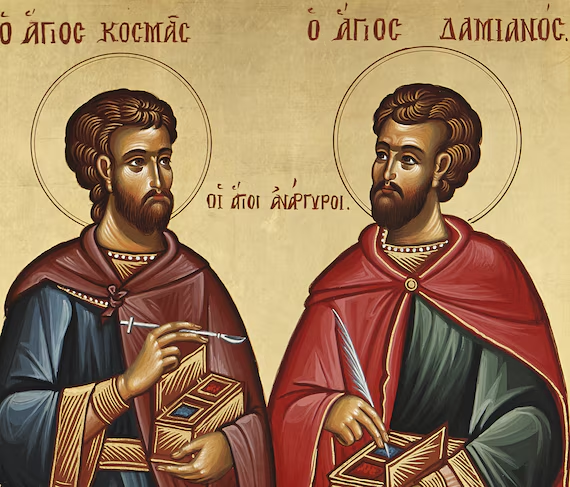
Saints Cosmas and Damian, September 26
Exaudi Staff
26 September, 2026
2 min

86 leaders from 16 countries will gather in Rome to discuss major leadership challenges in the era of artificial intelligence
Exaudi Staff
25 September, 2026
10 min

Our Lady of Mercy
Exaudi Staff
24 September, 2026
5 min