(EN)
(EN)
 (ES)
(ES)
 (IT)
(IT)

The Saints, a Great Proposal
How the Saints Reflect Christ and Guide the Christian Life
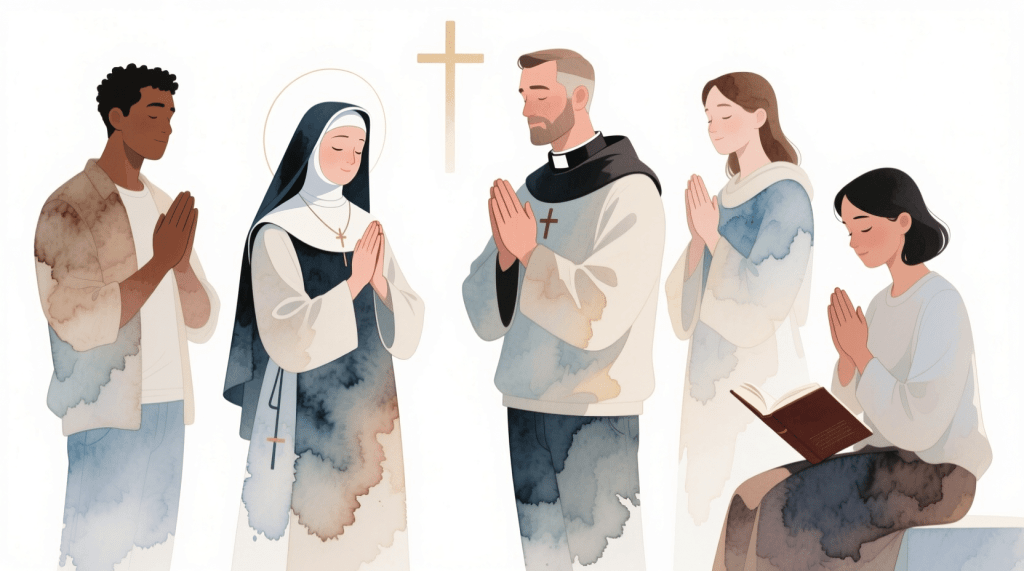

The “Being” of God is holiness. Only God is holy. God is infinitely holy. Christ, who is perfect God and perfect man, is most holy. Christ is the most important model. The saints “have” only “in part” the holiness of Christ. The Christian saint is a good imitator of Christ. Therefore, he resembles Christ; he is an image of Christ. What is interesting about a saint is what he reflects of Christ. The saints are another Christ, Christ among us.
Although Christ infinitely surpasses all the saints, we understand Christ through the saints. Indeed, each saint reflects Christ in a beautiful, true, diverse, and complementary way. Thus, Saint Maximilian Kolbe, to save a father from death, gave his own life. In turn, Saint Raymond Nonnatus—like so many other saints from orders that redeemed captives—endangered the faith of a Christian, a captive of the Moors, and allowed himself to be imprisoned so that he could be freed. Both examples help us understand that Christ, for liberating redemption, gave his own life. In turn, Saint Peter Claver, by becoming a slave to the black slaves, helps us understand, in a simple, clear, illuminating, and striking way, the episode of Christ washing the apostles’ feet.
I will now consider “diversity.” According to Saint Thomas Aquinas, the greatness of God can be best expressed if there is a multiplicity and diversity of beings. A garden, to be beautiful, must have diverse flowers. In turn, Saint Paul noted the need for multiplicity and diversity in the Church, the Body of Christ. Furthermore, each human person is unique and unrepeatable. It is understood, then, that God freely distributes his natural and supernatural gifts in different ways according to beings, who are diverse and distinct. Not all beings correspond equally to God and his gifts. The saints, too, are very varied. The totality of the saints, including those not canonized, is something of great beauty, which can be represented by an unfolded fan, with an immense number of different stems, all of which give off, in their own way, the fragrance of the sweet smell of Christ.
There is an order to the saints. Hierarchies, or scales, of saints can be established, or they can be classified according to ascending steps. For, on the one hand, some saints, “in themselves,” occupy a higher place in order of importance, reflect Christ much better, and are of particular interest. Thus, for example, the Blessed Virgin, etc. On the other hand, we can view some saints as “more interesting to us,” for certain particular reasons.
Within the diverse group of saints, we can establish groups or categories. Thus, for example, in a world with so many obstacles, in which it is difficult to live the faith with courage, the group of martyrs takes on special relevance and importance. They allowed themselves to be killed rather than sin, they preferred being killed than denying Christ, they shone for their courage in the face of difficulties, and they demonstrated very eloquently that the only thing that matters is loving Christ, even if it means losing everything.
There are also saints whose lives, while still very precious, are very different from ours. Thus, Saint Simon Stylites always lived on a column. Others transmit to us something very close to our own lives. Saint Josemaría Escrivá de Balaguer, for example, besides being our contemporary, is immensely practical for us, as he marvelously transmits to us something so important, and so close to so many millions of people: the greatness of ordinary life and the universal call to holiness of all the baptized. All the baptized must be saints.
Ultimately, it’s not just about whether human beings are saints, but also about where they stand in relation to our life and to God. Some saints can contribute more to us than others.
With de-Christianization, it has become common to consider as models, not saintly people, but famous film personalities, or similar, who are proposed only for merely natural or human values, such as their sympathy, their beauty, their knowledge, etc. This, in turn, occurs in a world full of confusion, in which there is a strong crisis of humanism, in which many even come to ignore the identity of human nature, in which the dignity of the human being continues to be trampled on with the genocide of abortion, etc. Or, more briefly, in which many do not even know what man is.
To remain, but only in the merely human, or in pure man, is to remain with man without grace, with man wounded. Not being in grace is a disgrace. Furthermore, when a society becomes de-Christianized, it declines sharply.
Something very different happens with the holy man, in whom grace has done a great work. Grace heals and perfects. The work of the Holy Spirit is much more ambitious than that of a celebrity. The Paraclete deifies. The Holy Spirit makes a human being a child of God, a saint, a fulfilled, happy, deeply content person, another Christ, and, moreover, leads to the glory of heaven, to eternal and complete happiness.
In short, the saints represent something very valuable for the present time. All saints are very important. As Pope Benedict XVI pointed out, the saints are a great light for the world. Often, more light is received by looking at the saints than in many other ways. We must return to the saints. We must allow ourselves to be illuminated by them, especially by those of special interest. Christ, the Blessed Virgin, Saint Joseph, Saint Josemaría Escrivá de Balaguer, etc., have much to tell us.

José María Montiu de Nuix
Nacido en Cervera, Lérida, España, en 1960 y bautizado ese mismo año. Ordenado sacerdote en 1992. Doctor en Filosofía. Licenciado en Filosofía y Ciencias de la Educación por la Universidad de Barcelona (UB). Licenciado (especialidad: Matemática Fundamental), cursos de doctorado y suficiencia investigadora en Ciencias Exactas por la UB. Licenciado en Filosofía por la Universidad de Navarra. Licenciado en Estudios Eclesiásticos por la Facultad de Teología San Vicente Ferrer, Valencia. Docente e investigador con más de medio millar de publicaciones. Académico de la Academia Hispanoamericana de Doctores.
Related
J.R.R. Tolkien and His Legendary
María José Calvo
16 April, 2026
5 min

Catholics and the Art of Servant Leadership: Lessons from Saint Catherine of Siena for Today’s Executives and Entrepreneurs
Javier Ferrer García
16 April, 2026
7 min

Five Keys to Raising Your Children with Humor
Luis Gutiérrez Rojas
16 April, 2026
3 min
An eternal moment that invites the Christian soul to contemplate the truth, beauty, and mystery of creation
Sonia Clara del Campo
16 April, 2026
7 min
Newsletter
Exaudi reaches millions of people every month with training, truth, and support.
Join our communication channels and share them.