(EN)
(EN)
 (ES)
(ES)
 (IT)
(IT)

Technoauthoritarianism
Big Data in the Service of a Theological-Political Project
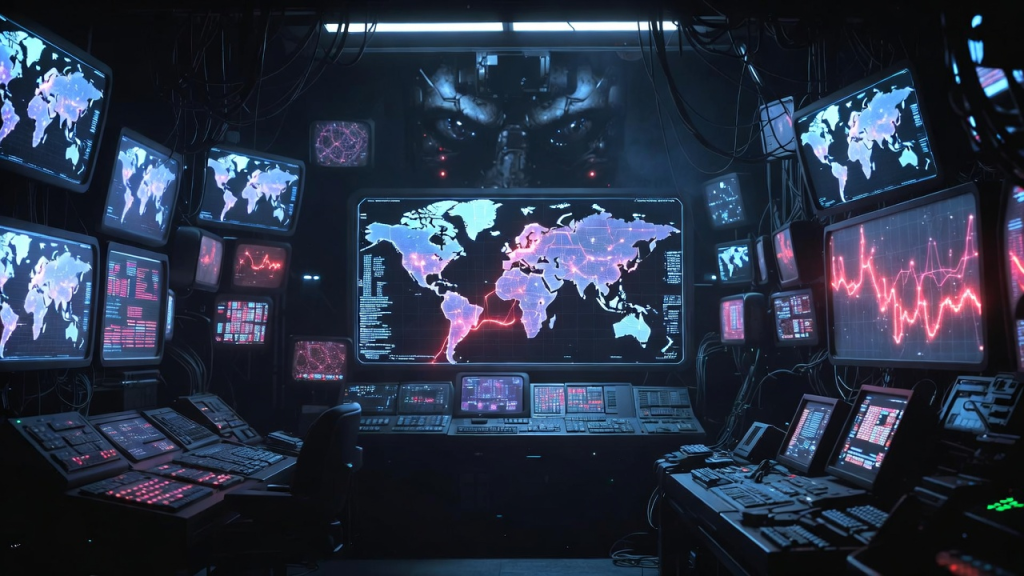

Peter Thiel is not just a Silicon Valley billionaire. He is one of the most influential thinkers on contemporary technopolitical power. The founder of PayPal is also the founder of Palantir . The latter is not simply a software company, but rather a unique theory of the state transformed into a business for the strategic implementation of decisions based on big data.
Palantir condenses surveillance, warfare, capital, and ideology into a single institution. For example, one of its most successful products is ” Gotham .” For years, it has served the world’s leading security and intelligence agencies. Therefore, Palantir’s problem is not only technical, but also political and anthropological. When a platform becomes indispensable for police, military strategy, and intelligence services, “vendor lock-in” emerges: the state no longer simply purchases a service, but the very intelligibility of its decisions. Technological dependence becomes a surrender of sovereignty.
We are not dealing with a neutral instrument, but rather with the ideal infrastructure of a techno-authoritarian power, capable of classifying populations, prioritizing objectives, and concealing political decisions under the guise of pure technical efficiency. The concrete example is “ Maven ”—AI-integrated software used in the Iran -Iraq War —which transforms the decision-making chain to the point of reducing human beings to an almost symbolic guarantee. The question “who is a legitimate target?” thus risks being displaced from human prudence to an algorithmic optimization system. Something similar occurs in the area of migration: “ Falcon ” and “ ImmigrationOS ” allow for the location of individuals, the reconstruction of family ties, the tracking of mobility patterns, and the coordination of violent expulsions. The migrant ceases to appear as a face and biography and becomes a “target” that must be captured.
Palantir is best understood when one studies the political theology that resides in the mind of its founder. Thiel takes from John Henry Newman the duty to watch for the signs of the Antichrist; from René Girard, the intuition that mimetic violence structures history; and from Carl Schmitt, the friend-enemy logic. The problem is that, where Girard saw in Christ the rupture of the sacrificial mechanism, Thiel retains the diagnosis of violence but shifts the response toward the accumulation of power. For Thiel, there must exist a force that contains the Antichrist, and that force is always ambiguous, always one step away from becoming the Antichrist itself. The United States, in his interpretation, occupies precisely this borderline position.
Pope Francis warned at the G7 summit that no innovation is neutral and that AI can impose uniform models and reinforce a “technocratic paradigm.” The Vatican document “Antiqua et nova” insists that peace cannot be sustained with instruments that justify injustice, violence, or oppression. Leo XIV reiterated that AI must be evaluated in light of the integral development of the person and never confused with intelligence, much less with wisdom. This stance is an important “sign of the times”: when technology promises to save us through total surveillance, algorithmic selection of enemies, and logistical management of the vulnerable, power ceases to serve humanity and begins to demand its obedience.

Rodrigo Guerra López
Doctor en filosofía por la Academia Internacional de Filosofía en el Principado de Liechtenstein; miembro ordinario de la Pontificia Academia para la Vida, de la Pontificia Academia de las Ciencias Sociales; Secretario de la Pontificia Comisión para América Latina. E-mail: [email protected]
Related