 (EN)
(EN)
 (ES)
(ES)
 (IT)
(IT)

St. Ignatius of Laconi, May 11
Capuchin Founder


This humble lay brother, who was a paragon of virtue, was born in Laconi, Sardinia, on December 18, 1701. He was the second of nine siblings. They grew up in a home lacking material resources but rich in spiritual wealth. At his baptism, he was given three names: Francisco, Ignacio, and Vicente, with the latter being the name his family used most.
Such a wealth of graces rained down from heaven through him that, as some of his biographers have noted, they became a martyrdom during his life and a “hindrance” after his death regarding the official recognition of his holiness. His mother, deeply devoted to St. Francis, would tell him about the saint’s life and miracles; Vicente became so enthused that he began making his first small efforts to imitate him.
Once again, maternal teachings proved to be a reliable way to encourage the path of a great vocation. This son, who listened entranced—revealing a profound sensitivity and tenderness for the divine—left no one indifferent. He caught the attention not only of his family but of the entire neighborhood.
They affectionately knew him as “il santarello” (the little saint). This aura of virtue would accompany him for the rest of his life. His father was a farmer and shepherd, and he followed in his footsteps. The prayer and fasting he practiced were so intense that his health declined, raising alarms in his circle because he was of a weak and sickly constitution.
In his early youth, he considered the religious life but was undecided and set the idea aside. However, at age 17, he suffered a grave illness that nearly cost him his life; he promised God that if he recovered, he would join the Capuchin Order. He regained his health, but for two years, he relegated his promise to oblivion.
That changed one day when his horse bolted. Terrified, he cried out to God for help while renewing the commitment he had made—this time for good. He was 20 years old and appeared so frail that the Provincial did not want to admit him, thinking he would not survive the rigors of convent life. Vicente did not lose heart. Through his parents’ mediation, he obtained a recommendation from the Marquis of Laconi, and in 1721, he joined the community of San Benito in Cagliari, fulfilling his longing.
The novitiate certainly required mettle. But he already knew the meaning of fasting and penance. However, he took on mortifications with such vigor that he was on the verge of collapsing. He had not properly measured his strength and turned to Mary: “My Mother, help me, for I can do no more.”
She comforted him and urged him to press on with renewed impetus: “Courage, Brother Ignatius; remember the sorrowful passion of my divine Son, and carry your cross with patience as well.” The fact is that in sixty years of consecrated life, he never experienced such fatigue again. He took his vows in 1722 and continued to progress in love through constant prayer, silence, and the living of evangelical virtues.
In his day-to-day life, there were no extraordinary events, but he distinguished himself by his heroism in perfection, seeking union with God. He lived poverty marvelously. He was so detached from everything that even the wretched state of his habit and his battered sandals—which caused bleeding wounds on his heels—betrayed his austerity.
He passed through several convents and was eventually transferred to Buoncammino in Cagliari. He had previously been a cook, and in this final assignment, he began working at the loom until his superiors entrusted him with the role of alms-gatherer, collecting food and providing for the material needs of the community.
The people esteemed him because they saw in him a true disciple of Christ. He mingled with those in the taverns and port squares, moved by the desire to succor the poor and help the many sinners who converted through his example. He was patient, grateful, and kind; he possessed all the qualities of a good alms-gatherer.
With his prudence, he won the soul of a wealthy usurer and moneylender who was surprised that Ignatius never asked him for anything, repeatedly passing by his door. One day, when the saint went to the merchant’s house as instructed by his superiors, he collected a shipment of goods that turned into a bloody mass along the way.
Upon arriving at the convent, he said: “See, Reverend Father, see the blood of the poor mixed with the thefts and usury of that man: those are his riches…” As the miracle spread through the city, the speculator repented of his greed, gave away his wealth, and no longer traded with the belongings of others.
Ignatius tried to hide the graces God granted him with stratagems that surely led many to consider him a sort of magician. Sometimes, even resorting to natural remedies, he made people believe that miraculous healings were actually the result of the latest medical formulas.
Amid the supernatural events attributed to him, his life—like that of all saints—was kneaded with intimate renunciations; by his daily conduct, he was recognized as a man of God. The citizens of Cagliari called him “the holy father,” a title attested by his contemporaries. Joseph Fues, a Protestant pastor residing on the island, wrote in a letter to a German friend: “Every day we see a living saint walking through the city asking for alms, a Capuchin lay brother who has won the veneration of his compatriots with his miracles.”
In 1779, he lost his sight and filled his days with prayer. He knew the hour of his death in advance, which allowed him to dismiss the friars from his bedside, asking them to go to Vespers. He died at the age of 80 on May 11, 1781, with a reputation for holiness among the people who had acclaimed him for his numerous virtues. The wonders they knew so well multiplied after his death. Pius XII beatified him on June 16, 1940, and canonized him on October 21, 1951.

Isabel Orellana
Isabel Orellana Vilches Misionera idente. Doctora en Filosofía por la Universidad Autónoma de Barcelona con la tesis Realismo y progreso científico en la epistemología popperiana. Ha cursado estudios de teología en la Universidad Pontificia de Salamanca. Con amplia actividad docente desde 1986, ha publicado libros como: Realismo y progreso científico en la epistemología popperiana, Universitat Autònoma de Barcelona, 1993; El evangelio habla a los jóvenes, Atenas, Madrid, 1997; Qué es... LA TOLERANCIA, Paulinas, Madrid, 1999; Pedagogía del dolor. Ensayo antropológico, Palabra, Madrid, 1999; En colaboración con Enrique Rivera de Ventosa (†) OFM. Cap. San Francisco de Asís y Fernando Rielo: Convergencias. Respuestas desde la fe a los interrogantes del hombre de hoy, Universidad Pontificia, Salamanca, 2001; La "mirada" del cine. Recursos didácticos del séptimo arte. Librería Cervantes, Salamanca, 2001; Paradojas de la convivencia, San Pablo, Madrid, 2002; En la Universidad Técnica Particular de Loja, Ecuador, ha publicado: La confianza. El arte de amar, 2002; Educar para la responsabilidad, 2003; Apuntes de ética en Karl R. Popper, 2003; De soledades y comunicación, 2005; Yo educo; tú respondes, 2008; Humanismo y fe en un crisol de culturas, 2008; Repensar lo cotidiano, 2008; Convivir: un constante desafío, 2009; La lógica del amor, 2010; El dolor del amor. Apuntes sobre la enfermedad y el dolor en relación con la virtud heroica, el martirio y la vida santa. Seminario Diocesano de Málaga, 2006 y Universidad Técnica Particular de Loja, Ecuador (2007). Cuenta con numerosas colaboraciones en obras colectivas, así como relatos, cuentos, fábula y novela juvenil, además de artículos de temática científica, pedagógica y espiritual, que viene publicando en distintas revistas nacionales e internacionales. En 2012 culminó el santoral Llamados a ser santos y poco más tarde Epopeyas de amor prologado por mons. Fernando Sebastián. Es la biógrafa oficial del fundador de su familia espiritual, autora de Fernando Rielo Pardal. Fundador de los Misioneros Identes, Desclée de Brouwer, Bilbao, 2009. Culmina la biografía completa. Encargada del santoral de ZENIT desde 2012 a 2020 y ahora en Exaudi
Related

He changed his mind and went: Commentary by Fr. Jorge Miró
Jorge Miró
26 September, 2026
3 min
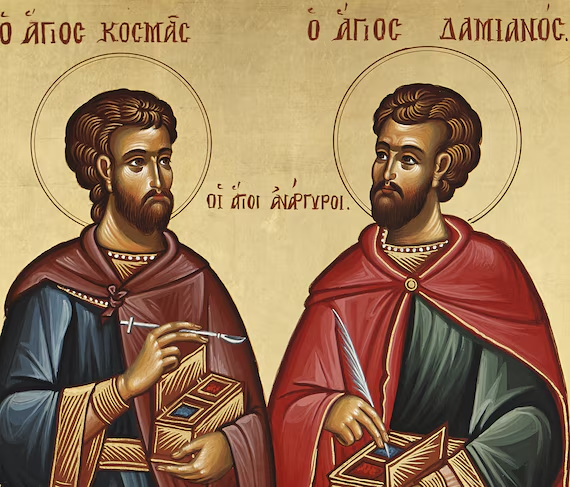
Saints Cosmas and Damian, September 26
Exaudi Staff
26 September, 2026
2 min

86 leaders from 16 countries will gather in Rome to discuss major leadership challenges in the era of artificial intelligence
Exaudi Staff
25 September, 2026
10 min

Our Lady of Mercy
Exaudi Staff
24 September, 2026
5 min