 (EN)
(EN)
 (ES)
(ES)
 (IT)
(IT)

Freedom of Conscience and the Limits of Authority
In “Sundays”
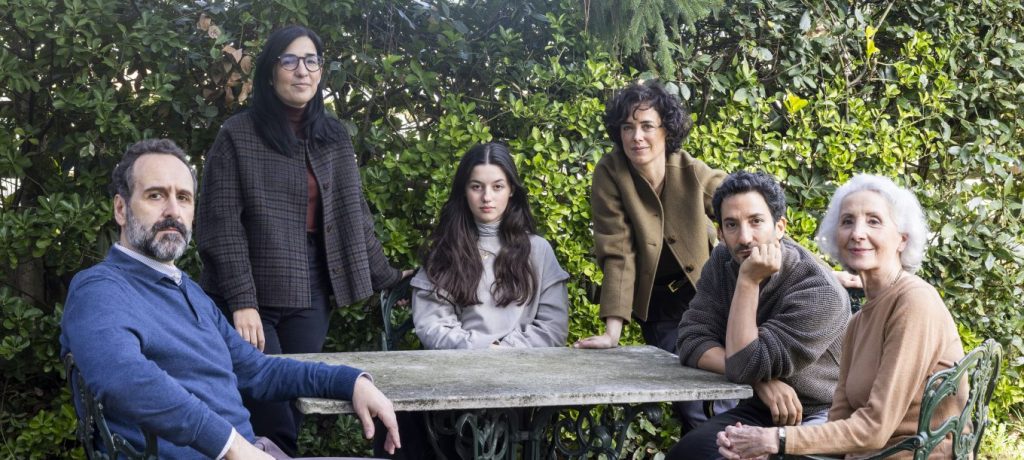

The film “Sundays,” directed by Alauda Ruiz de Azúa, poses a universal ethical dilemma: what does it mean to follow one’s conscience when the price is disobeying family and societal expectations? The filmmaker offers this reflection through the religious vocation of Ainara, a teenager who wants to enter a convent and must confront the incomprehension and pressures of those closest to her. The film portrays with respect and subtlety how, at times, love is confused with control and care with the denial of the other.
As Ainara’s (Blanca Soroa) family awaits news of her university studies for the coming year, the teenager defies expectations by announcing her desire to become a cloistered nun. At 17, this bright and responsible young woman, who has been caring for her two younger sisters since their mother’s death, explains that her decision stems from an intimate process of vocational discernment guided by a young priest from the Catholic school she has attended since childhood. Ainara asks her father (Miguel Garcés) for permission to live for several weeks with the nuns at the convent she wishes to enter, hoping to solidify her decision. However, the news that she feels increasingly close to God and that her conscience is urging her to follow her religious vocation causes a rift within her family and bewilderment among her closest friends, along with the resulting external pressures. In these stories, the affection of those around her is intertwined with the fear of losing connections and the perception that the path chosen by the young woman means squandering her talents, her opportunities, and even life itself. The various external perceptions of what is good and valuable—based on more superficial and utilitarian contemporary values—clash with the protagonist’s inner voice, which responds to a profound, ethical, and spiritual calling, beyond social or familial criteria for success and personal fulfillment.
The filmmaker from Biscay delves into the motivations that might lead a young woman to consider becoming a nun and how this announcement unsettles those around her, allowing the actions and words of each character to speak for themselves. Alauda Ruiz de Azúa’s camera shows, without judgment, the ethical tensions between faith, religious vocation, family love, and personal value systems. In this sense, the film opens a respectful space for ethical reflection and dialogue among the different voices. The family meals each Sunday function, in fact, as a microcosm of the moral conflict, exposing the cracks, misgivings, and suspicions.
The voice of conscience and the forms of love
Ainara’s inner voice evokes Antigone’s classic dilemma: the tension between obeying external expectations—the “laws” of her family and social environment—or following the unwritten inner law that leads the protagonist of the Greek tragedy to bury her brother, disobeying King Creon’s command. Similarly, Ainara faces the dilemma of her own conscience, which dictates what is right, beyond fear or convenience, above external norms and pressures. The young woman acts out of commitment to herself, guided by a profound ethic and fidelity to an intimate truth. Her inner voice also alludes to the idea of conscience formulated by John H. Newman, who affirmed that, even within faith, one must offer oneself “first to conscience, then to the Pope.” With this, Newman did not question ecclesiastical authority, but rather affirmed that conscience is the voice of God inscribed on the human soul, the highest instance of moral discernment. Therefore, this does not oppose faith, but rather authenticates it.
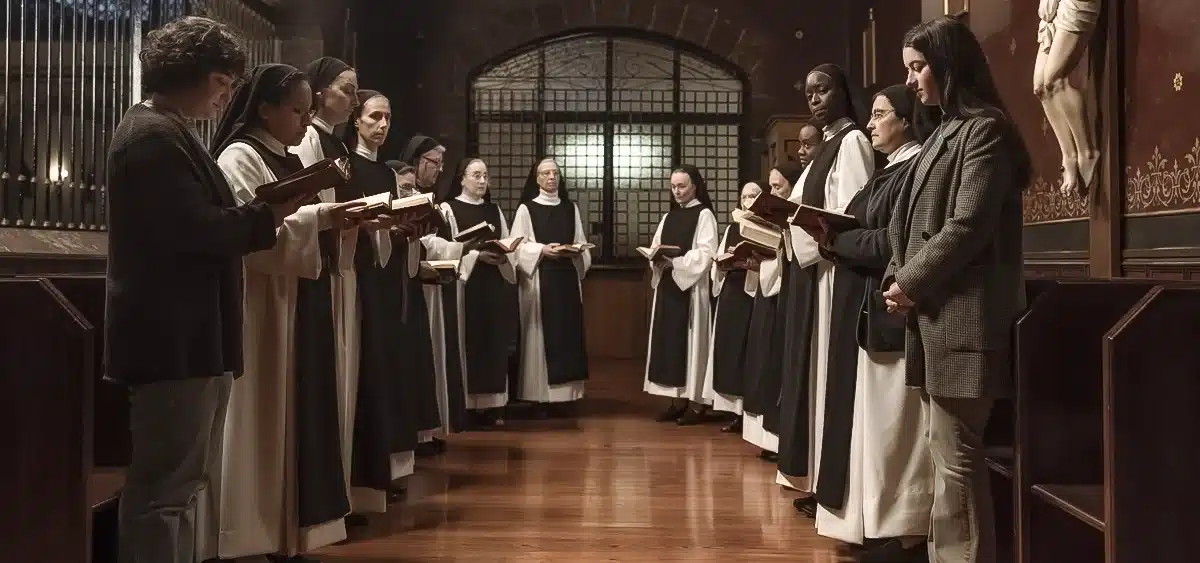 Ainara’s father, after initial moments of doubt, dispels his unfounded fears about family disintegration or his daughter’s supposed psychological manipulation when he meets the priest who has guided the teenager through her vocational discernment process and speaks with both the headmistress of her school and the Mother Superior of the convent. They all confirm that his daughter is not joining any sect and that no one will prevent her from leaving the convent if she changes her mind. His unconditional love, which respects his daughter’s freedom and conscience, leads him to accept Ainara’s religious calling, offering an example of caring ethics without imposition. However, this stance displeases the rest of the family, particularly Aunt Maite (Patricia López Arnaiz) and Grandmother (Mabel Rivera), who is influenced by her daughter’s fears and prejudices toward religion.
“Why don’t you take her to a psychologist or send her away to study? Don’t you see they’re manipulating her? You have to guide her in a different direction! And that priest, he’s an adult who’s meeting with a minor…” Maite, an atheist, confronts her brother, the teenager’s father, making all sorts of unfounded accusations, even accusing him of abandoning his daughter to start a new life with another woman. However, Ainara’s father simply replies: “I just want her to be okay and happy.”
The aunt tries to convince her niece to reconsider her decision, arguing that if her vocation and love for God are genuine, they can wait to be fulfilled in other aspects of life. But Ainara’s unwavering convictions lead her to lose patience and shout at her: “You don’t talk to anyone. God doesn’t exist! That kind of love doesn’t exist!” In her desperation, she seeks an alliance with the young woman’s closest friend to tempt her with more sinful pleasures. She even lies to the prioress of the convent (Nagore Aramburo)—before leaving Ainara for her probationary weeks in cloistered quarters—claiming that she has had sexual relations with a classmate and that it is within her power to dissuade the teenager from her religious vocation. Another of her dissuasive arguments is that the young woman is confusing the pain of losing her mother with a search for solace. “Faith is a gift from God; you either have it or you don’t. What you’re asking for is beyond my control,” the Mother Superior replies to Maite’s pressure. Maite, in her actions, confuses love with control and care with the denial of the other person. In fact, without realizing it, she also displays this behavior toward her husband (Juan Minujín) and their young son.
Bioethical assessment
From a personalist bioethical perspective, conscience is not merely psychological autonomy or unlimited freedom of choice: it is the place where the person opens themselves to truth and discerns the good. In this sense, freedom of conscience means responding responsibly to what one recognizes as true and just. The dignity of the person implies respecting this inner freedom because it is within this freedom that one’s deepest moral vocation is realized. Every form of authority—whether institutional, familial, or affective—aims to promote the integral good of the person, not to replace their conscience. Consequently, when authority oversteps this boundary and attempts to impose decisions, it ceases to be legitimate.
The dilemma arises when a person, guided by their conscience, comes into conflict with an authority that seeks to direct them from the outside. In personalist bioethics, the inner voice takes  precedence because it is the space where the person is constituted as a moral subject. To deny this freedom would be to deny the very dignity of the person. Fidelity to conscience, however, must be coupled with an attitude of dialogue and openness, recognizing that every inner voice can grow in truth and maturity. Personalism avoids both extremes: individualistic autonomy that severs all bonds and blind obedience that denies freedom. Freedom is genuine when it is lived in relationship and when conscience is formed through dialogue. While the ultimate decision belongs to the person, authority, for its part, must accompany and respect this process without replacing it.
In the film, Ainara’s conscience embodies this principle: her decision to follow her religious vocation stems from an inner calling she perceives as genuine. Aunt Maite, in attempting to impose her vision—marked by fear and her atheistic stance—oversteps the ethical boundaries of care by transforming love into control. The father, on the other hand, while not perfect, respects his daughter’s conscience, accompanies her, and supports her without imposing his own will. True love, like true moral authority, does not negate the other’s conscience, but rather illuminates it.
Ainara’s conflict resonates with the contemporary challenge: learning to discern amidst the noise. We live in a culture saturated with stimuli, opinions, and urgent matters, where inner life is threatened by distraction and immediacy. The inner voice demands silence, listening, and discernment. Today, this is a countercultural act that reclaims independent judgment against the manipulation of collective slogans [1] .
The film was awarded the Golden Shell at the 2025 San Sebastián Film Festival and won the top prize at the Montpellier Mediterranean Film Festival. In Sundays , Alauda Ruiz de Azúa demonstrates her skill in exploring family dynamics with respect and depth, portraying intimate conflicts without resorting to judgment, prejudice, or oversimplification. The filmmaker has garnered audience acclaim for her previous works: the film Five Little Wolves (2022) and the television miniseries Wanting (2024). Sundays is a return to God, against all odds.
Amparo Aygües . Master’s Degree in Bioethics from the Catholic University of Valencia. Member of the Bioethics Observatory, Catholic University of Valencia .
***
Technical sheet:
Original title: Sundays
Year: 2025
Director: Alauda Ruiz de Azúa
Country: Spain
Duration: 110 min.
***
[1] Bibliography:
Han, B-Ch. (2025). On God. Thinking with Simone Weil . Paidós.
Murdoch, I. (2023). The Sovereignty of Good . Taurus.
Newman, JH (1875). Letter to the Duke of Norfolk. The Primacy of Conscience. Paul VI Foundation.
Pérez de Laborda. (2015). God in sight . Rialp.
Ratzinger, J. (2010). In Praise of Conscience: Truth Questions the Heart . Word.
Spaemann, R. (1987). Ethics and fundamental questions . Eunsa.
Spaemann, R. (2010). People. On the distinction between “something” and “someone” . Eunsa.
Weil, S. (2024). Waiting for God . Trotta

Observatorio de Bioética UCV
El Observatorio de Bioética se encuentra dentro del Instituto Ciencias de la vida de la Universidad Católica de Valencia “San Vicente Mártir” . En el trasfondo de sus publicaciones, se defiende la vida humana desde la fecundación a la muerte natural y la dignidad de la persona, teniendo como objetivo aunar esfuerzos para difundir la cultura de la vida como la define la Evangelium Vitae.
Related
“The only mess I want to get myself into is God”
Se Buscan Rebeldes
17 March, 2026
3 min
The Sorrow of Jesus’ Loss in the Temple and the Joy of His Finding
Miguel Morales Gabriel
15 March, 2026
2 min

Reflection by Bishop Enrique Díaz: The Lord Looks at Our Hearts
Enrique Díaz
15 March, 2026
6 min

Christ is the Light: Commentary by Fr. Jorge Miró
Jorge Miró
14 March, 2026
3 min