 (EN)
(EN)
 (ES)
(ES)
 (IT)
(IT)

“Behind self-help books lies the individualistic and narcissistic view that one creates oneself”
The Charles Péguy Chair of Cultural Studies at the Central University of Venezuela (UCV) brings together philosopher and writer Jorge Freire, priest and philosopher Juan de Dios Prieto, and Comillas University professor Carlos Giménez for a roundtable discussion
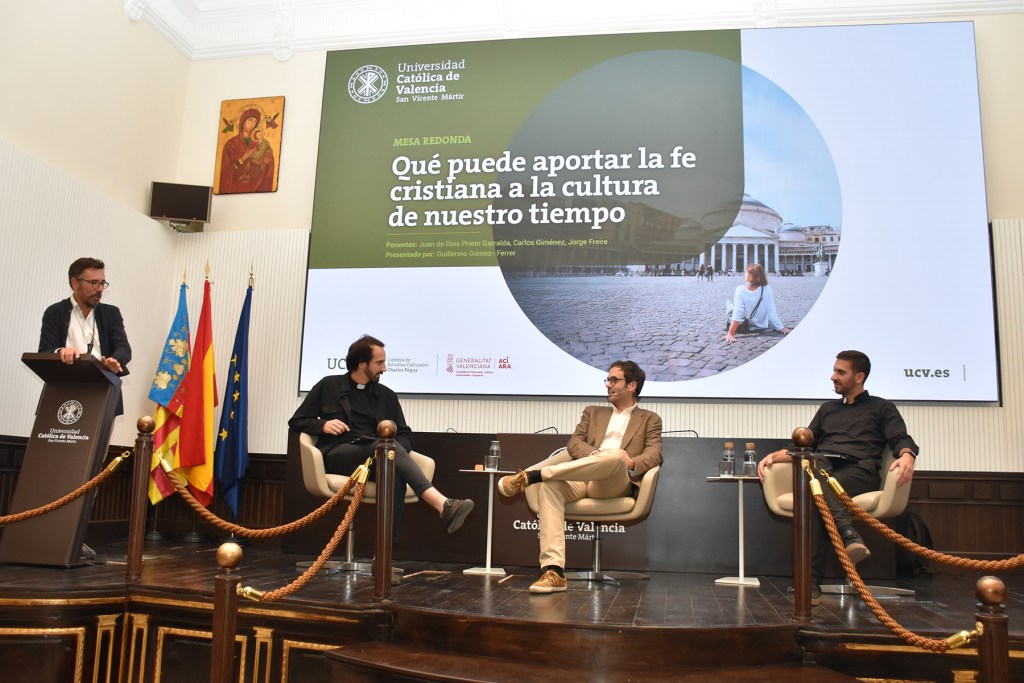

The Charles Péguy Chair of Cultural Studies at the Catholic University of Valencia (UCV) held a round table discussion at its Trinitarios campus, where several experts reflected on the contributions that the Christian faith can make to contemporary culture. In his remarks at the event, philosopher and writer Jorge Freire strongly criticized one of the “characteristic” elements of our times: self-help books. “These works conceal an individualistic and narcissistic mindset. The view that we create ourselves, that we are our own artists. That is the contemporary subject.”
“Many of our disappointments and our emotional pains stem precisely from this absurdity, which leads us to believe that we are the sole architects of our own personal adventure. That I’m a self-made man, what Nietzsche called ‘the morality of the artist.’ It is the utterly insane idea of denying the debt we owe to others; that is, of denying our own nature, because human beings are communal, relational animals,” he asserted.
In Freire’s opinion, “the obstinacy with our identity leads to the error of believing that that small thing that differentiates us from others is what makes us who we are. Freud called this conception ‘the narcissism of the small difference.’ This is not the case; it is a mistaken conception; what constitutes us is not precisely that minimal facet that makes us different from others.”
“This relates to what the Christian faith could accomplish today: to humanize culture, which is cultivation, to nurture. However, we see that present-day culture is often opposed to human nature, because it doesn’t create persons, but rather individuals. Although these terms are often confused, they are opposites. I refuse to be an individual; I want to be a person. The former is a caricature of the latter, its reduction to a mere number, an atomic entity, indistinguishable, absolutely interchangeable with others,” he argued.
Similarly, Freire referred to the “mistake” of “using economic arguments to discuss what faith can contribute to society,” such as “justifying that the Santiago de Compostela Cathedral shouldn’t be demolished and replaced with a Primark because keeping it standing provides an economic benefit to the city.” He finds “ethos” “more” convincing, but it doesn’t work for him either: “I’m referring to the notion that in what we’ve come to call the Iberosphere, which would extend from Patagonia to Cape Creus, there are a series of shared virtuous customs that could form part of the foundation of what constitutes Catholicism.”
“Faith answers the question of ‘Who am I?’ by opening you up to something much bigger than yourself.”
Another participant in the round table—which also included the Chair’s director, Guillermo Gómez-Ferrer—was Carlos Giménez, a priest and professor at the Pontifical University of Comillas (Madrid). “That faith opens you to something greater than yourself is one of the great contributions Christianity can make to contemporary culture,” he asserted in one of his remarks. “We must answer the question of identity, because the question ‘Who am I?’ has become the central question of today’s culture. Forty years ago, the existential enigma to be resolved was ‘What is the meaning of my life?’ This has changed; sociologists speak of a transformation of intimacy. Now, the question of one’s own identity is embedded in all aspects of contemporary life.”
“Today’s human being is like Disney’s Simba from The Lion King. He claims he’s going to discover who he is on his own, without anyone telling him anything, and without being tied to any affiliation or tradition. But the reality is that our identity is much bigger than what makes us different. It’s important to recognize that everyone has different things to contribute, but one’s own identity isn’t a secret pearl inside me that I have to discover,” he argued.
In this regard, Giménez recalled that Christian theologians point out that “one’s identity is defined as a transcendental entity; that is, it is discovered in something greater. Therefore, faith makes you authentic, because it links you to something much greater, to the absolute. Your identity is in God, in what He has always dreamed or planned for you, a greatness far greater than the label or category with which you define yourself each day.”
“The trap is that we believe we can discover who we truly are right here and now, guided solely by our desires, by what motivates us, what we are passionate about. And if you turn your passion into your work, you’ll be the happiest person in the world, they say. On the contrary, that perspective generates a great deal of frustration and endless work, because you never quite define yourself properly, never truly know who you are. In the end, that secret treasure you think you have inside doesn’t exist. The reality is that your identity is built relationally and founded on something much larger than yourself. This idea, I believe, is something that faith can offer to modern man. In that sense, faith is purifying, and it frees you from that defining tension,” he emphasized.
“Faith can transmit to today’s culture the passion for the good, the beauty and the truth that exists in the world.”
For his part, the priest and philosopher Juan de Dios Prieto, from Granada, emphasized that, to contribute anything to culture, “faith must begin with contemporary man; otherwise, it is impossible for it to say anything. Unfortunately, there have been attempts to separate faith from human experience in order to elevate it, so to speak, to an ideal spiritualism, but one that has little to do with life and the concrete reality of Christians and people today. In this nihilistic culture, one of the greatest contributions that faith can make is to transmit the passion for the good, the beauty, and the truth that exist in the world.”
“Good, beautiful, and true things truly touch a person’s heart, speaking to their being without erasing their identity; on the contrary, they make it shine. These three elements are the only ones that can build a culture of truth and beauty. An example is Tolkien’s The Lord of the Rings, where all three are present. It is a work that has touched the hearts of both men and women for many years. The book was even published in the Soviet Union, while books by C.S. Lewis, for example, which were explicitly Christian, were banned!” he recalled.
According to Prieto, in The Lord of the Rings, the English writer “doesn’t speak of faith explicitly, and that’s his genius: using mythology. Tolkien tries to unveil the deepest being of man, who is made for good, and shows that this triumphs with all its power in the third part, The Return of the King. Human beings are made for good, truth, and beauty, and that is already profoundly Christian, because everything that is truly human is truly Christian. Jesus is the authentic man!”
“Furthermore, Tolkien met every week with his friends from the Oxford writers’ group, the Inklings, which included C.S. Lewis, to drink beer and discuss what they were writing. That is passion for life, for goodness, for beauty, and for truth. And that is a change that can be generated in culture. That is what we Christians are called to: to live with passion and intensity the mission that God has given each of us in our lives,” he pointed out.

Exaudi Staff
What is Exaudi News? Exaudi News is an international Catholic media outlet that informs, shapes, and transforms daily in Spanish, English, and Italian. Through news, analytical articles, and live broadcasts of the Pope's events, Exaudi seeks to strengthen Christian unity and contribute to the evangelization of the world, always guided by the Church's social doctrine. We work to bring Christian truth and values to every corner of the planet. Help us transform the world with Exaudi! At Exaudi, we believe that evangelization and quality information can change lives. To continue our mission and expand our reach, we need your help. In addition, we are looking for committed people to join our team. With your support, we will reach more people, spread the message of Christ, and strengthen Christian unity. Will you join our mission? For more information on how to collaborate, visit Exaudi.org or contact us directly: [email protected] Exaudi: Informs, educates, and transforms.
Related

Leave your social media and follow me!
Exaudi Staff
22 March, 2026
5 min

Reflection by Bishop Enrique Díaz: I will put my Spirit within you, and you will live
Enrique Díaz
22 March, 2026
5 min

Christ Is Life: Commentary by Fr. Jorge Miró
Jorge Miró
21 March, 2026
4 min
An Unknown Eucharistic Miracle
Wlodzimierz Redzioch
20 March, 2026
4 min