(EN)
(EN)
 (ES)
(ES)
 (IT)
(IT)

Youth Loneliness: A Global Challenge with Profound Bioethical Implications
Adolescents More Lonely Than Adults: The Paradox of Hyperconnectivity and the Bioethical Risk of AI
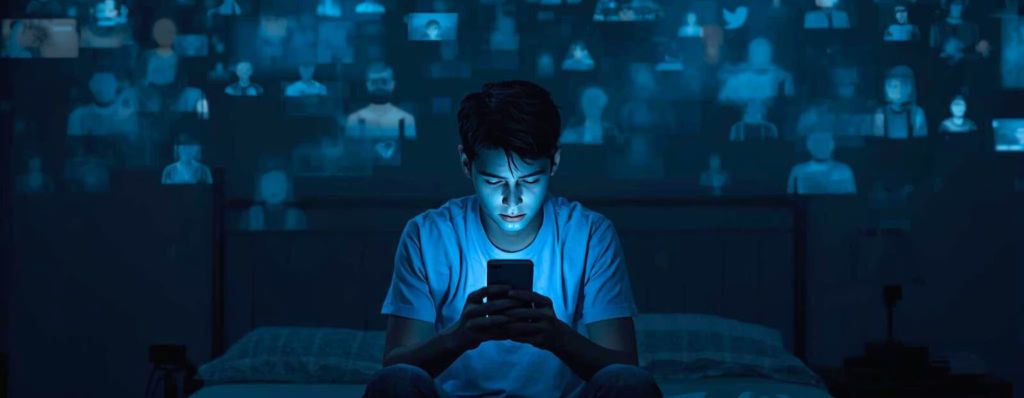

Loneliness has become a structural and public health problem that hits adolescents particularly hard, a group where its incidence now surpasses that of people over 60. This article analyzes how exacerbated individualism and the weakening of the family institution have paved the way for an isolation that, paradoxically, coexists with digital hyperconnectivity. From a bioethical perspective, it examines the risk of technology and Artificial Intelligence supplanting real human connections, offering “emotional anesthesia” that does not resolve the anthropological need for relationship, and raises the urgent need to rebuild spaces for authentic coexistence in the face of the threat of normalized loneliness.
Loneliness has become one of the most worrying social and health phenomena of our time, with a particularly intense impact on adolescents and young adults. Far from being a marginal or transitory experience, various recent studies agree that it is a structural problem, closely linked to mental health, social transformations, and the increasing use of digital technologies.
An international report based on research promoted by the World Health Organization reveals that adolescents are currently the age group experiencing the most loneliness worldwide. Around 20.9% of adolescents report feeling lonely, a percentage that rises to 24.3% for girls, clearly surpassing other age groups, including those over 60. This data dismantles the stereotype that associates loneliness almost exclusively with old age and highlights a particularly vulnerable stage of life.
Loneliness, technology, and digital answers
This context helps explain recent phenomena such as the success in China of an app designed for young people living alone to periodically confirm they are still alive, alerting a contact if they fail to do so. As reported by various media outlets, including La Nación , the app—which has become one of the most downloaded—doesn’t address a specific emergency, but rather a widespread fear of social invisibility: the possibility of suffering an accident or crisis without anyone noticing. The virality of this tool highlights how technology attempts, in a limited and ambiguous way, to compensate for the lack of stable human connections.
These proposals raise important questions: To what extent can—or should—technology replace presence, care, and shared responsibility? Are we normalizing structural loneliness instead of addressing it as a social and relational problem?
The Spanish case: a persistent reality
In Spain, the situation is no less worrying. The Study on Unwanted Loneliness and Youth in Spain shows that one in four young people between the ages of 16 and 29 (25.5%) suffer from unwanted loneliness, and that in almost half of the cases this situation lasts for more than three years. Furthermore, 69% of young people report having felt lonely at some point, with a higher incidence among women and in the 21-26 age group.
The study also highlights significant risk factors: loneliness is more common among young people facing economic hardship, those who have experienced bullying, and vulnerable groups. Furthermore, while social media use is not the direct cause, replacing face-to-face relationships with exclusively online connections doubles the risk of loneliness.

A matter of health and social ethics
The consequences are not only emotional. Loneliness has a two-way relationship with mental health: young people who experience it are 2.5 times more likely to suffer from psychological problems, and suicidal thoughts increase alarmingly. These data, provided in the aforementioned study, make youth loneliness a genuine public health problem.
This reality directly challenges society as a whole. It’s not simply a matter of designing individual coping strategies or apps, but of strengthening community ties, emotional education, and inclusion policies, recognizing that human beings are, by nature, relational beings. Persistent loneliness among young people is not just a generational symptom: it’s an indicator of the kind of society we are building and of the urgent need to rethink, ethically as well, our ways of living together and caring for one another.
The roots of isolation
To understand the magnitude of youth loneliness, it is necessary to look beyond the statistics and recognize the philosophical underpinnings that fuel it: an exacerbated individualism that has distorted the social nature of the person. According to Nacho Tornel, PhD in Law and Restorative Family Mediation, “Current culture pushes us toward absolute autonomy, pathologizing interdependence and denying the fundamental anthropological truth that ‘it is not good for man to be alone.’ This context has given rise to a postmodern youth profile marked by hedonism, consumerism, and a frenetic activism that seeks to fill the existential void with noise to avoid internal reflection and self-discovery.”
We are thus experiencing the paradox of the most prosperous and technologically connected society in history, yet one inhabited by the most isolated young people, who often substitute deep connections with a misguided sense of freedom that, lacking commitment and a focus on the common good, ultimately damages their own dignity. Faced with the proliferation of single-person households and isolated lives , scientific evidence—such as the Harvard longitudinal study —confirms that happiness does not reside in individual success or self-sufficiency, but rather in the quality of our relationships and in genuine service to others.
Bioethical assessment
There are structural factors in modern societies that can be identified as contributing to this crisis of imposed loneliness. The first and most important is the irrelevance attributed, from many quarters, to the family institution—a school of human relationships, a place of support, and a privileged environment for socialization.
The crisis related to marital breakdowns, low birth rates, the proposal of alternative family models, or the abandonment of the educational task by many parents who are very busy with productivity, throws contemporary young people into situations of isolation that can lead to pathological consequences.
In this context, the proliferation of generative Artificial Intelligence (AI) , which reproduces forms of communication similar to, and sometimes indistinguishable from, human communication, is beginning to fill the void left by the absence of parents, siblings, friends, neighbors, or even mere acquaintances. Relationships with virtual characters, which increasingly succeed in mimicking human appearances, can become the factor that multiplies isolation and its consequences for so many young people, disconnected from the reality with which they do not interact, and resigned to “emotional anesthesia” that, through AI-created avatars, allows them to renounce the most genuinely human dimension: the relational one. This dimension enriches us, allows us to escape the slavery of self-indulgence, and opens human beings to transcendence, to the other…
We are witnessing with concern the growing fascination with the uncontrolled proliferation of the virtual world, which, thanks to new technologies, seduces so many and deprives them of genuine human connection. The alarming inaction in the face of this enormous risk multiplies the likelihood of isolation and destitution for so many young people and adults who are gradually abandoning the richness of real human relationships, with their inherent risks, discoveries, sacrifices, and triumphs. And this is especially true within the family, a privileged ecosystem for human development.
Julio Tudela. Cristina Castillo. Bioethics Observatory. Catholic University of Valencia

Observatorio de Bioética UCV
El Observatorio de Bioética se encuentra dentro del Instituto Ciencias de la vida de la Universidad Católica de Valencia “San Vicente Mártir” . En el trasfondo de sus publicaciones, se defiende la vida humana desde la fecundación a la muerte natural y la dignidad de la persona, teniendo como objetivo aunar esfuerzos para difundir la cultura de la vida como la define la Evangelium Vitae.
Related

J.R.R. Tolkien and His Legendary
María José Calvo
16 April, 2026
5 min

Catholics and the Art of Servant Leadership: Lessons from Saint Catherine of Siena for Today’s Executives and Entrepreneurs
Javier Ferrer García
16 April, 2026
7 min

Five Keys to Raising Your Children with Humor
Luis Gutiérrez Rojas
16 April, 2026
3 min

An eternal moment that invites the Christian soul to contemplate the truth, beauty, and mystery of creation
Sonia Clara del Campo
16 April, 2026
7 min
Newsletter
Exaudi reaches millions of people every month with training, truth, and support.
Join our communication channels and share them.