 (EN)
(EN)
 (ES)
(ES)
 (IT)
(IT)

Three Chinese from the Bidasoa Seminary will carry out their summer pastoral ministry in parishes in Madrid
Along with them, 28 other seminarians from various countries will collaborate with Madrid parish priests as part of their comprehensive formation
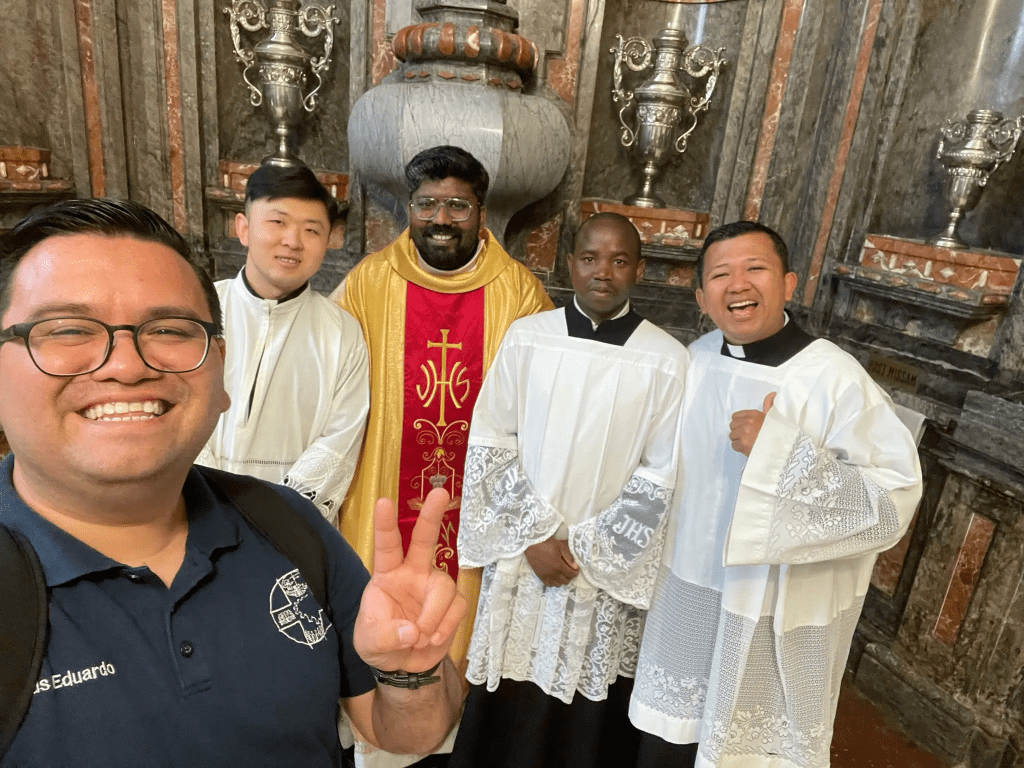

When Xudong Feng, who adopted the Spanish name Pedro Mari, first set foot in Spain, he had no idea that the journey would mark his life forever. He comes from Taiyuan, an ancient diocese in northern China; he arrived with his eyes wide open, his heart full of faith, and a trembling soul. It was the first time he had left his country, and although he was overcome with uncertainty and the difficulty of the language, something inside him told him he wasn’t just coming to study: he was coming to grow.
Along with Xudong Pedro Mari, two other seminarians from China, residents of the Bidasoa International Seminary and studying at the Ecclesiastical Faculties of the University of Navarra, will carry out their pastoral ministry in Madrid this summer, collaborating with parish priests in liturgical and catechetical tasks.
Xudong Pedro Mari’s compatriots are Pengfei Wang (Jose Pedro), who belongs to the Archdiocese of Taiyuan and has just completed the bridge course of the Bachelor of Theology, and Zhinqinag Duan (Paul) from the Archdiocese of Beijing, who is studying the fourth year of the Bachelor of Theology.
A universal Church
Along with Xudong Pedro Mari, Pengfei José Pedro, and Zhinqinag Pablo, 28 other seminarians from different countries will travel to Madrid parishes during the summer months. This group of young men will collaborate with the parish priests in preparing for the sacraments, catechism, and other pastoral and liturgical tasks as part of their comprehensive formation process.
At the Bidasoa International Seminary, Xudong Pedro Mari found something he hadn’t expected. In that corner of Pamplona, he not only made friends from almost every continent—Africa, Latin America, Europe, Asia—but also discovered “the beauty of a truly universal Church,” he says. Every conversation, every shared celebration, every dish he tasted or custom he learned was a lesson in communion for him.
“At first, I had a hard time speaking. I didn’t understand the language very well, but little by little, I began to understand. Today I can say I understand more than words; I understand hearts,” says Xudong Pedro Mari with a friendly smile.
The spiritual atmosphere of Spain
Xudong Pedro Mari studies at the University of Navarra thanks to the support of the CARF Foundation. Every day, he walks through the halls of the Ecclesiastical Faculties, notebook in hand, and deeply convinced that his vocation is a gift for others.
Xudong Pedro Mari has been particularly impressed by the spiritual atmosphere he found in Spain. “There are many churches here. Even in the universities, in the hospitals… You breathe faith. It’s something that nourishes me from within. It reminds me that the Church is alive!” he exclaims.
From Navarre, he shares every discovery with his family. “I tell them everything: the culture, the customs, the food, the way we live our faith. They’re very happy. They’re glad I’m here learning, because they know it makes me feel better when I come home.”
The difficulties of the Church in China
And his home is Taiyuan, a diocese with more than 100,000 Catholics, where the sacrifice of centuries of persecution is still felt. “The Church in China has been through a lot. From the Tang Dynasty in the 7th century, with the Nestorian Church, to the arrival of the Jesuits in the 16th century. There have been many difficulties, but the faith remains, like a flame protected by old hands.”
Xudong Pedro Mari recalls with emotion how his vocation was born in that land steeped in fidelity: “My grandfather and my parents taught me to go to Mass every day since I was a child. It wasn’t an obligation, it was an inheritance. That’s how I began to feel that I wanted to be a priest.”
Today, as he completes his formation, he knows that China needs many priests and missionaries. The Church is growing, but it still faces challenges: social tensions, limited freedom in some places, and, above all, the need for hope.
“I’m here thanks to many people who believe in our vocation. Thanks to the CARF Foundation, I can pursue a solid education to serve better. I know my journey doesn’t end in Navarre: it’s just beginning. I want to return to my town, to my diocese, and give back what I’ve received.”
Xudong Pedro Mari, the seminarian with oriental eyes and a universal heart, walks slowly, unhurriedly, but firmly. His story is that of thousands of Christians in China who, amid silence and fidelity, continue to keep their faith alive. And it is also the story of a Church without borders, where a young man from Taiyuan can find, in Spain, a home for his vocation.
About : The CARF Foundation was founded on February 14, 1989, inspired by Saint John Paul II and encouraged by Blessed Alvaro del Portillo, with three goals: to pray for priestly vocations; to promote the good name of priests throughout the world; and to assist in the comprehensive formation of seminarians, diocesan priests, and religious men and women to better serve the Church throughout the world.
Since its inception, thanks to the support of its benefactors and friends, the CARF Foundation has funded educational grants for more than 30,000 low-income students from 130 countries to enhance their intellectual, human, and spiritual formation at the Pontifical University of the Holy Cross in Rome and at the Ecclesiastical Faculties of the University of Navarra in Pamplona. Among them, 128 students have been ordained bishops and four have been created cardinals.
Fundación CARF
Trabajamos para llevar la sonrisa de Dios a todos los rincones del mundo a través de los sacerdotes y ayudando a su formación. Gracias a nuestros benefactores, ayudamos a la formación de los sacerdotes, difundimos su buen nombre y rezamos por su fidelidad y las vocaciones. Trabajamos para servir a la Iglesia y que ninguna vocación se pierda y luego ellos puedan transmitir en su labor pastoral toda la luz, ciencia y doctrina recibida. Académico Las licenciaturas, programas de especialización o doctorados, otorgan a cada candidato una formación específica en Teología, Filosofía, Derecho Canónico o Comunicación Social Institucional. Espiritual Los seminaristas y sacerdotes complementan su formación académica y humana con la espiritual, ya que deben estar preparados para seguir su vocación y prestar su cuerpo y su espíritu al Señor. Humano A través del ambiente de familia y de preparación, se consigue el desarrollo de actitudes, capacidades y valores que impactan en el crecimiento personal y social de los sacerdotes.
Related
The best vocations are at this table
Se Buscan Rebeldes
31 March, 2026
6 min

Haitian Priest: “Sometimes a year goes by without celebrating the Eucharist”
Fundación CARF
25 March, 2026
5 min
A Rebel with a Cane: The Cross That Became a Miracle
Se Buscan Rebeldes
24 March, 2026
3 min

“The only mess I want to get myself into is God”
Se Buscan Rebeldes
17 March, 2026
3 min