(EN)
(EN)
 (ES)
(ES)
 (IT)
(IT)

Thinking for Yourself When It’s Not Comfortable
Persepolis
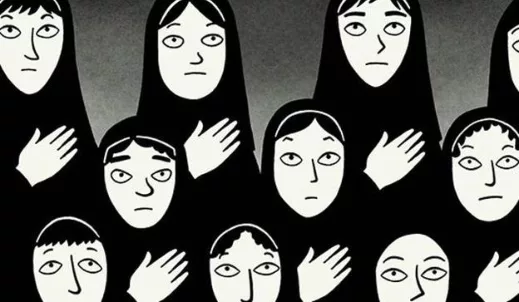

There are times when thinking differently is not just an opinion.
It’s a decision with consequences.
In Persepolis, we do not only witness the growth of a girl. We witness the formation of a conscience in an environment where freedom is not always guaranteed.
And that makes it a profoundly relevant film.
It’s not a story about politics. It’s a story about judgment.
Marjane grows up in a country undergoing a revolution. What begins as a collective dream gradually transforms into a system that dictates what can be said, worn, listened to, or thought.
But the film doesn’t dwell on geopolitics. It focuses on something more delicate:
 How do you develop your own thinking when the environment tries to define who you should be?
It’s not just about obeying or disobeying.
It’s about understanding.
Tradition, authority, and conscience
After The Secret of Kells , where tradition was a living heritage, and Wolfwalkers , where obedience clashed with conscience, Persepolis takes it a step further:
What happens when tradition becomes imposition?
The film doesn’t caricature. It doesn’t simplify. It shows a real tension: between family and system, between belonging and freedom, between cultural identity and personal judgment.
And it asks uncomfortable questions:
-
Do we think what we think because we believe it… or because we have inherited it?
-
Are we active citizens or passive spectators?
-
What do we do when the norm conflicts with our conscience?
For young people: freedom is not just choosing, it’s taking responsibility
At a stage where many decisions seem small—how to dress, what to listen to, what to say— Persepolis reminds us of something important:
Freedom is not just about being able to choose.
It’s about understanding why you choose.
Marjane makes mistakes, doubts, rebels, runs away, comes back.
She’s not a perfect role model. She’s human.
And that’s what’s valuable: thinking for yourself isn’t comfortable.
But it’s not automatic either.
Have you ever wondered where your own ideas come from?
For families: educating is not about making replicas
The film shows something very powerful: family can be a refuge from the system.
In the midst of social pressure, it is the adults who sow critical thinking, memory, and dignity.
That raises a key question for any household:
Are we educating them to repeat…
or to understand?
Transmitting values is not about imposing answers.
It’s about teaching people how to ask questions.
For educators: citizenship is learned
Persepolis is an extraordinary tool for working:
- critical thinking
- freedom of expression
- historical memory
- cultural identity
- individual responsibility
But above all, it allows us to address something essential:
citizenship is not limited to rules or rights.
It is built from awareness.
Educating for citizenship is not about politicizing.
It’s about developing critical thinking skills.
Freedom with consequences
The film does not idealize rebellion.
It does not turn dissent into easy epics.
Show something more honest:
thinking differently can have a cost.
And therein lies the true core of the film.
Because freedom without risk is not freedom.
It’s comfort.
A reflection for our time
In societies where information is constant and opinions multiply, Persepolis raises something essential:
It’s not enough to simply have an opinion.
You have to know why you have that opinion.
Reacting is not enough.
We must understand.
It’s not enough to belong.
You have to decide how you belong.
The question that remains
When the environment defines what is right,
who decides what you are willing to stand up for?

Marketing y Servicios
Ideas para mejorar el mundo . Director: José Miguel Ponce . Profesor universitario e investigador en Marketing y Gestión de Servicios, con experiencia en cinco universidades públicas y privadas. Sevillano de origen, ha vivido en varias ciudades de España y actualmente reside en Sevilla. Apasionado por la educación, la comunicación y las relaciones humanas, considera la amistad y la empatía clave en su vida y enseñanza. Ha publicado investigaciones sobre Marketing, Calidad de Servicio y organizaciones sin ánimo de lucro. Humanista y optimista, promueve el agradecimiento y la coherencia como valores fundamentales.
Related

What are we? The doctor, the soul, and the software of the cosmos
Observatorio de Bioética UCV
27 February, 2026
4 min

The divine art of loving those you didn’t choose… but God did!
Laetare
27 February, 2026
4 min

Behind every biolegislation there is always a biopolitics
Observatorio de Bioética UCV
25 February, 2026
9 min

An obedience discerned in faith and charity, the foundation of ecclesial communion
Patricia Jiménez Ramírez
24 February, 2026
4 min