 (EN)
(EN)
 (ES)
(ES)
 (IT)
(IT)

“The Word of God satisfies our thirst for meaning, for truth about our lives”
Pope Leo XIV delves into the Constitution Dei Verbum during the General Audience, highlighting the role of Scripture in the Church and its missionary impulse

In a General Audience marked by profound reflections on faith and current events, Pope Leo XIV continued his catechesis on the Dogmatic Constitution Dei Verbum of the Second Vatican Council, emphasizing the vital link between the Word of God and the Church. Before thousands of faithful gathered in the Paul VI Hall, the Pontiff stressed that Sacred Scripture is not a static text, but an inexhaustible source that reveals the mystery of God and nourishes the faith journey of believers.
The Holy Father began his homily by contrasting the “many empty words” that surround daily life with the Word of God, which “is the only ever-new word: in revealing to us the mystery of God, it is inexhaustible, never ceasing to offer its riches.” According to Leo XIV, the Church is the “proper home” of Scripture, born of the People of God under the inspiration of the Holy Spirit and destined for them. In the Christian community, the Bible finds its habitat to manifest its meaning and power, proclaiming Jesus Christ as the incarnate “living Word of the Father,” whose saving presence is announced throughout the Scriptures for every person and for all humanity.
Frequently quoting St. Jerome, the Pope recalled that “ignorance of Scripture is ignorance of Christ,” and presented Revelation as a friendly dialogue where God speaks to humanity, especially through the prayerful reading of the Bible. This Word, entrusted to the Church, sustains and strengthens the community, calling all the faithful—especially in the Eucharist and the sacraments—to drink from this source. Bishops, priests, deacons, catechists, exegetes, and theologians must be guided by love for and familiarity with Scripture, which constitutes the foundation and soul of theology.
The Pope expressed the Church’s ardent desire that the Word reach every member and nourish their journey of faith, while at the same time impelling the ecclesial community beyond itself, continually opening it to mission for all. In this context, Leo XIV invited everyone to open their hearts to this gift “in the school of Mary, Mother of the Church.”
Addressing the Polish pilgrims specifically, the Pope invoked Saints Cyril and Methodius, apostles to the Slavs and patrons of Europe, as a model for building a “new unity” on the continent, overcoming tensions, divisions, and religious and political antagonisms, following the example of Saint John Paul II in his encyclical Slavorum Apostoli .
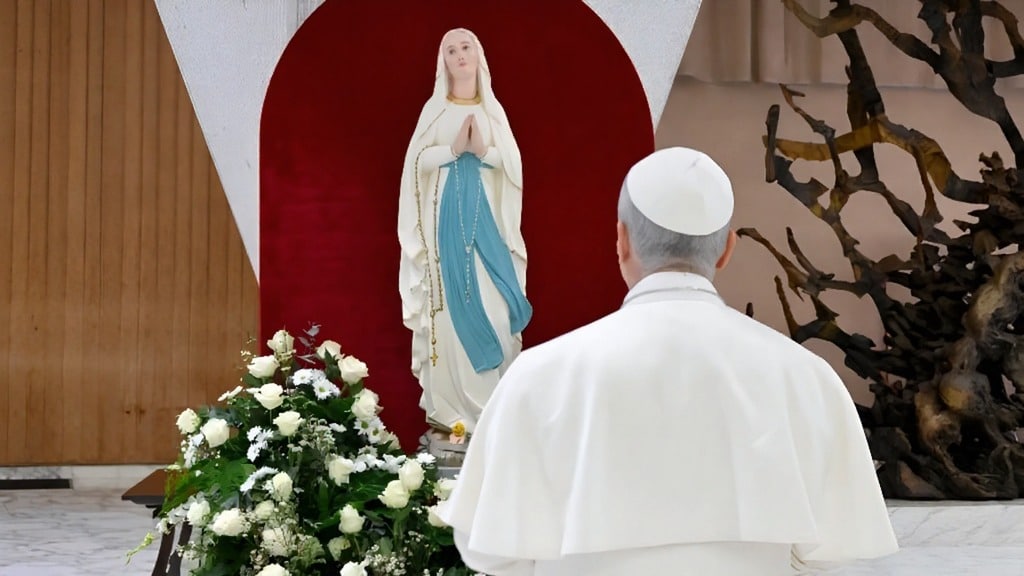
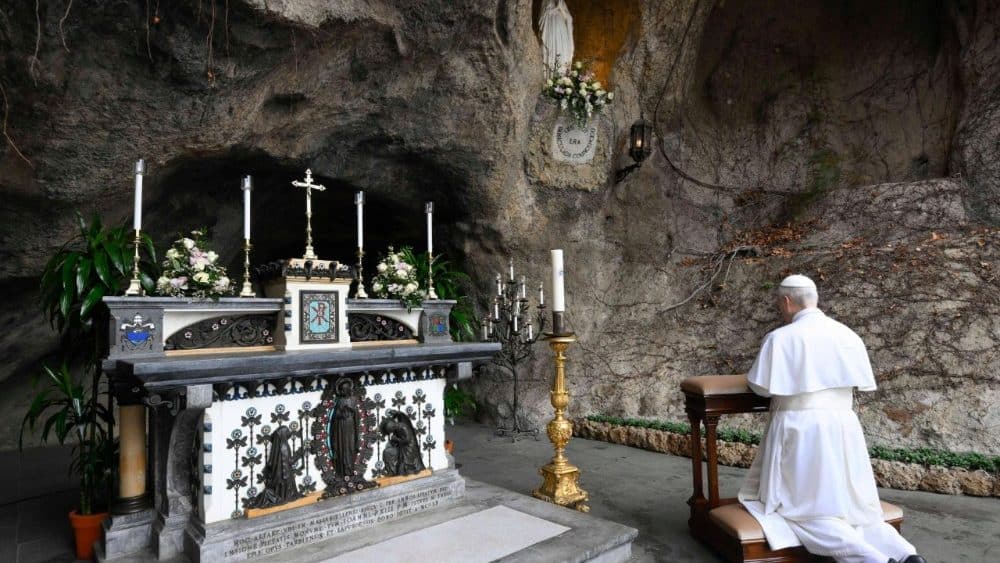
Referring to current events, Leo XIV recalled the beginning of Lent next Wednesday, as a time to deepen our knowledge and love of the Lord, examine our hearts, and refocus on Jesus through prayer, fasting, and almsgiving. Coinciding with the World Day of the Sick, the Pope lit a candle before the statue of Our Lady of Lourdes in the Aula Magna and prayed at the Grotto of Lourdes in the Vatican Gardens, spiritually uniting himself with the celebration at the Shrine of Our Lady of Peace in Chiclayo, Peru, and entrusting the sick and their families to Marian protection.
Finally, the Holy Father issued an appeal for solidarity with the victims of the severe floods in Colombia, urging the international community to support the affected families through charity and prayer, entrusting them also to Our Lady of Lourdes. The Audience concluded with blessings and a call for openness to the Gospel in a world thirsting for truth.
Full text of the Hearing:
LEO XIV
GENERAL AUDIENCE
Audience Hall
Wednesday, 11 February 2026
___________________________________
Catechesis. The Documents of Vatican Council II. I. Dogmatic Constitution Dei Verbum 5. The Word of God in the life of the Church
Dear brothers and sisters, good morning and welcome!
In today’s catechesis we will look at the profound and vital link that exists between the Word of God and the Church, a bond expressed by the Conciliar Constitution Dei Verbum, in the sixth chapter. The Church is the rightful home of Sacred Scripture. Under the inspiration of the Holy Spirit, the Bible arose from the people of God, and is destined for the people of God. In the Christian community it has, so to speak, its habitat: indeed, in the life and the faith of the Church it finds the space where it can reveal its meaning and manifest its power.
Vatican Council II reminds us that “the Church has always venerated the divine Scriptures just as she venerates the body of the Lord, since especially in the sacred liturgy, she unceasingly receives and offers to the faithful the bread of life from the table both of God’s word and of Christ’s body”. Furthermore, “she has always maintained them, and continues to do so, together with sacred tradition, as the supreme rule of faith” (Dei Verbum, 21).
The Church never ceases to reflect on the value of the Sacred Scriptures. After the Council, a very important moment in this regard was the Ordinary General Assembly of the Synod of Bishops on the theme “The Word of God in the life and mission of the Church” in October 2008. Pope Benedict XVI gathered its fruit in the post-Synodal Exhortation Verbum Domini (30 September 2010), in which he affirms: “The intrinsic link between the word and faith makes clear that authentic biblical hermeneutics can only be had within the faith of the Church, which has its paradigm in Mary’s fiat… the primary setting for scriptural interpretation is the life of the Church” (no. 29).
In the ecclesial community, Scripture therefore finds the sphere in which to carry out its particular task and achieve its purpose: to make Christ known and to open dialogue with God. Indeed, “ignorance of the Scriptures is ignorance of Christ”. [1] This well-known expression of Saint Jerome reminds us of the ultimate purpose of reading and meditating on the Scriptures: to get to know Christ and, through Him, to enter into a relationship with God, a relationship that can be understood as a conversation, a dialogue. And the Constitution Dei Verbumpresented the Revelation to us precisely as a dialogue, in which God speaks to humans as though to friends (cf. DV, 2). This occurs when we read the Bible with an inner attitude of prayer: God then comes towards us and enters into conversation with us.
The Sacred Scripture, entrusted to the Church and preserved and explained by her, performs an active role: indeed, with its efficacy and power it sustains and invigorates the Christian community. All the faithful are called to drink from this wellspring, first and foremost in the celebration of the Eucharist and the other Sacraments. Love for the Sacred Scriptures and familiarity with them must guide those who carry out the ministry of the Word: bishops, priests, deacons, catechists. The work of exegetes and those who practise biblical sciences is invaluable, and Scriptures have a central place in theology, which finds its foundation and soul in the Word of God.
The Church ardently desires that the Word of God may reach every one of her members and nurture their journey of faith. But the Word of God also propels the Church beyond herself; it opens her continually to the mission towards everyone. Indeed, we live surrounded by so many words, but how many of these are empty! At times we even listen to wise words, which do not however affect our ultimate destiny. On the contrary, the Word of God responds to our thirst for meaning, for the truth about our life. It is the only Word that is always new: revealing the mystery of God to us, it is inexhaustible, it never ceases to offer its riches.
Dear friends, living in the Church one learns that the Sacred Scripture is totally relative to Jesus Christ, and one experiences that this is the deep reason for its value and its power. Christ is the living Word of the Father, the Word of God made man. All the Scriptures proclaim his Person and his saving presence, for each one of us and for all humanity. Let us therefore open our hearts and minds in order to receive this gift, following the example of Mary, Mother of the Church.
_____________________________________________
[1] S. Girolamo, Comm. in Is., Prol.: PL 24, 17 B.
____________________________________________________
Special greetings
I greet the English speaking pilgrims and visitors taking part in today’s audience, in particular the groups from England, the Netherlands, Sweden, Israel and the United States of America, Next Wednesday, the season of Lent begins. It is a time for deepening our knowledge and love of the Lord, for examining our hearts and our lives, as well as refocusing our gaze on Jesus and his love for us. May these coming days of prayer, fasting and almsgiving be a source of strength as we daily strive to take up our own crosses and follow Christ. Upon you and your families, I invoke the joy and peace of our Lord Jesus Christ. God bless you!
_____________________________
Summary of the Holy Father’s words
Dear brothers and sisters, in our catechesis on the Dogmatic Constitution Dei Verbum, today we considered the profound and vital connection between the Word of God and the Church. Sacred Scripture, which has been entrusted to the Church and is guarded by her, reveals its meaning and manifests its strength in the life and faith of the Church, above all in the celebration of the Holy Eucharist. For this reason, the Church continually meditates upon and interprets Scripture because it is the means by which we come to know the incarnate living Word of God who is Jesus Christ. Indeed, praying with Scripture opens the door for an intimate relationship with God who through these sacred writings invites us into conversation with him. As Saint Jerome rightly points out, ignorance of Scripture is ignorance of God. With this in mind, I encourage you to read and contemplate the inspired word of God daily. May the Word of God nourish our hearts and minds and lead us to the fullness of life.

Exaudi Staff
What is Exaudi News? Exaudi News is an international Catholic media outlet that informs, shapes, and transforms daily in Spanish, English, and Italian. Through news, analytical articles, and live broadcasts of the Pope's events, Exaudi seeks to strengthen Christian unity and contribute to the evangelization of the world, always guided by the Church's social doctrine. We work to bring Christian truth and values to every corner of the planet. Help us transform the world with Exaudi! At Exaudi, we believe that evangelization and quality information can change lives. To continue our mission and expand our reach, we need your help. In addition, we are looking for committed people to join our team. With your support, we will reach more people, spread the message of Christ, and strengthen Christian unity. Will you join our mission? For more information on how to collaborate, visit Exaudi.org or contact us directly: [email protected] Exaudi: Informs, educates, and transforms.
Related
Pope Leo XIV Highlights Mary’s Example of Suffering and Love During World Day of the Sick
Exaudi Staff
11 February, 2026
1 min
Sixth World Day of Grandparents and Older Persons: “I Will Not Forget You”
Exaudi Staff
11 February, 2026
1 min
Pope Leo XIV will visit Spain in 2026: preparations begin for a historic trip
Exaudi Staff
09 February, 2026
3 min
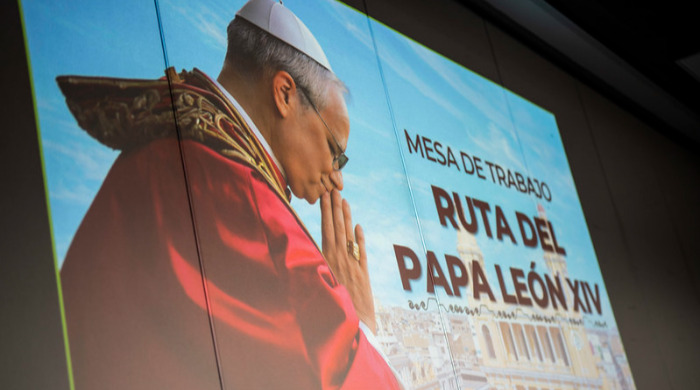
Pope Leo XIV will visit Peru
Exaudi Staff
09 February, 2026
2 min