 (EN)
(EN)
 (ES)
(ES)
 (IT)
(IT)

The Origin of the “World”
How Early Life Shapes the Relationship Between the Person and Their Environment
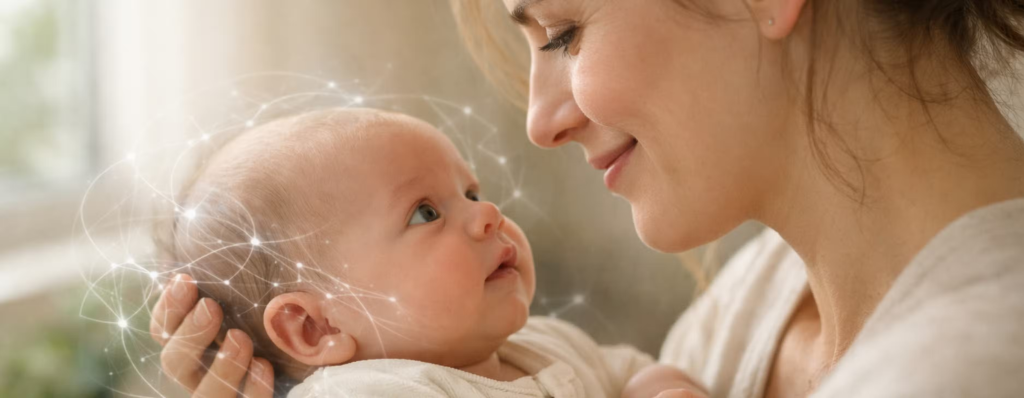

Human development begins long before a child is self-aware, in a constant and profound dialogue with their environment that shapes not only their biology but also their inner world. This article explores how, from the earliest stages of life—even before birth—the interaction between the infant and their environment progressively shapes their nervous system, their emotions, and their way of being in the world. Through the concept of the “primary warp,” the crucial importance of early bonds and the family environment in shaping the individual is revealed, opening a reflection that transcends the merely biological to delve into the spiritual dimension of human development.
In order to establish a proper relationship with its environment, every animal needs adequate stimulation. This requires timely and varied stimulation, which allows its physiological senses, motor patterns, and ability to perceive its surroundings to develop appropriately. All of this is linked to the configuration and refinement of the underlying nervous processes. The same applies to our case: the baby (even in its earliest stage as a fetus, and later as a child) must be properly stimulated for its healthy development, enabling it to achieve optimal behavior. However, in our case, the matter is more complex, as it involves spiritual factors that go beyond the strictly biological.
In its relationship with its environment, the baby is not passively exposed to all the information coming from outside, but rather, in some way, ‘responds to it’: there is a continuous interaction between the baby and the environment according to patterns of assimilation and response that are gradually established based on the experiences it has; all of which will have its corresponding nervous correlate. How does this process occur? In the ontogenetic development of the new person coming into the world, its physiological structures are generated based on genetic information. These structures, for their constitution, continuously request resources from their environment, which can be identified with the mother’s body in the case of the fetus, and with the family environment in the case of the baby and child (regardless of whether the family environment can also affect the fetus). An interesting circularity occurs here, which will be especially relevant when the fetus is born, particularly during its first months and years of life: on the one hand, the developing organism is eager for resources, which come from its environment; And, on the other hand, the constitution of that same organism will depend on those resources received. Little by little, the baby’s structures develop genetically and take shape according to everything received; a development that will in turn influence how future resources are received so that, in light of their richness and quality, their nervous structures, and with them their personality, will be progressively configured.
What kind of resources are needed? First and foremost, biological ones; but not only biological: as the organism develops, it becomes possible to receive another kind of information of a spiritual nature, which, at first, is eminently affective. This is justified by the fact that the brain structures that first consolidate are the brainstem and subcortical structures, intimately linked to the vegetative and affective dynamics of the newborn. All this initial neurophysiological configuration is what Rof Carballo calls the primary warp . It is not that there is already a configured structure, a warp, that is then configured in one way or another, but rather that, by virtue of organic development and the relationship with the environment, the warp will be constituted in one way or another, which is something quite different. From this perspective — says Rof in Affective Weave and Illness — «the primary weave is now shown to us, therefore, as a transfer of receptive patterns , of capturing schemes of the excessively rich world around us» (Rof Carballo, 1999: 313).

The baby’s relationships with its environment, therefore, contribute to shaping its primary framework, and this consolidating primary framework, in turn, will establish how the baby relates to its surroundings. A feedback process thus occurs, whereby the baby, as it grows, constructs its world . A world that, to a large extent, will be analogous to that of its parents, but not entirely, given the unique character of each individual. The vital energy that vibrates at the core of every person, the impulse to exist and develop, needs, yearns for, a world—that is, for a certain ordering of its environment. A person cannot be understood without their world. If a person is a being born largely unfinished, and this completion occurs thanks to the set of transactional relationships with their parents and with others, thus constituting their primary framework, then the world would be the other side of the coin, forming an indissoluble unity in the existence of each of us.
This world is not merely a representation of the environment: because the baby not only learns to perceive and represent it, but also learns to situate itself and move within it; it assimilates an order that is not only cognitive but also affective and axiological, which is nothing other than the precipitate of its personal interaction with the order that its parents express through the family structure, which the baby encounters at birth. All of this occurs with increasing complexity, in tandem with the physiological development of the baby’s body and, above all, its nervous system: if, on the one hand, the different parts of the organism develop and integrate into a whole, on the other hand, this goes hand in hand with nervous coordination and brain configuration: along with the development of its structures, new networks of connection are established, integrating the somatic with the emotional, the cognitive, and the motor, in a cluster of new pathways that will go hand in hand with the experiences lived by the baby in its personal and physical environment. Thus, the baby’s world is shaped by the interpersonal relationships fostered by their parents or parental figures, receiving a way, a style, not only of perceiving, but also of feeling, acting, and valuing—in short, of situating themselves within their existence. All of this is internalized by the child, a far more profound internalization than that which conventional education can later provide, and which will undoubtedly affect their personality and how they relate to their environment, as well as how they receive that conventional education.
Alfredo Esteve Martín. Research Group ‘Emotion, Cognition, Action’. Catholic University of Valencia

Observatorio de Bioética UCV
El Observatorio de Bioética se encuentra dentro del Instituto Ciencias de la vida de la Universidad Católica de Valencia “San Vicente Mártir” . En el trasfondo de sus publicaciones, se defiende la vida humana desde la fecundación a la muerte natural y la dignidad de la persona, teniendo como objetivo aunar esfuerzos para difundir la cultura de la vida como la define la Evangelium Vitae.
Related
Saint Joseph and the Annunciation: Two Eternal Lights for the Vocation of Fathers and Mothers
Laetare
27 March, 2026
6 min
The Mind versus Reality
Observatorio de Bioética UCV
27 March, 2026
6 min

Noelia will receive euthanasia today after a legal process marked by intense debate
Observatorio de Bioética UCV
26 March, 2026
4 min
The Relevance and True Story of Saint Oscar Romero
Agustín Ortega
26 March, 2026
6 min