 (EN)
(EN)
 (ES)
(ES)
 (IT)
(IT)

“Teachers must be allowed to teach”
José María Barrio Maestre is a Spanish philosopher whose personal and professional life has been closely intertwined with educational reality and reflection


Trained in philosophy, his intellectual identity is clearly recognized in that field, and as he tells me, he is a philosopher, although not a pedagogue, a distinction that he embodies naturally during our conversation.
His teaching career began at the secondary level. He belongs to the now-defunct corps of tenured high school teachers and taught Philosophy at two high schools in the Community of Madrid. In this context, he experienced the years leading up to the implementation of the LOGSE (1990), and like many of his colleagues, he was able to foresee its consequences. This classroom experience formed a crucial basis for his subsequent theoretical reflection on education. While still a high school teacher, he was hired by what was then the Faculty of Philosophy and Educational Sciences at the Complutense University of Madrid. He joined the Pedagogy department, not the Philosophy department, a significant fact that characterizes his academic work. From there, he has developed a philosophical approach applied to the field of education, without relinquishing his identity as a thinker.
Conversing with him is a cultured, brilliant, and delightful experience that confirms the coherence between his work and his words. His thought combines clarity, depth, and a demanding defense of intellectual education. His most recent book, Socrates in the Classroom , shows us the synthesis of all of the above.
He has been at the Complutense University of Madrid for about forty years. The curious thing is that you are a philosopher, yet you work among educators. What interests you about pedagogy?
To be precise, I’ve been teaching at Complutense University for 39 years. Initially, I taught Philosophy of Education, Ethics and Politics of Education, and Pedagogical Anthropology, subjects that have since disappeared or become largely marginal in the current Faculty of Education curriculum. For the last twenty years, I’ve been teaching a course called Educational Theory to first-year students in the Primary Education Teaching degree program.
“What is called ‘Pedagogy’ or ‘Educational Sciences’ seems to me to be a collection of delusions expressed in quaint jargon.”
To your question about my interest in pedagogy, I must honestly say that it’s inversely proportional to my interest in philosophy: the latter tends toward infinity… There’s no need to explain where the former tends toward. If you’ll allow me the joke, although I’ll deny having said this, since my retirement is approaching, I can afford the luxury of speaking frankly. The truth is that pedagogy, given what I’ve seen—what I can see in my field—interests me less and less. It shouldn’t be this way, I admit. And some of my colleagues in pedagogy are wise people from whom I have much to learn, but the body of doctrines, theories, or approaches that make up what is called “Pedagogy” or “Educational Sciences” seems to me a collection of delusions expressed in a quaint jargon, which constantly coins infamous words, almost all Anglicisms that are in use for a few years and then need to be replaced by even more delusional ones.
Do you think that Spanish educators partly reject philosophy?
The person who invited me to work at the University trusted that I could contribute something here, especially given my familiarity with the German academic world; I know it somewhat better than the Anglo-Saxon one, which is the reference point for almost all Spanish educators. The Germans have other problems, but in the academic sphere of the Faculty of Education, there certainly isn’t the animosity toward philosophy that is perceived around here. This professor is José A. Ibáñez-Martín; he was a professor of Philosophy of Education, and I am very grateful to him for his help in my promotion to full professor. He has an excellent philosophical background, and we were both students of Antonio Millán-Puelles, professor of Metaphysics at the Complutense University and one of the greatest philosophers of recent centuries. Don Antonio held the first chair of Philosophy of Education at the Spanish university for a few years, and Don José Antonio succeeded him in that position when the former assumed the chair of Metaphysics at the Faculty of Philosophy.
“My research and teaching work focuses on matters of metaphysics and epistemology, which, however, I consider crucial for understanding the teaching task.”
In short, the fact is that, given this background, I’ve always had one foot in philosophy and the other in pedagogy. However, the wall that has sprung up between the two—which I describe in the booklet as one of the main causes of the devastation—has been rising and becoming increasingly insurmountable. As a result, this bipedalism was becoming increasingly uncomfortable, as the height of the wall was dangerously close to my groin. Years ago, I decided to take the plunge and dedicate myself to philosophy, let’s say, in exile. My research and teaching work focuses on matters of metaphysics and epistemology, which, it must be said, I consider crucial for understanding the teaching profession. I have developed these topics in the simplest way I could, so that first-year students—those I teach in my courses—can understand them, in another recent booklet entitled “Epistemology for Teachers” (which can be downloaded online at the following address: Epistemology for Teachers ).
Philosophy lives in you as an ordered logical reason, do you think the same is true for some theoretical pedagogues?
The problem some educators have is that they think pedagogy is an exact science. They yearn for it to achieve the prestige, rigor, and efficiency of technical disciplines like engineering. Frankly, I don’t think it’s that far-fetched. Without meaning to diminish its value, I believe pedagogy is not a science but an art, the art possessed by teachers who, through experience, have learned to effectively manage both continuity and the necessary gap between example and exemplary behavior. In other words, pedagogy is the art of setting good examples, a skill acquired through trial and error, through experimentation. Pedagogical examples are images that demand to be transcended, that don’t draw more attention to themselves than they redirect toward the concept. A good example helps students to abstract, that is, to avoid getting stuck on the iconic, on the “case of” something. So, I believe pedagogy is the art of those who have become experts in this.
And what do their fellow educators at the university think?
They usually get annoyed when I tell them that what they do isn’t science, but a profession. Anyway, they’re understanding of the kind of nonsense I throw at them because they’re good people; they certainly have less of a mean streak than we philosophy students usually do. However, they tend to get a bit carried away with this whole “educational sciences” thing. They tolerate me because I’m a “teacher dinosaur” and I’m getting closer to that point. I found that nickname a student slapped on me last year hilarious. In any case, if I have any advantage, it’s that what little I know about pedagogy I learned by hanging onto the chalkboard during my years in high school, an experience most of my colleagues who theorize about education without ever having held a chalkboard have never had.
“If I have any advantage, it’s that what little I know about pedagogy I learned hanging from the chalkboard during the years I spent in high school.”
In his latest book, Socrates in the Classroom , he reflects on the national education system. What would Socrates say about our teaching if he returned from Hades today?
I think I would ask that teachers be allowed to teach what they know and that they be encouraged to learn a lot about what they teach. That alone would be the beginning of a recovery.
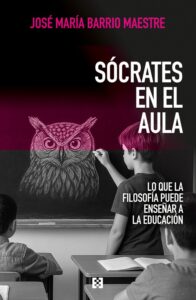
Why does Socrates permeate his last book? Was this thinker perhaps the founder of philosophy and pedagogy?
Socrates is the founder of the philosophical school. There are some very interesting pre-Socratic early works, but philosophy in earnest begins with him. He is the one who taught us Europeans to think rigorously, and, following in his footsteps, Plato and Aristotle. For our part, we still consider him the first teacher of the West. A teacher above all in a moral sense, because of how he lived and especially how he died. But also in an intellectual sense. From him, we know that the task of the teacher consists not so much in “instilling” ideas, or what some call values, but above all in “educating,” in drawing out, in bringing forth the best in each person whom he tries to help in the “mental birth.” He tells his friend Theaetetus that his profession was the same as that of his mother, Phaenarete, who was a midwife. It is an image of what teaching means that remains very significant today.
Our teaching undoubtedly boasts a long Socratic tradition; what is the point of a pedagogy without philosophy?
Very little, I think. I often say that a pedagogy without a serious philosophical foundation becomes mere social engineering, an emulsion of “human factor” for industry, or worse, a factory of “skilled beasts,” as Nietzsche would say, experts at preying before being preyed upon. With no small amount of irony, William Deresiewicz denounces a form of “leadership” that inspires work in many prestigious Anglo-Saxon universities, which promote intellectually mediocre people who are experts at kissing the asses of those above them and kicking those below them. In short, what I’m saying is a bit harsh, but this danger is real, and philosophy can generate some immunity against it. I would also say that, conversely, a philosophy incapable of being translated into a formative proposal for human beings is underdeveloped, even philosophically; it is not sufficiently thought out.
“I often say that a pedagogy without a serious philosophical foundation becomes mere social engineering, an emulsion of ‘human factor’ for industry.”
During his initial period as a professor at the Complutense University of Madrid, philosophy and pedagogy shared strong links, but years later both sections separated, what happened?
The then-rector Villapalos, I believe ill-advised, decided to separate the two sections of the former Faculty of Philosophy and Educational Sciences into two distinct faculties: one of Philosophy and another that began to be called (I believe it was in 1990) the Faculty of Education – Teacher Training Center, which combined the former pedagogy section with the two University Schools of Teacher Training (Pablo Montesinos and María Díaz Jiménez). Previously, philosophers and educators shared little, but they did at least share the Faculty Board, which implied some academic contact and facilitated a dialogue that, however limited, was nonetheless interesting. Since the emergence of the new entity—which, moreover, has since been located further away on campus—the umbilical cord that bound us to a form of rationality other than the merely instrumental has weakened. Although many welcomed this change, I deplore it.
In the book, he tells us that philosophy and pedagogy have suffered a profound and unfortunate divorce in our educational system. When do you think this began, what consequences did it entail, and how did it happen?
Naturally, with exceptions, in the English-speaking world, teacher training colleges (schools of education) tended to be more distinguished by their focus on the technical aspects of teacher preparation than on its humanistic dimension. Teacher “leadership” was viewed much more in terms of mastery of certain teaching methodologies than mastery of subject matter.
For its part, the high school curriculum in the United States tends to place diverse activities—such as sports, volunteer work, or various forms of social engagement—on equal footing and academically assimilate them with subjects of greater intellectual weight or with others that are more “playful.” This is understandable given the American penchant for measuring results, rankings, and anything operational . There has indeed been some interest in the philosophy of education in Great Britain, although it has been largely focused on aspects related to language analysis.
“There has indeed been some interest in the philosophy of education in Great Britain, although very much focused on aspects relating to the analysis of language.”
In any case, the world of educational research in the Anglo-Saxon sphere stands out more for focusing on practical or technical matters in which there is plenty of room for didactics, psychology, operational research, statistical analysis and, at most, some aspects of practical philosophy related to civic and moral education (or what they call there “character education”).
What’s happening in Germany?
In Germany, the situation is different. As I mentioned, the tradition of academic pedagogy has never been hostile to philosophy, not even to high-level theoretical philosophical discussion. It is no coincidence that pedagogy as a science—whatever that may be—can be considered a German invention, born within the philosophical tradition of Romantic idealism. The great founders of scientific pedagogy were German philosophers who lived in the second half of the 19th century. Technical subjects are certainly present in teacher training curricula, but never in competition with philosophy. Moreover, it was very common for university professors of pedagogy to have studied philosophy, or even to be primarily philosophy professors who dedicated one or more semesters to educational topics. Thus, for example, Kant published in 1803 some lectures on Pedagogy (Über Pädagogik) that compile his teaching in Königsberg during the winter semester of 1765-66. A typical feature of the German university, especially in humanities and social science studies, is the flexibility of the curriculum and the possibility of articulating it in a very varied way according to the preferences of the students.
But in Germany, was there also a divorce between philosophy and pedagogy?
Around the 1950s, a change occurred, not a paradigmatic one, which they call the “realist turn” (realistische Wendung), which has a certain Yankee influence, and which over time has somewhat distanced pedagogy from philosophy there, although never as much as in environments closer to our own.
“In 1978, a scientific event, the Bonner Forum Mut zur Erziehung (boldness to educate), took place in Bonn, in which top-level philosophers participated.”
In 1978 a scientific event took place in Bonn, the Bonner Forum Mut zur Erziehung (boldness to educate), in which top-level philosophers such as Robert Spaemann, Hermann Lübbe, Golo Mann, Dietrich Benner participated, which had an important impact on German academic discussion for several years, and which undoubtedly contributed to attenuating the intensity of that “turn”.
Some claim that new pedagogies and their educational innovations have destroyed national education, that the transmission of knowledge has been taken out of the classroom. Is this more false than true, or more true than false?
There’s a lot of truth to that. Although the problem has been brewing for much longer, the laws that organize the education system since the LOGSE have gradually devastated school education in its intellectual aspect, among other things because both that law and all its consequences adopt a constructivist ideology that is delusional.
What difference do you think exists between LOGSE and subsequent laws?
The LOGSE and its successors have followed the same path. This is the devastation they have left in secondary and upper secondary education, and particularly in state-run schools. These are institutions where highly qualified professionals carried out work characterized by conceptual rigor, a humanistic perspective, and a commitment to providing students with a solid intellectual education, but which have gradually become infantilized and transformed into theme parks where the aim is to keep young people entertained.
There are also those who consider the educational hypotheses of the new pedagogies in force to be devoid of arguments; what adjectives would you use to define them?
Weak and blind, to say the least. The main problem, I would say the original sin of modern pedagogy—therefore, not since Socrates but since Rousseau—is that most of this profession believes that what school education should primarily aim for is not that children and young people know things, but that they have “values,” that they learn to be tolerant, democratic, and inclusive. I remember how, years ago, the idea that “living together is living,” as stated in the famous Delors Report, made educators salivate. The concern for morality and civic responsibility, which are undoubtedly important aspects of human development in which education is committed, is seen by a large part of the teaching profession as competing with and detrimental to intellectual development.
“The issue is that quite a few educators think that for a boy or a girl to be tolerant, democratic, and supportive of values, they need to be a little ‘slow'”
The thing is, quite a few educators think that for a boy or girl to be tolerant, democratic, and a supporter of values, they need to be a little “dim-witted,” because if they know too much, they become arrogant nerds, resistant to coexistence and all that. Obviously, they don’t say it like that, because it would be too harsh… But that’s what they think, and without taking that approach into account, the devastation wrought in schools by educational laws of the last, let’s say, thirty years is literally incomprehensible. Anyway, Rousseau is partly to blame for this. I’m constantly surprised by the truly pious devotion that this group shows to Emile, which is a veritable collection of nonsense. Rousseau was a great philosopher, but not precisely because of that little book, but because of other, much more interesting things he said.
Rousseau believed that society and its formal education corrupt children, and that what is important are their original, good feelings…
Driven by this passion for people to have good feelings, rather than for them to study and know things, many educators completely disregard academic performance; what matters to them is that students are committed to all sorts of supposedly progressive and “social” causes. After rambling for a while about the importance of being “inclusive” and non-discriminatory, about the crucial presence of affective-sexual arguments in the classroom, about battling against “heteropatriarchy,” i.e. , opening up closed spaces and making visible groups victimized by the heterosexual male father—who is, of course, suspected of being an “abuser” until he proves otherwise—and already fed up with the same old song and dance about ICT in the classroom, multiple intelligences, emotional management, autonomous learning, etc., etc. —I’m probably leaving out several other noble causes that have been championed by the pedagogical rhetoric of recent decades—, but today it’s gamification that takes center stage. With the lightheartedness that educators have for coining Anglicisms, “gamifying” everything has recently become the talisman for reviving something that seemed long buried, something that once embodied the cliché of “learning through play.” Despite its innovative appearance, this trend is recurrent.
“I believe that the official distribution networks of what some have called a pedagogical sect – the education ministries of almost all Western countries – are hopelessly lost to the cause of recovering public schools.”
And in all of this, where does the public school fit in?
I believe that the official distribution networks of what some have called a pedagogical sect —the education ministries of almost every Western country—are irretrievably lost to the cause of reclaiming public education. Infected by that intellectually flabby passion for innovation and a complete disregard for philosophy since the mid-20th century—both structural vices, made in the USA —these channels have become unrecoverable for sanity. I wish I were wrong, but I fear that’s the case.
From ” I only know that I know nothing” to ” I don’t know much about almost anything ,” do you think we have gone from non-Sophist philosophy to pedagogical ideology?
These formulas that you have just used seem very appropriate to the current situation.
In our teaching, what should be more important? Learning to learn or learning to think?
Let’s see: I think educators should make a little effort to better explain what they mean by “learning to learn.” It seems very intuitive, but if you pay close attention to the dictum , it’s not so clear what it means. This is the problem many educators have—certainly not all—: they haven’t studied enough. This needs to be done slowly, narrowing the focus and concentrating with unhurried, deliberate attention. If they stopped to think about it when they say it, they would probably realize that something doesn’t quite add up. Supposedly, and this is what’s intuitive at first glance, this expression refers to the technique—quite basic, by the way—of accessing sources of knowledge, tinkering with digital tools and internet search engines that enable what they call “autonomous learning” and that empty promise some people love so much: that children should “investigate.” I modestly believe I know what research is, and I don’t think a kid tinkering with a gadget equipped with a search engine can do that. The technological nonsense that has invaded schools has devastated the minds of two generations. I completely agree with Catherine L’Ecuyer when she says that the best preparation for an online world is an offline school , or whatever you call that in English. On the other hand, “learning to learn” that doesn’t lead to actually learning “things” ends up in a vicious cycle, a loop destined to never actually learn… anything.
“This is the problem that many educators have –certainly not all–: they have not studied enough.”
Some educators also talk about teaching people to think for themselves.
It is no less foolish to claim that thinking for oneself—and there is no way to do that except by doing it “for oneself”; one cannot think on behalf of others—or, as it is often said, having critical thinking skills, are abilities or competencies that can be learned in a purely structural or functional way, therefore entirely independent of content, that is, of thoughts, of things that have been thought by someone with whom we enter into real or virtual discussion when reading and listening. Margaret Mead is credited with saying that one must teach how to think, not what to think. Well, although the phrase seems perfect, it is utter nonsense to claim that one can think without having something to think about, or to teach how to do that without showing some thoughts that, certainly, will later require critical attention, making them the object of reflective analysis. But the first thing is to think something. If it is true that this woman said that, I would reply that, although she knew a lot about cultural anthropology, she was rather lacking in philosophy. It’s like trying to learn to play the guitar by reading a guitar manual. No: you learn by playing the guitar, obviously badly at first, and gradually correcting your mistakes with the help of the manual. To assume that you can learn to think without “thinking about something,” and then “think about that thought of something”—that is, reflect on the truth value of what you’ve thought—is equivalent to imagining that you could learn such a thing by taking a pill, or learn Russian in four afternoons.
And what about critical thinking, which is so often discussed in pedagogy?
Critical thinking is not an intellectual skill that can be achieved merely formally, without considering concrete thought processes. To fail to recognize something as basic as this is a naiveté comparable to that required to dismiss memory as if it were the “intelligence of the dull,” as many educators claim. We’re back to square one: it’s good to strive for an education that isn’t merely rote, but to go from there to despising memory is intellectually suicidal, because we know what we remember. It’s true that knowing something is, obviously, more than simply remembering it, but the first condition for knowing something is, at the very least, not having forgotten it. Something as fundamental as this seems to be overlooked by those who constantly rail against traditional schooling because it’s “rote learning.”
“Critical thinking is not an intellectual skill that can be achieved in a purely formal way, without taking into account concrete content of thought.”
Another thing that experienced teachers know well is that it’s preferable for students to store information in their memory rather than in a digital repository, because the former is the foundation of knowledge, while gossip is utterly idiotic, even if it contains a lot of gibberish. Of course, memory alone isn’t enough for intellectual development, but this shouldn’t make us forget that the only thing that cannot be critical is ignorance: all human knowledge is, at least potentially, critical, meaning it can be subsequently reflected upon, analyzed, and its truth value assessed. But the first thing needed to think and reflect is to think about something, that is, to have something to reflect on.
Does today’s school harbor a disdain for knowledge?
The teaching profession has managed to transform schools into one of the main enemies of knowledge—something many teachers deplore, and I modestly agree—turning them into parking lots for children and teenagers who are entertained by doing many cute and useful things, but above all, by playing. However, as Gregorio Luri titles one of his books, ” School is not an amusement park.”
Regarding certain ideologies that are clearly against traditional teaching methods, what would you add?
Teachers aren’t the kind of people who like to get up on a platform and raise their voices. If they do that, it’s with the intention of “teaching,” that is, of pointing things out and directing students’ attention toward reality, not toward their own navels. They do it from the conviction that reality possesses such richness that it overflows, enriching even those who are capable of holding an attentive and lingering gaze upon it. Learning to listen to reality, the “language of being”; understanding that things aren’t just what they are to me, or what I say they are, or what I would like them to be, or what I “feel” they are, but that they have their own order and their own laws, and the first thing I must do is listen and learn them… All of this is a difficult, arduous learning process, but one with a profound human and humanizing impact. That is why the school was founded in the Socratic tradition: to learn to have respect for the truth, for reality, to have what Heraclitus called “an attentive ear to the being of things”.
“That’s what the school was founded for in the Socratic tradition: to learn to have respect for the truth, for reality.”
In classical Greece, it was the pedagogues who led students to the philosophers’ classrooms. Now it seems that pedagogues are steering students away from philosophy. Do you think the role of the ancient pedagogues has truly been reversed?
For many years, educators have been telling teachers that they have nothing to teach, that what they have to do is “guide” in so-called autonomous learning, “be there” and catalyze synergies so that people empathize, play, are emotionally satisfied, and all those little things they enjoy so much. This message, which the laws governing the education system have embraced for over 30 years, deeply discourages many truly dedicated teachers who want to teach the subject they know and try to transmit to others what excites them. These are the teachers who can truly pull us out of this mess, and we shouldn’t hinder them from doing their job to the best of their ability. Because that work is what a teacher can truly contribute to the growth and development of the people they try to help. We must let teachers teach.
What prevents teachers who advocate for the transmission of knowledge from teaching?
Driven by the constructivist frenzy and the mania the teaching profession has cultivated against the lecture—which, whatever anyone says, constitutes the essential work of a teacher, namely, explaining, clarifying concepts, and helping students understand and enrich their vocabulary—educational authorities are increasingly demanding that teachers at all levels—including universities—dedicate more time to office and computer tasks than to actual teaching, which, in this order—not axiological but chronological—is: preparing lessons, delivering them, and answering student questions. Preparing lesson plans, schedules, teaching guides, curriculum adaptations, continuous assessments, coordination meetings, and all the other obstacles that educators have invented to hinder teaching consumes almost more time and effort.
“My work attempts to explore the scope and humanizing reach of teaching, which is what the pedagogical establishment increasingly wants to distance us teachers from.”
It cannot be denied that all this work, fundamentally administrative, is connected to academics, but it diverts a great deal of energy from the core, which is the work in the classroom and the library. Yet this impulse to disrupt—I would even say sabotage—the lecture, ultimately, and please excuse my insistence, stems from the conviction, at least implicit in the minds of most of the teaching profession, that teachers have nothing to teach; their role is merely to be there acting as traffic signals so that each student can go their own way—which is all well and good, and very “Socratic”—but not to where they should be going to grow, but rather to where their own autonomous design of their virtual world and what is meaningful to them leads them, that is, where their whims or the fancies of the moment dictate.
Finally, I would ask him, “Why should we read the book ‘Socrates in the Classroom ‘?”
I don’t know if they should read it. Certainly not for educators with heart conditions, or those who are unwilling to engage in a cathartic experience—something, incidentally, also very Socratic. It might, however, be thought-provoking for those who wish to understand more deeply a fascinating experience that every teacher has had at some point in the classroom: seeing a student’s face light up when they’ve grasped something. My work attempts to explore the scope and humanizing reach of teaching, which is precisely what the educational establishment seems to want to distance us teachers from.
… In any case, it will always be more worthwhile to read Dostoevsky.
Interview conducted by David Rabadà . Educational Evidence

Exaudi Staff
What is Exaudi News? Exaudi News is an international Catholic media outlet that informs, shapes, and transforms daily in Spanish, English, and Italian. Through news, analytical articles, and live broadcasts of the Pope's events, Exaudi seeks to strengthen Christian unity and contribute to the evangelization of the world, always guided by the Church's social doctrine. We work to bring Christian truth and values to every corner of the planet. Help us transform the world with Exaudi! At Exaudi, we believe that evangelization and quality information can change lives. To continue our mission and expand our reach, we need your help. In addition, we are looking for committed people to join our team. With your support, we will reach more people, spread the message of Christ, and strengthen Christian unity. Will you join our mission? For more information on how to collaborate, visit Exaudi.org or contact us directly: [email protected] Exaudi: Informs, educates, and transforms.
Related
The Shroud disturbs those who do not want to encounter Christ in their lives
Wlodzimierz Redzioch
03 April, 2026
4 min

Marta Velarde: “Spain trivializes abortion and is one of the countries with the highest abortion rates”
Exaudi Staff
02 April, 2026
5 min

The best vocations are at this table
Se Buscan Rebeldes
31 March, 2026
6 min
A Rebel with a Cane: The Cross That Became a Miracle
Se Buscan Rebeldes
24 March, 2026
3 min