(EN)
(EN)
 (ES)
(ES)
 (IT)
(IT)

Saint John Henry Newman and the University Spirit
Lessons for Recovering Academic Refinement and Warmth
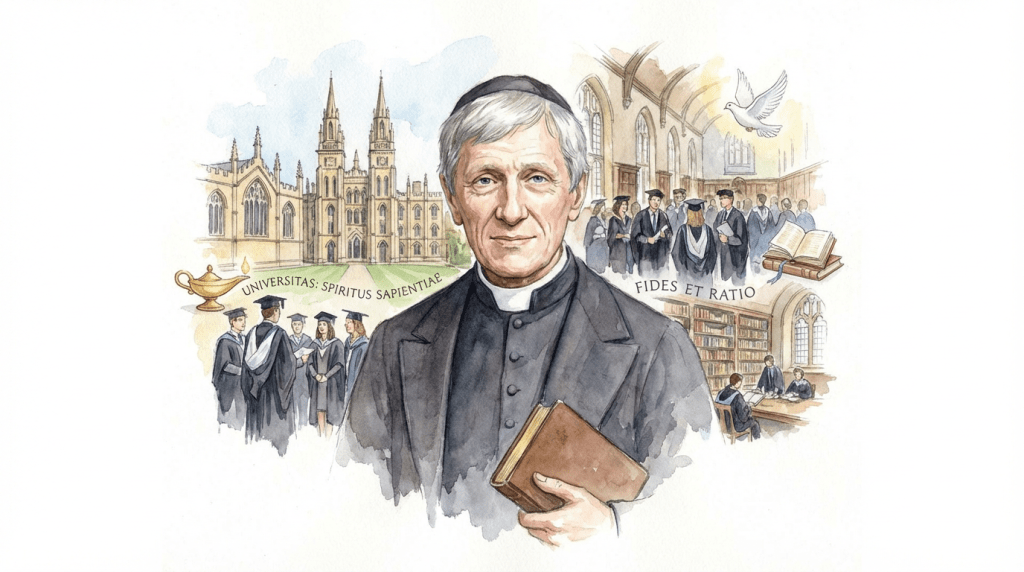

Saint John Henry Newman (1801-1890), Doctor of the Church, was a true academic. He embodied the Oxford academic spirit, served as Rector of the Catholic University of Ireland, and dedicated several of his writings to the ideal of the university. He knew what he was writing about. He did not speak like an official who views the university as an object to be controlled and supervised. Just as his episcopal motto was “heart speaks to heart,” so too did Newman write, from his experience and scholarship, from one academic to another.
In *The Rise and Progress of Universities * (Encuentro, 2024, Kindle edition), one can appreciate, among other things, the university spirit traceable back to the dawn of Hellenic culture. “The education that Athens provided,” Newman points out, “was what the student observed, heard, and grasped through the magic of empathy, not what he read” (p. 68). The teacher is listened to, engaged in dialogue with; then, his work is read. These are the stellar moments of university teaching where the exposition of ideas and the desire for knowledge converge. Spaces where a glimpse of reality is illuminated, like when one says, “I see it now.”
My years in university life have led me to emphasize the importance of in-person learning in a student ‘s education . “The general principles of any discipline can be learned from books at home; but the detail, the color, the tone, the spirit, the life that makes that discipline live within us… all of that must be received from those in whom it already lives (p. 39).” Teaching transmits life; it is taught with passion—as another great teacher, George Steiner, reminded us. When everyone in a classroom is on the same wavelength, an affinity between minds is created. Everything contributes and matters: the tone of voice, gestures, glances, emphasis. In this regard, I recall the ease with which Professor Carlos Llano—a professor at the Pan-American University of Mexico—handled a large audience, a medium-sized classroom, or a personal conversation over coffee. There was a connection, the same kind that is often described in the classes of the great Romano Guardini.
Carlos Cardona, another great academic, a metaphysician with the soul of a poet, said that we learn from those we love. Indeed, teaching flows more smoothly when there is harmony between the professor and the students: closeness and warmth, talent and simplicity, trust and respect. How important are rapport, affinity; personal relationships in the classroom, during breaks, in the hallways, in the cafeteria, in the courtyards, in the rich university life where the uniqueness of each and every person is revealed.
What happens when this refined spirit, so characteristic of the university, dissipates? What remains is quite impoverished. The “institution” continues to function, but only through processes. Professors become rigid, dedicated to delivering canned, monotonous, and uncreative knowledge. Processes have frozen the spirit, turning it into a cold statue, trapped in lifeless documents and ideologies. In the absence of spirit, only the materiality of structures, buildings, and academic systems remains. Necessary, certainly, but at the price of transforming professors and students into the “gray men” of Michael Ende’s novel Momo : magnificent time-savers without souls.
University studies, Newman insists, must contribute to character formation, both intellectually and morally. Therefore, the university reaches its full potential when it provides its members with the appropriate means to respond to the human need for knowledge, accompanying all members of the university community in the relentless pursuit of truth. These timeless reasons should not be overshadowed by the urgency of training professionals. The primary objective of forming better people remains valid, and the cultivation of the humanities fosters the flourishing of humanity to this end. Mere utilitarianism—even when it solves problems—is insufficient for the sustainability of society. The guiding light of humanistic wisdom lends depth and distinction to professional expertise, facilitating the value-based practices characteristic of good people.

Francisco Bobadilla
Francisco Bobadilla es profesor principal de la Universidad de Piura, donde dicta clases para el pre-grado y posgrado. Interesado en las Humanidades y en la dimensión ética de la conducta humana. Lector habitual, de cuyas lecturas se nutre en gran parte este blog. Es autor, entre otros, de los libros “Pasión por la Excelencia”, “Empresas con alma”, «Progreso económico y desarrollo humano», «El Código da Vinci: de la ficción a la realidad»; «La disponibilidad de los derechos de la personalidad». Abogado y Master en Derecho Civil por la PUCP, doctor en Derecho por la Universidad de Zaragoza; Licenciado en Ciencias de la Información por la Universidad de Piura. Sus temas: pensamiento político y social, ética y cultura, derechos de la persona.