 (EN)
(EN)
 (ES)
(ES)
 (IT)
(IT)

Saint Edward, October 13
The Confessor
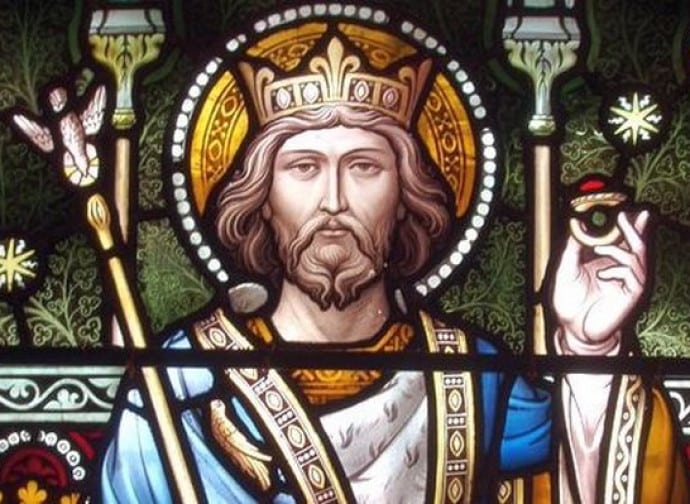

Saint Edward, known as Edward the Confessor, was King of England and is venerated by the Catholic Church as a saint. His liturgical feast day is celebrated on October 13, a date that commemorates the solemn translation of his relics to a chapel in Westminster Abbey in 1163.
Origins and early years
Edward was born around 1003 in Islip, Oxfordshire. He was the son of the Anglo-Saxon king Ethelred II “the Undecided” and Emma of Normandy, daughter of Duke Richard of Normandy. During his childhood, when England suffered Danish invasions, his mother’s court fled to Normandy, taking Edward and his brother Alfred with them.
In Normandy, Edward grew up under the influence of church life, developing a deep inclination toward prayer and piety.
Accession to the throne and reign
Upon the death of the Danish king Hardicanut in 1042, Edward was summoned to the throne of England, supported by the nobility and the powerful Earl Godwin.
In 1045, despite having taken a vow of chastity, he married Edith, daughter of Earl Godwin, on the condition that they would live as siblings and both would observe continence.
During his reign (1042-1066), he sought to govern justly, suppress excessive taxes, and distribute wealth generously to the poor. He was a peaceful monarch who sought the well-being of his people rather than war or conquest. Among his most notable works is the construction of Westminster Abbey, dedicated to Saint Peter, which was consecrated shortly before his death.
Death and canonization
Edward died on 5 January 1066 in London. He was canonized by Pope Alexander III in 1161, and his incorrupt body was solemnly transferred to a new chapel in Westminster in 1163, in a ceremony presided over by Saint Thomas Becket.
The date 13 October commemorates this transfer, and it became his feast day.
Virtues and legacy
Saint Edward is remembered for his profound faith, his spirit of prayer, his justice, and his generosity. He was a humble, peace-loving ruler who administered his kingdom with balance and piety.
Among the virtues the Church attributes to him are:
-
His charity towards the poor and needy.
-
Her purity and fidelity to the vow of chastity.
-
His devotion to the Church and his support for monastic life.
-
His love for peace and his renunciation of unjust violence.
For these reasons, he is considered the patron saint of marriages in difficulty, of kings and rulers, and of those seeking reconciliation and inner peace.
Although he was long the patron saint of England, he was later replaced by Saint George as the national patron saint.
Prayer to Saint Edward the Confessor
O glorious Saint Edward, holy king and model of virtue,
you who ruled with justice and compassion,
who knew how to unite authority with service,
look kindly upon those who invoke you today.
You who offered your crown to the Lord as an act of humility,
and who raised temples to honor his name,
intercede for us before the divine throne:
may we imitate your life of faith, purity, and devotion.
Help us, especially, in our marital difficulties
and in troubled or separated marriages,
so that, with your help, true love in Christ may be reborn.
Through your intercession, Lord, grant us the grace we now ask for
(mention your request here).
May we, strengthened by your example, walk perseveringly toward holiness,
and one day find you in eternal glory.
Amen.

Exaudi Staff
What is Exaudi News? Exaudi News is an international Catholic media outlet that informs, shapes, and transforms daily in Spanish, English, and Italian. Through news, analytical articles, and live broadcasts of the Pope's events, Exaudi seeks to strengthen Christian unity and contribute to the evangelization of the world, always guided by the Church's social doctrine. We work to bring Christian truth and values to every corner of the planet. Help us transform the world with Exaudi! At Exaudi, we believe that evangelization and quality information can change lives. To continue our mission and expand our reach, we need your help. In addition, we are looking for committed people to join our team. With your support, we will reach more people, spread the message of Christ, and strengthen Christian unity. Will you join our mission? For more information on how to collaborate, visit Exaudi.org or contact us directly: [email protected] Exaudi: Informs, educates, and transforms.
Related
Saint Joseph: A Model of Fatherhood, Faith, and Protection
Patricia Jiménez Ramírez
19 March, 2026
4 min

Saint Joseph: Perpetual Smile
Luis Herrera Campo
19 March, 2026
3 min

Treintena to St. Joseph
Exaudi Staff
19 March, 2026
5 min

The Silences of Saint Joseph: Eloquence of Love and Obedience
Javier Ferrer García
19 March, 2026
2 min