 (EN)
(EN)
 (ES)
(ES)
 (IT)
(IT)

Life is a Boat: The Church as a Place of Salvation
From Noah's Ark to Peter's Ark, via the Sea of Galilee: An Invitation to Become Aware, Remain in the Boat, and Rescue Others
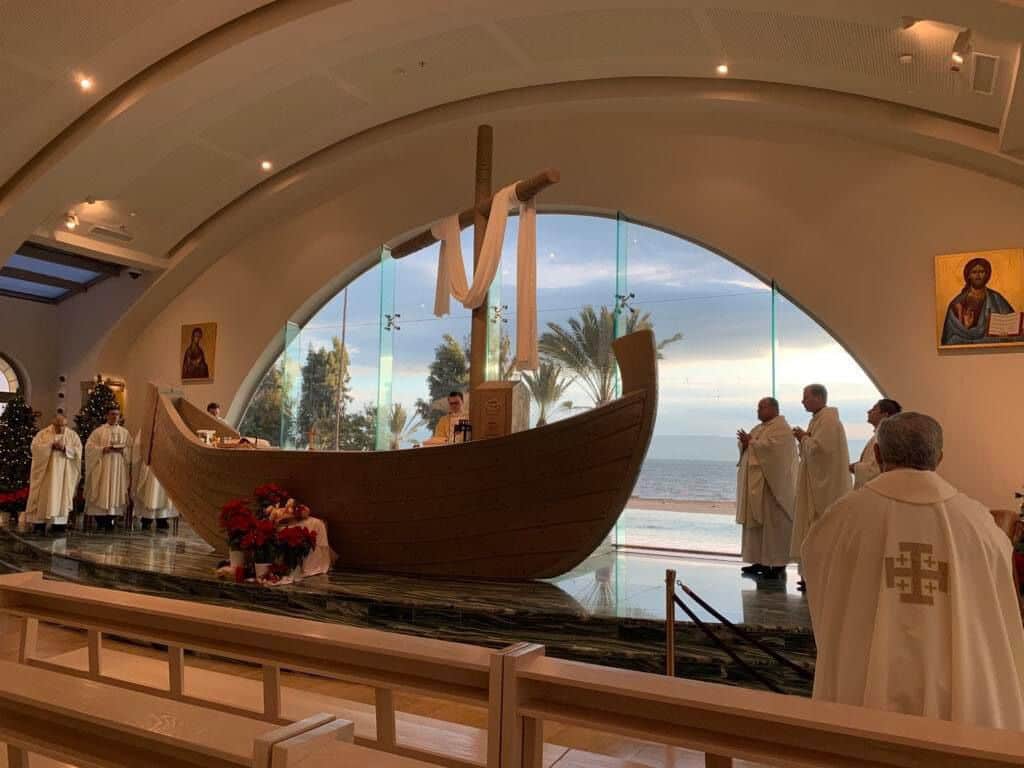

Every time I go to Jerusalem—I try to go at least once a year—I usually travel with pilgrims. It’s breathtakingly beautiful. If you’re interested in coming, leave a comment on the channel, and we’ll share information to help you plan your trip.
One of the things I love most is celebrating Mass in Magdala, specifically at an altar shaped like a boat. It’s beautifully enormous. Why a boat? Because Jesus asked Peter for the boat, “Put out into deep water,” he told him. From there he preached to the crowds and then called Peter and the others. He performed the miraculous catch of fish in a boat, traveling from place to place on the lake. He deliberately left the apostles alone in the boat in the middle of the night to appear to be walking on the water. And from a boat he calmed the storm.
If I’m not mistaken, between 75% and 80% of Christ’s public life took place around the Sea of Galilee, also known as the Sea of Gennesaret. Everything revolved around Peter’s house, the boat, Magdala, Tabgha, and those nearby places. He went by boat, he returned by boat, “Cast your nets,” “Cast your nets on the other side”… Always the boat.
But what is the first boat we hear about in the Bible? Noah’s Ark.
Sometimes we imagine the ark as something gigantic, bigger than the Titanic, big enough to fit two elephants, two tigers, two giraffes, two gorillas, two pandas… No, no. What animals did Noah know? Dogs, cats, goats, cows, sheep, maybe a camel… and that’s about it. He didn’t pack vipers, boas, cobras, or pythons in Gerber jars; nor chinchillas, gnats, flies, or mosquitoes. These were the animals he knew that could fit in that boat where eight people entered: Noah, his wife, his three sons, and their wives.
In that boat, humanity was saved—the promise, the covenant that God made with humankind. Later came Peter’s boat, the boats Jesus used, and all as a symbol of the true boat: the Church.
Just as the flood came and all those not in the ark perished (not necessarily in hell, but they died in this world; each received their own judgment), God sent that punishment because they were wicked. But Jesus himself calls us all wicked: “If you then, who are evil, know how to give good gifts to your children, how much more will your heavenly Father!” We all make mistakes; even the saints have had imperfections. Those in the ark were saved and continued to live.
This boat is a symbol of the Church. God asks us to enter, but to truly enter. I entered the Church eight days after I was born (or perhaps four; I have both dates: birth and baptism). At eight years old, I was already in the boat, but unconsciously, in my mother’s arms. Later, I had to become aware that’s what catechism, confirmation, the Eucharist, the Gospel, and the maturation of faith were for.
I was a kid like any other. Don’t think that at 13 I was in Bible classes or doing missions; nothing like that. It wasn’t until I was 18, at a retreat, that I decided to give it a serious try. The rest was pretty ordinary.
We gradually realize that we’re all in the same boat. But some who are already on board get out; they jump into the water. I know people who went to Mass for 25 years and then stopped; they used to pray and then stopped; they were missionaries and then stopped. At 15, I decided to disobey my parents and never set foot in a church again… Most likely, you never truly grasped that you were in the boat. You were baptized, born into a Catholic family, went to a Catholic school in a Catholic country… you were on board, but you leaned over the side, you liked what was outside better, and you said, “What am I doing here?” You jumped into the water, like the prodigal son.
The prodigal son was in the boat, in his father’s house: there were servants, warmth, protection, food, wine, bread… But external voices seduced him: “Behind the mountain there is a wonderful country, a little town where you’ll have a great time. Here you lack nothing, but you don’t have everything either.” He left, and a few days later he was already drowning.
Dear friends, don’t get out of the boat. Remember that you’re still in it. Being in the boat comes with responsibilities: someone cooks, washes, raises the sails, is at the helm, cleans the bow, the stern… We all have a role. Many of us rescue those who have fallen overboard: we pull them out with ropes; they’re heavy, it’s complicated.
Don’t think we’re on an all-inclusive ocean liner with a pool, waiters, and shrimp. No, it’s a lifeboat. Here we pray, we work, we do missions, we care for others, and we’re safe inside, pulling as many people as we can along. There are many outside clinging to a plank, a rope, a float… The dangers are out there.
First, realize you’re in the boat. Experience the beauty of being there. Don’t get out under any circumstances. And what a beautiful thing it is: bring everyone you can in. Some seem happy outside: “We’re richer in the water.” Wait for the storm, the tempest, the predators… There’s nothing like being inside the boat.
Spread the word to everyone you want. Let’s do all the good we can. Let’s stay in the boat; let’s bring in those who are outside.
May God always bless you.
P Angel Espinosa de los Monteros
El Padre Ángel Espinosa de los Monteros ha impartido más de 4,000 conferencias sobre matrimonio, valores familiares y espiritualidad en diferentes ciudades de México, Estados Unidos, Francia, Italia, España y Sudamérica. Ha atendido a cientos de matrimonios ofreciendo consejos y programas de crecimiento conyugal y familiar. Es autor del libro «El anillo es para siempre», traducido a diferentes lenguas y a partir de las cuales ha dictado más de 20 títulos de conferencias. Actualmente se dedica de tiempo completo a impartir conferencias y renovaciones matrimoniales en 20 países del mundo.
Related

Good Friday: The Day Love Gave Himself for All
Exaudi Staff
03 April, 2026
3 min
Electric Wins Casino Register Account And Start Playing
Alberto Ramírez
03 April, 2026
9 min
VipZino Login In The United Kingdom: Access And Security Guide
Alberto Ramírez
03 April, 2026
10 min
Solving BoomsBet Login Problems In The Netherlands
Alberto Ramírez
03 April, 2026
9 min