 (EN)
(EN)
 (ES)
(ES)
 (IT)
(IT)

Ice Chapels and Hugs That Melt Winter: The Engineer Who Left Airplanes to Unite a World Coldened by Indifference
The Moving Lesson of Martin Soros, the University of Notre Dame Valedictorian Who Confessed His Own Flaws and Chose to Live on the Margins of Society


In the Indiana winter, when the thermometer plummeted to nineteen degrees Fahrenheit, the natural reaction of any college student would have been to seek refuge inside. Martin Soros did the exact opposite: he went out onto campus with his friend Wes, armed with recycling bins, bunk bed ladders, and the hood of an old car. Their goal? To fill the bins with snow, compact bricks, and build an ice chapel in the middle of campus.
Six days later, a crowd of students, teachers, and neighbors from the South Bend community gathered around the frozen structure to celebrate Mass. They hadn’t just built an ice temple; in the midst of the cold, they had ignited a community.
This anecdote perfectly encapsulates Martin Soros, the newly elected valedictorian of the prestigious University of Notre Dame. Soros, a young man from Bethesda, Maryland, and the son of Argentine immigrants, bid farewell to his class with a speech that shook the audience with its devastating honesty and its urgent call to combat the “coldness” of modern society.
The change of course: from airplanes to the ground
Martín’s story could have been very different. Passionate about aviation since childhood, his original plan was to study aerospace engineering. However, the summer before starting university, a trip to Argentina—the land where his family has its roots—changed the course of his life forever.
At “La Nazarena,” a community center run by the Schoenstatt Sisters of Mary in one of Buenos Aires’ most vulnerable neighborhoods, the young man discovered a reality that can’t be learned in physics labs. There, he began to understand how infrastructure itself can become a real path to breaking the cycle of poverty.
Upon returning, he changed his major to civil engineering. He didn’t want to design spaceships; he wanted to build solutions on Earth. During his university years, he maintained a brilliant GPA of 3.98 out of 4, while also pursuing two minors—theology and education—in addition to his primary degree. He served his fellow students as a residential assistant at Coyle Hall and undertook high-impact social projects. Through a student organization, NDSEED, he dedicated nearly 400 hours to the technical design of a suspension bridge for an isolated village in Bolivia, traveling there himself last summer to build it alongside seven other students. For Martín, the success of engineering is not measured by the complexity of the structure, but by the human dignity of those who cross it.
An uncomfortable confession: the cold we carry inside
What made Soros’s speech stand out from the usual messages of corporate success and professional ambition was his profound vulnerability. Far from presenting himself as an impeccable hero, he confessed to 30,000 people that he had personally experienced the same selfishness he criticizes in the contemporary world.
“I think of all the times I’ve been walking down a street, focused on my destination, when I come across a man sitting on the curb” Soros bravely admitted. “I immediately become uncomfortable. I start fidgeting. I glance in the other direction. I pretend he isn’t there. I’m afraid to look at his fragile humanity for fear that he will see mine.”
This paralysis in the face of others’ suffering, according to the graduate, is the true winter that freezes our era: a world paralyzed by indifference and comfortable looking the other way. The response to this frozen landscape, he asserts, is to emulate the spirit of Father Sorin, the university’s founder, who arrived in those frozen lands in 1842 and, despite having neither money nor students, found the courage to build a place that radiated warmth.
Faces with names and the power of a hug
In his address, Martín made sure to acknowledge those who build the daily life of the campus away from the academic spotlight. He explicitly thanked university staff like María, the employee who always greeted students with a smile in the cafeteria, and Cory, a cleaning staff member who always inquired about their weekends. He also expressed gratitude to the professors who pretended not to notice when a student fell asleep, the priests and mentors who supported them through difficult times, and the families who laughed and cried alongside them.
The final part of his speech evoked a harrowing experience he had in Buenos Aires, a city he returned to every summer and with which he stayed connected during the school year by teaching English online. During a nighttime retreat with teenagers from the La Nazarena center—young people scarred by deep wounds of addiction, abuse, and hunger—they organized an activity where each child was welcomed into a small chapel with the embrace of a loved one.
“I watched from a distance as each one of them stepped in, melted into the embrace, and began to weep,” Soros recounted, his voice filled with emotion. “Life had been so cold for them that this embrace, this moment of tenderness, radiated a sacred warmth.” When it was his turn, Martín himself broke down in tears, understanding that warmth is bidirectional: when you share warmth with someone, it floods you as well. In that moment, the “us” and the “them” cease to exist, giving way simply to “us.”
While the brilliant graduating class heads off to prominent positions on Wall Street, at law firms, or in prestigious medical centers, the immediate future of the university’s top student is radically different. Martín Soros has decided to forgo corporate offers to move to Argentina and serve for the next two years as development manager at the La Nazarena center. “I feel called to be here. I want to be on the ground as much as possible,” he concluded, leaving an indelible reminder that the most difficult and urgent bridges to build are not those of steel, but those of human solidarity.

Exaudi Staff
What is Exaudi News? Exaudi News is an international Catholic media outlet that informs, shapes, and transforms daily in Spanish, English, and Italian. Through news, analytical articles, and live broadcasts of the Pope's events, Exaudi seeks to strengthen Christian unity and contribute to the evangelization of the world, always guided by the Church's social doctrine. We work to bring Christian truth and values to every corner of the planet. Help us transform the world with Exaudi! At Exaudi, we believe that evangelization and quality information can change lives. To continue our mission and expand our reach, we need your help. In addition, we are looking for committed people to join our team. With your support, we will reach more people, spread the message of Christ, and strengthen Christian unity. Will you join our mission? For more information on how to collaborate, visit Exaudi.org or contact us directly: [email protected] Exaudi: Informs, educates, and transforms.
Related

He changed his mind and went: Commentary by Fr. Jorge Miró
Jorge Miró
26 September, 2026
3 min
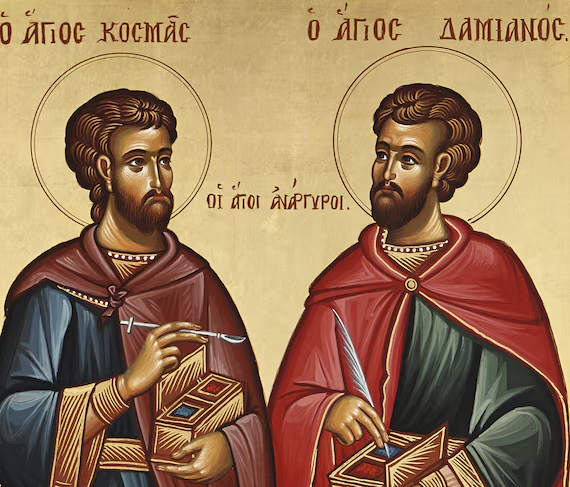
Saints Cosmas and Damian, September 26
Exaudi Staff
26 September, 2026
2 min

From the Stage to Eternal Truth: The Fascinating Conversion of Sir Alec Guinness
Sonia Clara del Campo
25 September, 2026
4 min

86 leaders from 16 countries will gather in Rome to discuss major leadership challenges in the era of artificial intelligence
Exaudi Staff
25 September, 2026
10 min