 (EN)
(EN)
 (ES)
(ES)
 (IT)
(IT)

“God is true reality”
A book of previously unpublished homilies by Benedict XVI
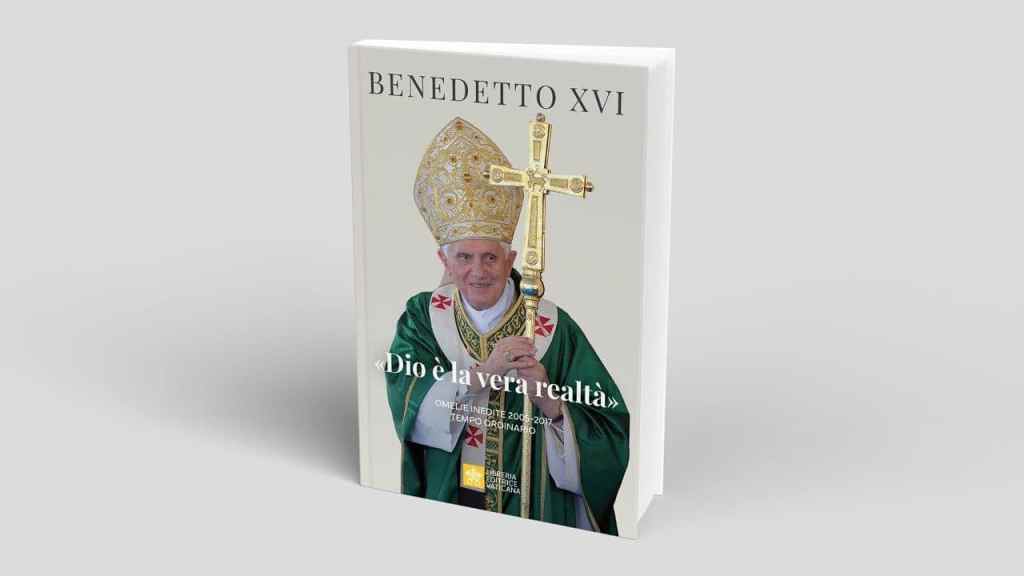

We present the full text of a reflection by Joseph Ratzinger, delivered on July 14, 2013, at the Mater Ecclesiae Monastery and never before published, included in the new volume from the Vatican Publishing House, which is now on sale. The book, which compiles 82 sermons delivered both during his Petrine ministry and after his resignation, will be presented on the afternoon of December 11 at the Vatican.
***
Dear friends,
This Gospel of the Good Samaritan constantly moves us. The dramatic relevance of this parable was evident during the Pope’s visit to Lampedusa. We have seen, and continue to see, the growing number of victims of violence throughout the world and, on the other hand, as the Pope said: “The numbing of the heart… the globalization of indifference.” What is happening?
In chapter 18 of Revelation, St. John tells us about the collapse of a great civilization, prophesied for the city of Rome. He shows how this civilization also created a system of trade, listing the numerous things that were bought and sold within it. Finally, he says that these merchants also traded in people and human souls (cf. Rev 18:13). Human souls, human beings, had become commodities, and so, in the end, this civilization collapses because it is no longer culture, but anti-culture.
This is precisely what happens to humanity, to individuals, when the human soul becomes a commodity. Consider those traffickers who promise to take people from the Horn of Africa to the earthly paradises of the West. They don’t care about the fate of these people; they could even drown at sea. In reality, they are only interested in money. For them, people are commodities that bring them money. The same thing happens in many other situations. Consider those in Romania who sell girls, promising them good jobs in the West, but in reality, they sell them into prostitution. Human beings are considered commodities and nothing more. Consider the tragedy of drugs: people who no longer see the meaning of life, who no longer see beauty. They yearn for beauty and goodness, but fall into the clutches of these drug traffickers, into the false paradises they destroy. Once again, human beings are mere commodities exploited to make money. The same is true for so many other victims of violence in Africa: children, soldiers, all of them… We see how humanity has fallen into the hands of thieves and expects the Samaritan to save it.
At this point, two questions arise. The first is: how is this phenomenon possible? How can we explain it in a civilization as rich and developed as ours? But the most important question arises as a consequence: what should I do? Ultimately, we shouldn’t make a general observation; ultimately, the question in the Gospel is the same as that of the rest of the law: what should I do? But first, we want to understand a little about why this is so, in order to better understand our mission, our possibilities, our task.
The modern era was born with two great ideals, which are the driving forces of its path: progress and freedom. We told ourselves: we no longer leave the world solely in God’s hands, we no longer simply wait for the afterlife; we take the initiative, the helm of history, we guide it along the path of progress. In reality, progress exists; we all know it. If I compare the world of my childhood, my youth, with today’s world, there is an immense difference; it doesn’t seem to be the same world. And we see how, in just the last thirty years, accelerated progress has changed the world: in the world of communications, incredible things can now be done, unimaginable even fifty years ago; in medicine, in technology that affects human life, etc., there is progress; humanity has possibilities that were previously unimaginable. But the question arises: is it true progress?
There is also real progress. If we consider that today there are international institutions that seek to prevent and avoid conflicts, heal and protect the sick; if we see how sensitivity toward people with disabilities, the sick, and the excluded has grown, along with respect for other nations and races, we must say that this is progress not only in our power, but also progress of the soul, progress for humanity, for humanism, for respect for others. And it seems to me that we can say, without false ideologies, that this progress is the result of the presence of the light of the Gospel in the world, because this light has allowed us to see the weak, those who suffer, others, as human beings, as children of God, as loved by God, as my brothers and sisters.
This vision of humanity, born of the Gospel, has transcended the confines of Christianity and become the heritage of humankind. We understand that we are all truly brothers and sisters; even the poor are our brothers and sisters; even those who belong to another race or religion are members of the same family. We must work to prevent violence, break the chains of evil, and help one another. Undoubtedly, there is progress. But we must also say that, nevertheless, progress remains very ambiguous; in fact, there is even a relapse for humanity. Precisely if we consider Lampedusa and everything we have mentioned, we see how human power, with all its possibilities, can also have the power of destruction. If humanity begins to produce itself, to manufacture itself, and to consider itself a commodity, something to be exploited, all this progress becomes an instrument of self-destruction; it is no longer progress, but a threat. The power of progress can only be useful if the light of the Gospel is stronger than all these human temptations, and only then will things not destroy us, but build humanity.
Let’s move on to the other word: freedom. Here, too, there has undoubtedly been real progress, in overcoming slavery, in achieving equality between men and women, in respecting children, and so on. But here, too, we find a destructive freedom; thus, we see that the world of drugs lives in the name of freedom, but it forces humanity into the most radical and destructive form of slavery, which is a caricature of freedom. This freedom, which is not freedom at all, but merely gives me the freedom to do whatever I want, is freedom that becomes a previously unthinkable form of slavery.
But what should I do? What can I do? The lawyer knew the answer, but it was only theoretical, an academic question for debate: “Who is, ultimately, my neighbor?” He doesn’t leave the intellectual and academic world; above all, his way of posing the question is selfish: “What must I do to save myself?” His priority is his own personal salvation. The Samaritan is entirely different. We don’t know if he knew the words of Deuteronomy, but the Gospel says that he “had compassion,” and the Greek expression is much more radical: “His heart was moved,” that is, he was moved inwardly, so much so that he had to do something. His heart was moved, but not only that: he knew what to do, what he had to do, because his heart spoke and showed him the way.
I also think of a passage from the prophet Ezekiel, where God says, “I will remove their heart of stone and give them a heart of flesh” (Ezekiel 36:26). This is the point: the “heart of stone,” which we all have because of original sin, which is also the heart of those who exploit human misery for profit, prevents us from understanding how much we can and should do; we need a “heart of flesh” to show us the way. I also think of a passage from the prophet Hosea, where God speaks of himself. God sees all the incredible sins of Israel, sees that, according to justice, he should destroy this kingdom, and says, “But I will not; my heart is turned within me” (cf. Hosea 11:8).
The heart of God is such that it cannot destroy humanity; it is such that it must help us, run after us; it is such that it goes out of itself, becomes human to save humanity; God went out of himself, his heart impelled him. Thus we see that the true Good Samaritan of humanity is Jesus Christ, the Son of God, who embarked on this journey, seeing human misery with a wounded heart, wounded by this reality. It is He who gives us the oil and the wine, the Sacraments, the Word of God; it is He who gives us refuge, the Church; it is He who guides us, transforms us, so that our hearts too may be like his.
This is how we see what is essential. This means that we only truly live if our hearts resemble the heart of Jesus, the divine heart. This is the purpose of the Gospel: that the true Samaritan, Christ, may conform us to himself, transforming our hearts of stone into hearts of flesh, and with that heart of flesh, we may know what to do. The world needs the light of Christ, and only if the light of Christ, the flame of his love, transforms our hearts, will each of us know what to do and when to do it. Faith itself transforms the world. The response we must give, therefore, is to discover Jesus, to believe in Jesus, to allow ourselves to be transformed by Jesus, so that our hearts may become hearts of flesh and tell us what to do. The light of Christ is the necessary answer.
Let us pray to the Lord to transform our hearts and help us to know what we should do in every moment of our lives. Amen!

Exaudi Staff
What is Exaudi News? Exaudi News is an international Catholic media outlet that informs, shapes, and transforms daily in Spanish, English, and Italian. Through news, analytical articles, and live broadcasts of the Pope's events, Exaudi seeks to strengthen Christian unity and contribute to the evangelization of the world, always guided by the Church's social doctrine. We work to bring Christian truth and values to every corner of the planet. Help us transform the world with Exaudi! At Exaudi, we believe that evangelization and quality information can change lives. To continue our mission and expand our reach, we need your help. In addition, we are looking for committed people to join our team. With your support, we will reach more people, spread the message of Christ, and strengthen Christian unity. Will you join our mission? For more information on how to collaborate, visit Exaudi.org or contact us directly: [email protected] Exaudi: Informs, educates, and transforms.
Related
The Church will have 12 new blesseds: 11 Spanish martyrs and one Argentinian layman
Exaudi Staff
18 December, 2025
4 min
The spirit of Christmas illuminates St. Peter’s Square with the unveiling of the Nativity scene and the Christmas tree
Exaudi Staff
16 December, 2025
2 min

Petrocchi Commission: No to the female diaconate, but the judgment is not final
Exaudi Staff
05 December, 2025
4 min
Pope Leo XIV abolishes the Commission for Donations to the Holy See
Exaudi Staff
05 December, 2025
6 min