(EN)
(EN)
 (ES)
(ES)
 (IT)
(IT)

Do you want to experience God?
The love of God cannot be explained, it can only be experienced
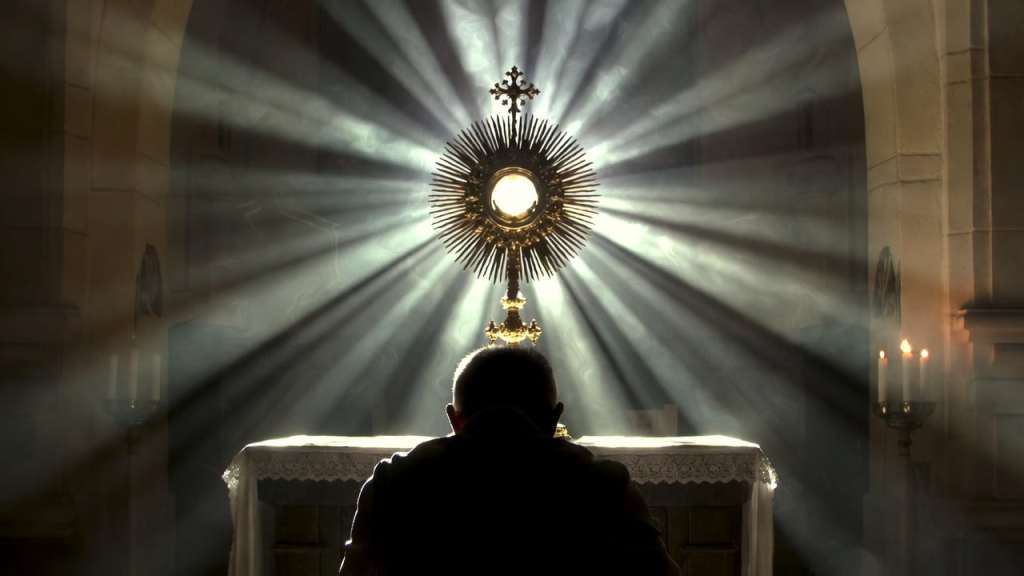

God’s love transcends words and rational explanations. As he himself expresses with simplicity and passion, it is something that is not conveyed through arguments , but rather experienced in a personal encounter with the Lord.
This idea is neither new nor exclusive to a contemporary preacher; it is at the very heart of the Catholic faith. The Catechism of the Catholic Church teaches that God is love (1 John 4:8) and that this love is revealed in the total self-giving of the Son (cf. CCC 221). However, knowing God is not merely an intellectual exercise: “Faith is a personal act, a free response to God’s proposal of revelation” (CCC 166). And this response is given in lived experience, not in mere definitions.
Father Ángel compares divine love to tangible realities of daily life: we can explain how a cell phone works, how to prepare a perfect paella, or even describe marital love through concrete details—the breakfast prepared, the daily acts of kindness, the walks shared. But when we speak of God’s love, words fall short. God doesn’t bring us coffee in the morning or invite us to the movies in a visible way; his presence is infinitely greater, more intimate, more transformative. He is in the depths of our hearts, in the very life he gives us, in the creation he sustains, in the miracle of each new human being born from an act of human love, but whose essence comes from him.
Here we find the quote the priest mentions, attributed to Rabindranath Tagore—a Hindu poet full of spiritual sensitivity: “I sought myself and did not find myself. I sought God and did not find him. I sought my brother and found all three.” This expression, although not directly from Scripture, finds a profound echo in the Gospel: Jesus identifies with his brothers and sisters, especially the least and the needy. “Truly I tell you, whatever you did for one of the least of these brothers and sisters of mine, you did for me” (Mt 25:40). In service to our neighbor, in the concrete act of love, we experience God the Father, the Son, and the Holy Spirit. Seeking our brother or sister in charity leads us to find the Three.
The Church has always insisted that experiencing God requires a path of surrender: daily prayer , Eucharistic adoration , meditative reading of the Word , contemplation , apostolate , and commitment to doing good. The Catechism emphasizes that prayer is “the living relationship of the children of God with their Father” (CCC 2565), and that contemplative prayer is a gift received in silence and openness of heart (cf. CCC 2710-2711). There is no fifteen-page “quick fix,” as Father Ángel jokes; it requires perseverance, commitment, and humility.
Jesus himself told us: “The truth will set you free” (Jn 8:32). Seeking the truth sincerely leads us to him. And in the saints we find living witnesses: conversions like those of St. Paul or St. Augustine, or even exceptional miracles like that of André Frossard—the atheist who entered a church by mistake and left a believer. But for most, the path is ordinary: Sunday Mass, a few minutes of daily prayer, speaking the truth, doing good, serving in the apostolate. Serving Jesus in our brothers and sisters, offering a glass of water, a word of advice, our presence, a Mass offered for others, a companionship. Because “whoever gives even a cup of water to one of these little ones and gives it to me” (cf. Mt 10:42).
In short, as the Catholic faith teaches and Father Ángel Espinosa de los Monteros reminds us: let us do all the good we can. Let us commit ourselves to Him in prayer and charity. For God’s love cannot be explained with words; it is experienced in the heart that opens itself to His grace. May He grant us this living and transformative experience.
May God always bless you.
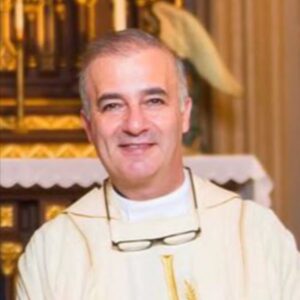
P Angel Espinosa de los Monteros
El Padre Ángel Espinosa de los Monteros ha impartido más de 4,000 conferencias sobre matrimonio, valores familiares y espiritualidad en diferentes ciudades de México, Estados Unidos, Francia, Italia, España y Sudamérica. Ha atendido a cientos de matrimonios ofreciendo consejos y programas de crecimiento conyugal y familiar. Es autor del libro «El anillo es para siempre», traducido a diferentes lenguas y a partir de las cuales ha dictado más de 20 títulos de conferencias. Actualmente se dedica de tiempo completo a impartir conferencias y renovaciones matrimoniales en 20 países del mundo.
Related
The “DJ Priest” and Faith in Tension: Between Mystery and the Algorithm
Juan Francisco Miguel
19 April, 2026
4 min
J.R.R. Tolkien and His Legendary
María José Calvo
16 April, 2026
5 min

Catholics and the Art of Servant Leadership: Lessons from Saint Catherine of Siena for Today’s Executives and Entrepreneurs
Javier Ferrer García
16 April, 2026
7 min
Five Keys to Raising Your Children with Humor
Luis Gutiérrez Rojas
16 April, 2026
3 min
Newsletter
Every month, Exaudi touches the lives of many through training, truth, and support
Join our communication channels and share them.