(EN)
(EN)
 (ES)
(ES)
 (IT)
(IT)

Contemplating a Sculpture
Excerpt from an essay on a historical episode in the life of Saint Francis of Assisi
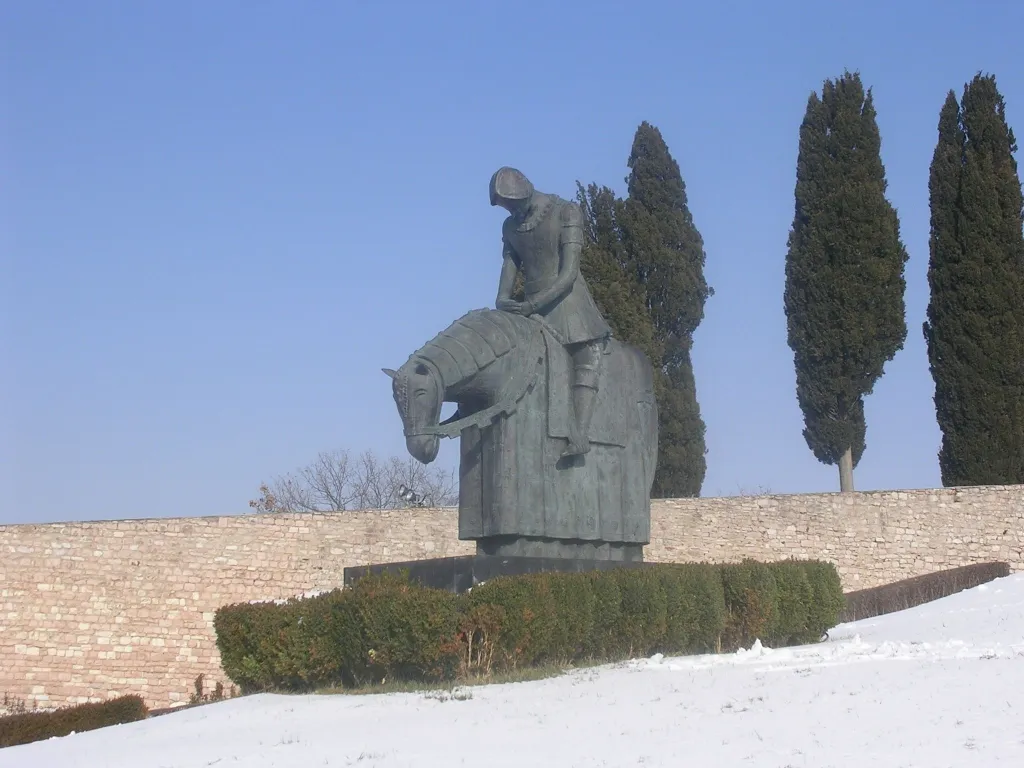

On the occasion of the 800th anniversary of his passing
In the garden of the piazza in front of the Upper Basilica of St. Francis in Assisi, in the Italian region of Umbria, stands a remarkable bronze sculpture by the Spello-born Naïve artist Norberto Proietti (1927-2009). Known as Il pellegrino di Assisi (The Pilgrim of Assisi ), it depicts, according to some sources, the young Francis’s return to his hometown after a truce was established in the intermittent war with the neighboring rival city of Perugia, following more than a year as a prisoner after the Battle of Collestrada in November 1202. However, a small plaque is sometimes placed a few meters from the sculpture, next to the low fence surrounding the garden, and is removed every December for the preparation of the Nativity scene. It contains a reference to a fragment of the second Life of Saint Francis, written by Tommaso da Celano between 1246 and 1247, which alludes to a different episode in which the young merchant from Assisi, with the somewhat snobbish, frustrated aspiration to become a knight—to use Jacques Dalarun’s expression—returns to his homeland from Spoleto. Around the summer of 1205, he had pursued his yearning for knightly glory after the adventure promised by an expedition with the army of Count Walter III of Brienne to the region of Puglia. Francis did not complete this expedition, however, because, feeling ill or unwell, he stopped precisely in the vicinity of Spoleto, about forty kilometers south of Assisi. There, an enigmatic and dreamlike nocturnal vision, merging the intimate and the celestial, transformed his perspective and revealed to him the consequent need to return home. Perhaps that’s why the name Il ritorno di Francesco This could also apply to the artwork depicting a knight without armor or sword, mounted on a steed whose limbs are hidden by a unique saddlecloth that extends to the base of the sculpture on its plinth, forming a solid block with the rest of the body. But a closer look at the work reveals something more: the horse curiously mirrors its rider’s downcast demeanor, which seems to enhance the portrayal of the character’s state of mind; a Francis with his head bowed towards his chest, as if both dejected and lost in thought, a state that prevents him from paying attention to the path he travels very slowly on his almost motionless mount, whose reins he barely holds. We assume he is returning to Assisi, though there is no expression of joy on his face, and his eyes, indistinguishable in the dark, sunken form of the bronze and perhaps directed downwards, see nothing, or rather seem to be looking inwards, perhaps searching for answers; his mind and spirit merely float or sink amidst piercing and inescapable questions. Perhaps he is in prayer, or, without excluding this, he is repeatedly replaying the words he heard in that extraordinary dream that revealed so much more of his being, of his desires and aspirations for fulfillment, of his own reality, and of all that he had previously been unaware of. The fact that a young and enthusiastic aspiring knight, whose sensitivity to the meaning of words was extremely intense and vivid, clearly heard the terms ” serve,” “servant,” and “lord” in the images that invaded his half-sleep must have disturbed his spirit, so confident in the power of his illusions, and incited him to a definitive process of inner questioning. Those precise words remain key to understanding the ideal of chivalry and its motivations, and by being specifically highlighted in the questions posed directly to his conscience, they could not be ignored by him through a simple or immediate response. If embarking on a chivalric adventure offered a promise of glory, what would that glory be, and what would it consist of? For a charismatic Francis, constantly celebrated in the festive atmosphere of his city’s youth, the appetite for fame aspired to extend into a heroic undertaking that could be carried out as a knight, and his desire to be invested as such. But, with all that apparent glorious aura, chivalry, in its primary definition, implies service, something essential that vanity always tends to overlook. What does it mean to serve? For a gentleman? And this question becomes even more problematic in the steps of the path the young man had begun when he was subtly questioned by a voice through the mysterious dialogue of his dream-vision: “Who can reward you better, the servant or the master?” The question could perhaps be refined even further if we consider the profession rather than the reward: Whom should he follow to serve better, the master or the servant? Undoubtedly, this deeply impressed Francis. That is why I like to think of the sculpture in the square of the Upper Basilica as Il ritorno di Francesco (The Return of Francis ), because there is perhaps something of the effects of those revelations in Spoleto that manages to register in the inspired work created by the artist Norberto, and which foreshadows Francis’s return to his senses and his beginning on a different path.
Francis ceased to be the man he had been up to that point in his failed chivalric adventure, following the vague idealization of his own identity. But, paradoxically, in the subsequent journey of doubts and questions, his being seemed to become even more pronounced, his self-absorption coinciding with the beginning of another period of searching that, although somewhat confused, would lead to a real realization he could not yet discern. André Vauchez would call this period of Francis’s profound inquiry into his inner self and the reality he experienced an existential turning point , a progressive but crucial transformation that moves from chivalric values to a life founded on the Gospel. In this sense, I believe that, from a personal perspective, the event that prompted Francis’s return, already marvelous and decisive according to his early biographers, acquires an additional and special significance if we consider how he felt, read, and understood the value of words—often with surprising literalness, as well as with an intuition as precise as it was accurate—and how this can be related to his enthusiastic fascination with the ideal of legendary chivalry present in the literary and oral tradition of his time.
I want to return our attention to Norbert’s sculpture and its title. We are still presented with the image of a knight, albeit a peculiar one, now unarmed, and not with that of Francis in his familiar habit of poverty, exultant and brother to all creatures, singing praises to the Lord—a representation that is more familiar to us and that also evokes greater sympathy even after so many centuries. Isn’t that curious? Why pause to consider this chivalric image of Francis, which, far from displaying a heroic fulfillment he could not achieve, perhaps in the manner of a triumphant condottiero like Donatello’s Gattamelata , is rather a dejected figure, undoubtedly different from those that remind us of the saint’s joy, tenderness, and loving brotherhood? What does the contemplation of this particular knight returning to Assisi invite us to do? The suggestion of the horse’s slow pace, the rider’s indifference to the path he travels, and that particular introspection bring to mind the figure of other pilgrim or lost knights who carry an inner sorrow, figures we find in literature: Perceval in his arduous quest, perhaps also Don Quixote, the Knight of the Sorrowful Countenance, continuing this dialogue across time in which we transcend epochal boundaries. The sculptural work merely presents us with the beginning of Francis’s conversion, a vital stage that can reveal interesting clues whose interpretation is worth exploring. Thus, when we read the name Il pellegrino di Assisi (The Pilgrim of Assisi ), we can also see its relevance and delve into the scope of the word “pilgrimage” within the context of this period of his life. On October 27, 2011, during the interreligious meeting held in Assisi, convened by Benedict XVI and themed ” Pilgrims of Truth, Pilgrims of Peace ,” Rabbi David Rosen observed that “a pilgrimage is, by definition, much more than a journey.” Thus, we might add, it is a spatial displacement that, in the journey and discovery of places, simultaneously offers a corresponding intimate revelation in the pilgrim’s soul. “The Hebrew words for pilgrimage,” Rosen noted, “are aliyah la’regel.”The expression means “ascent on foot,” a concept that had both a literal and a spiritual meaning: literal because it involved ascending from the mountains of Judea to the Temple in Jerusalem, and spiritual or symbolic in the sense of ascending toward God. Thinking of the pilgrim of Assisi and appreciating his downcast expression as a prelude, we encounter a first paradox that will characterize his intense and authentic way of acting. Although essentially agreeing with this description of symbolism in the definition of pilgrimage, the spatial, social, and existential “translation” of the journey that Francis is just beginning will not be exactly an “ascent” and a gaze upwards, but rather will propose a contrary direction in his climb up the slope on which he will continue “on foot”: a descent from cavalry and his horse, and also from his status in the Commune of Assisi; his departure from the center of the city located on the hill, to go to the fields of the valley and forests outside the walls; The replacement of the company of old friends from his wealthy social standing with the fraternal treatment of the most despised and excluded, the lowest rung of the ladder. In the steps of his chosen descent on this new pilgrimage, his ascent to God will undoubtedly occur.
The translation I’m referring to also extends to the existential shift Vauchez alluded to, since in some ways those chivalric values that prompted Francis’s adventurous departure acquire a different, perhaps more radical, meaning. Beyond the metaphors of the early biographers, in which the new Francis is seen as a Knight of Christ ( miles Christi ) through a path of spiritual and mystical asceticism, meditating on the terms associated with chivalry leads us to reconsider the conceptions we might have based on initial impressions of the heroic and the hero. I believe that, once again, Norberto’s sculpture helps us in this regard, especially when we compare it with other equestrian statues of powerful warriors, such as those dedicated in the Quattrocento by Donatello and Verrocchio to two different condottieri . Besides the obvious stylistic differences with 21st-century sculpture, the works of Gattamelata and Bartolomeo Colleoni depict the victorious hero of military campaigns, full of energy and resolve, a physical presence that expresses power and implies dominance on the battlefield. Clearly, these figures align with a widespread notion of heroism, though they also appear somewhat distant. Max Scheler, in his study of human models, points out that the hero represents vital-spiritual values; this is often embodied in the image of strength and physical power that inspires admiration, an image that, in the first instance, represents an aspiration for human fulfillment. Francis, whose body did not appear robust or possess the potential physiognomy of a hero—”of medium height, rather short than tall (…) lean of flesh…” writes Tommaso da Celano in his First Life —contrary to his spirit full of eagerness and enthusiasm, perhaps held this same idea of chivalric heroism, hence his hurried desire to leave for Puglia, despite the failed attempt at Collestrada, the year in prison in Perugia, and a long illness that afflicted him in 1204. Francis would thus have been inspired by a vision of fulfillment that he perhaps associated with glorious exaltation, princely recognition. Of course, he understood that this could only be the result of carrying out his adventurous undertaking and its success; in other words, of achieving feats of valor, of performing that courageous and energetic action that defines heroism. And therein lies the crux of the matter, where the definition of the heroic, according to Scheler, is properly specified: it is not success, but “the impetus of the acts”; the feat consists in the form The action itself is heroic, regardless of the motives for undertaking it. Beyond what might lead to its execution and thus result in defeat or failure, the heroic act is in itself an expression and a concrete manifestation that encompasses values we might call “objective”: courage and selflessness, the offering of oneself at the moment of action; both imply a renunciation of vital certainties and entail generosity. In the heroic form, the aesthetic and the ethical merge, particularly in a critical situation, such as when one risks, or even more so, when one sacrifices one’s own life to achieve what is considered a good. And in this, a human fulfillment seems to be glimpsed. But this is not complete until the feat is recorded in song or legend, that is, in another form that evokes that instant. Without this glorious crystallization, there would be no heroism, because the hero’s dwelling place is the story when it is read or heard. Accordingly, the warrior, with his recognized feats, can become a heroic figure, and the celebration of his exploits would lead him to fame and perhaps other rewards. Don Quixote understood this clearly when he continually considered the possible account of his adventures that some hypothetical scholar might write, an idea that, in a way, materialized when, in the second part of the novel, he learned not only of the publication of the first part of his adventures and its celebrated reading, but also of the publication of Fernández de Avellaneda’s apocryphal work—a rather interesting problem of metafiction. Likewise, on some occasions, equestrian statues of certain figures are not only tributes, but also invitations to remember the record of heroism. None of this can be associated with * Il ritorno di Francesco *. At the beginning of his journey to Puglia, Francis likely thought with enthusiasm, and perhaps even carelessly, about his heroic deeds in battle, and consequently, he saw himself soon rewarded with a noble title and its associated honors. But perhaps he also forgot that a warrior is not exactly the same as a knight, although both can be heroes. Chivalry, at least the kind that would take its spiritual form in the 12th century and that which appears in the wondrous tales of Arthurian legends, demands something more: warrior valor is oriented toward service, and this cannot be reconciled with vainglory. Francis must have become familiar with some of these stories and their ideals through the oral tradition of tales and songs, which can be observed in certain passages of his writings and in the biographies of him written by his contemporaries. In the verse stories of Chrétien de Troyes (c.1130-c.1180), Yvain, Lancelot and Perceval are examples of the figure of chevalier servantThey serve especially King Arthur and his justice, and all ladies and maidens, aiding those in danger or need during their adventures. Perceval, with his naive departure and subsequent conversion to continue his quest for the Grail, offers further suggestions when, in his confession to his hermit uncle near the end of the unfinished novel, he affirms the conscious definition of the chivalric profession, which begins with love of God and continues in service. Likewise, reaching its climax in the same 12th century and coinciding with the context of fin’ amors or courtly love , the poetry of the troubadours, and later that of the trouvères, uses the language of feudal vassalage as a metaphor to express love, the central theme of the cançó : the word ” to serve” is synonymous with “to love.”
The knight must be a servant , and this term, in turn, is linked to a precise verb, which, in its literal metaphor, leads one to consider meanings of greater transcendence within the context of Christian culture, beyond the chivalric. Therein lies the essential difference, a revelation that is simultaneously a disconcerting question marking the turning point in Francis’s return journey. So, what is chivalric service? Or more precisely, how can this service be understood in light of the Lord’s voice? To this quest, we can also add the question that Vauchez intuits in his vision of this moment in the life of the young man who wished to be a knight: “But who is this ‘Lord,’ and how can we know him?” The formulation of such questions might not be associated with statues of condottieri , but perhaps with that of Francis on his way back to Assisi, an image perhaps closer to the path of anxieties and perplexities of the human pilgrimage.
This image of Francis, both enthralled by the chivalric ideal and disillusioned, frustrated, and perhaps even mocked upon his return from Spoleto—as G.K. Chesterton astutely observed—suggests we delve into certain aspects of the saint’s life to better understand him within his context and the process of his inner questioning, his restless spiritual inquiry, and the decisions that would ultimately shape his life. Consequently, exploring the theme of chivalry in Saint Francis of Assisi allows for reflection on certain elements that may be of interest for understanding a Francis who still inspires personal human quests in our present day; perhaps shaping a vision of his complex conversion process and his unique way of translating the values of the chivalric ideal into everyday life through the light of the Gospel, values that later manifested in his original and innovative way of living. Thus, we seek to understand the unique personal experience of God’s love that the saint of Assisi had: a subjective experience of faith, of deep intimate emotion that translated into a historical reality.

Cristian Álvarez
Doctor en Letras por la Universidad Simón Bolívar (USB) de Caracas, Venezuela, es Profesor Titular en la misma universidad. En la USB fue Decano de Estudios Generales, Jefe del Departamento de Lengua y Literatura, Director de la Editorial Equinoccio y Coordinador fundador de la Licenciatura en Estudios y Artes Liberales. Ha publicado los libros Ramos Sucre y la Edad Media (1990; 1992); Salir a la realidad: un legado quijotesco (1999); La «varia lección» de Mariano Picón-Salas: la conciencia como primera libertad (2003; 2011; 2021); ¿Repensar (en) la Universidad Simón Bolívar? (2005); y Diálogo y comprensión: textos para la universidad (2006). Para Monte Ávila Latinoamericana, preparó la edición de las Biblioteca Mariano Picón-Salas, que consta de doce volúmenes, de los cuales fueron publicados seis. Junto a su esposa Sandra López, pertenece a la Orden Franciscana Seglar en la Fraternidad La Chinquinquirá de Caracas.
Related