 (EN)
(EN)
 (ES)
(ES)
 (IT)
(IT)

World Day of the Unborn Child
Analysis of a warning from Mother Teresa
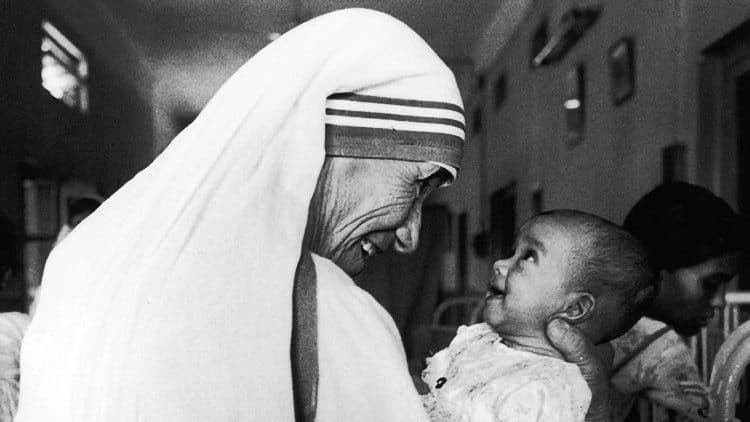

In 1979, upon receiving the Nobel Peace Prize, Mother Teresa of Calcutta stated: “I want to share something with you all. The great destroyer of peace today is the crime of the innocent unborn child. For if a mother can kill her own child in her womb, what can stop you and me from killing one another?”
Since the nun from Calcutta uttered those words, the number of abortions worldwide has been increasing, including in Spain. The door to abortion was opened during Felipe González’s term in office, in 1985. It was justified based on the existence of extreme cases (pregnancy resulting from rape or when the pregnancy poses a serious risk to the mother’s mental health) that, they said, “humanly” cried out for compassion.
The door continued to open, little by little, in abortion clinics thanks to medical reports that were written and signed diagnosing the pregnant woman with psychological distress, without including anyone’s name or having undergone a medical examination. The woman’s name was simply written on these certificates when she was about to have an abortion. This is the testimony of a colleague, a gynecologist, days after she had refused such a proposition. During Zapatero’s term, the time limits for abortion were extended. Currently, 100,000 abortions are performed each year in Spain, while the number of borderline cases that could be explained by the aforementioned “humanitarian” arguments would not exceed about 150 per year.
A few months ago, the Prime Minister expressed his intention to enshrine abortion as a right in the Spanish Constitution , following the example set by France in 2014. Therefore, one wonders, what factors are influencing the Spanish government to continue expanding access to abortion?

The ideology behind what was achieved in France—that is, the inclusion of the right to abortion in the Constitution , a legal model that Spain is attempting to emulate—appears on page 106 of the book, Why I Stopped Being a Freemason , written by Serge Abad-Gallardo, and states the following: “On issues such as abortion, it is rather risky to formulate an opinion contrary to Masonic ‘doxa’.” In short, what Abad-Gallardo explains in his book is that it is not possible to be against abortion within French Freemasonry.
Furthermore, it is known that “in France, many ministers have been Freemasons since 2012, and the Grand Masters of the Grand Orient of France want to change society through laws such as the abortion law” (see Alberto Bárcena’s *Church and Freemasonry *, p. 286). Therefore, it is not surprising that, with Macron as President of the French Republic and a Freemason, they managed to include abortion as a right in the French Constitution in 2025.
If this trend continues in Spain, the right to abortion will eventually be enshrined in the Constitution, and, as a consequence of this measure, doctors will be legally obligated to perform abortions and will be prevented from invoking conscientious objection.
Conscientious objection is recognized in current legislation, and the law provides for the registration of objectors. However, the requirement to create objector lists has recently become a key part of the government’s political agenda. Consequently, these lists could, in practice, become a form of discrimination; therefore, many professionals and various communities oppose this measure.
To give a positive meaning to such lists, another list could be created in the Medical Colleges of Spain, which could be called “the Hippocrates list,” and headed with the Hippocratic formulation that says: “I will not provide any woman with an abortifacient pessary,” because, if doctors were to massively register on this list, it would be the most effective way to remind society that refusing to perform abortions, apart from matters of conscience, derives from the ethical obligation that all members have not to perform abortions according to article 61.1 of the Code of Medical Ethics of Spain.”
And finally, it is worth remembering that Mother Teresa returned to this issue of abortion years later, at the UN General Assembly in 1985, when she said: “I believe that the greatest enemy of peace today is abortion, because it is a war against the innocent child killed by its own mother.” She uttered these words after warning that a society that becomes accustomed to justifying the elimination of the most defenseless being ends up weakening its own moral foundation. The wording may be debated, but the substance of the warning should not be disregarded. A society insensitive to the life of the unborn child can hardly build a genuine culture of peace. As long as abortion continues to be presented as unquestionable progress, it will remain necessary to remember that not everything legal is just, nor is everything socially accepted morally correct.
Ángel Jiménez Lacave. Oncologist

Observatorio de Bioética UCV
El Observatorio de Bioética se encuentra dentro del Instituto Ciencias de la vida de la Universidad Católica de Valencia “San Vicente Mártir” . En el trasfondo de sus publicaciones, se defiende la vida humana desde la fecundación a la muerte natural y la dignidad de la persona, teniendo como objetivo aunar esfuerzos para difundir la cultura de la vida como la define la Evangelium Vitae.
Related
RTbet Promo Codes In Canada: Where To Find Them And How To Apply
Editorial Exaudi
13 April, 2026
8 min

The Silence That Conquers the Noise: Contemplation Every City Dweller Can Experience Today
Miguel Morales Gabriel
10 April, 2026
5 min

The International Olympic Committee prohibits transgender women from competing in the women’s category
Observatorio de Bioética UCV
10 April, 2026
5 min

Abortion: The Catholic Church and the message of the last five Popes
Patricia Jiménez Ramírez
10 April, 2026
3 min