 (EN)
(EN)
 (ES)
(ES)
 (IT)
(IT)

Why is the erection of the monument to King Sobieski in Vienna blocked?
Austrian cancellation culture with an Islamist touch

The Battle of Vienna in 1683, due to its scope as well as its strategic and political significance, is considered one of the most important battles in European history. The victory of the Polish King John III Sobieski over the Sultan’s army halted the Ottoman conquest of Europe and the Islamization of our continent. Today, left-wing Austrian politicians and Islamists are preventing the construction of his monument in Vienna.
In the summer of 1682, Turkey began preparations for war against Austria. On June 29, 1683, a powerful Turkish army set out toward Vienna. In Belgrade, the Sultan handed command of the 110,000-strong army to Grand Vizier Kara Mustafa. The Austrian troops, outnumbered by the Ottoman Turks, were forced to retreat inland. On July 14, the siege of the Austrian capital began. The defending forces numbered around 30,000 men. In this dramatic situation, an Austrian envoy arrived before King John III Sobieski requesting aid. On September 3, the allied forces converged on the Danube, and John III Sobieski assumed command of all Austrian, German, and Polish forces, totaling 67,000 soldiers (including 31,000 cavalry).
On the morning of September 8, 1683, in the chapel on Kahlenberg hill overlooking Vienna, the Italian Capuchin friar Marco d’Aviano celebrated Holy Mass, delivering a fiery sermon. The King of Poland personally served the Mass. At the end, instead of “Ite, missa est,” the monk said: “Vinces Joannes” – you will conquer, John. On September 12, as the allied forces marched against the Turks, Father Marco d’Aviano took up a cross and stood on a hill with the knights. Throughout the day, he ran among them, encouraging them and praying with the words used in exorcisms: “Ecce crux Domini, fugite partes adversae.” The battle lasted about 12 hours and ended with a complete victory for the Christian forces, which not only saved the Austrian capital but also marked the collapse of Ottoman aggression in Europe: King Sobieski saved Christian Europe from Islamic conquest.
The victory in Vienna is also owed to this Italian Capuchin, who after the battle received another important assignment from the Polish king: to deliver to Pope Innocent XI a letter in which John III Sobieski wrote: “Venimus, vidimus et Deus vicit” – “We came, we saw, and God conquered.” The Pope awarded the king the Defensor Fidei medal and, in memory of the victory at Vienna, instituted September 12 as the feast of the Most Holy Name of Mary.
Muslims have never forgotten the Battle of Vienna and the defeat of the Sultan’s forces. When a group of Islamic terrorists decided to declare war on the West by attacking the heart of America, they chose a special day for their attack: September 11, 2001, on the eve of the Battle of Vienna. Al-Qaeda terrorists openly admitted to choosing that day to avenge the greatest defeat suffered by Muslim forces, which prevented the conquest of Europe.
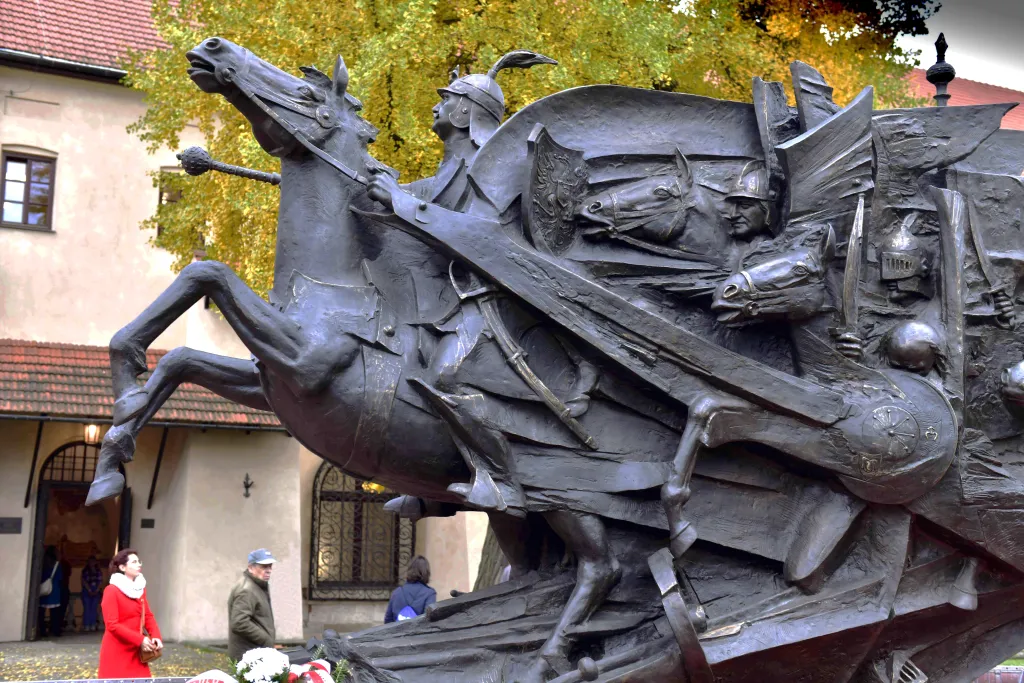
Unfortunately, King John III Sobieski has never been honored with a monument in Vienna, even though without his intervention the Austrian capital would likely have become the largest Muslim city in Europe. For this reason, it was the Poles themselves who recently promoted the donation of a monument to the city’s liberator. It was created by the famous Polish sculptor Czesław Dźwigaj: the sculpture depicts King Sobieski during a charge, with winged hussars visible behind him and the defeated Ottoman army beneath the horses’ hooves. The committee for the construction of the monument was chaired by the project’s initiator, Piotr Zapart, from the historic Brotherhood of Fusiliers of Krakow.
On the occasion of the 330th anniversary of the liberation of Vienna, on September 12, 2013, the first stone of the monument to King Sobieski was laid on Kahlenberg hill, where the Polish troops had camped before the battle. Among those attending the ceremony were the mayor of Krakow, representatives of Vienna’s authorities, and members of the Fusiliers’ Brotherhood.
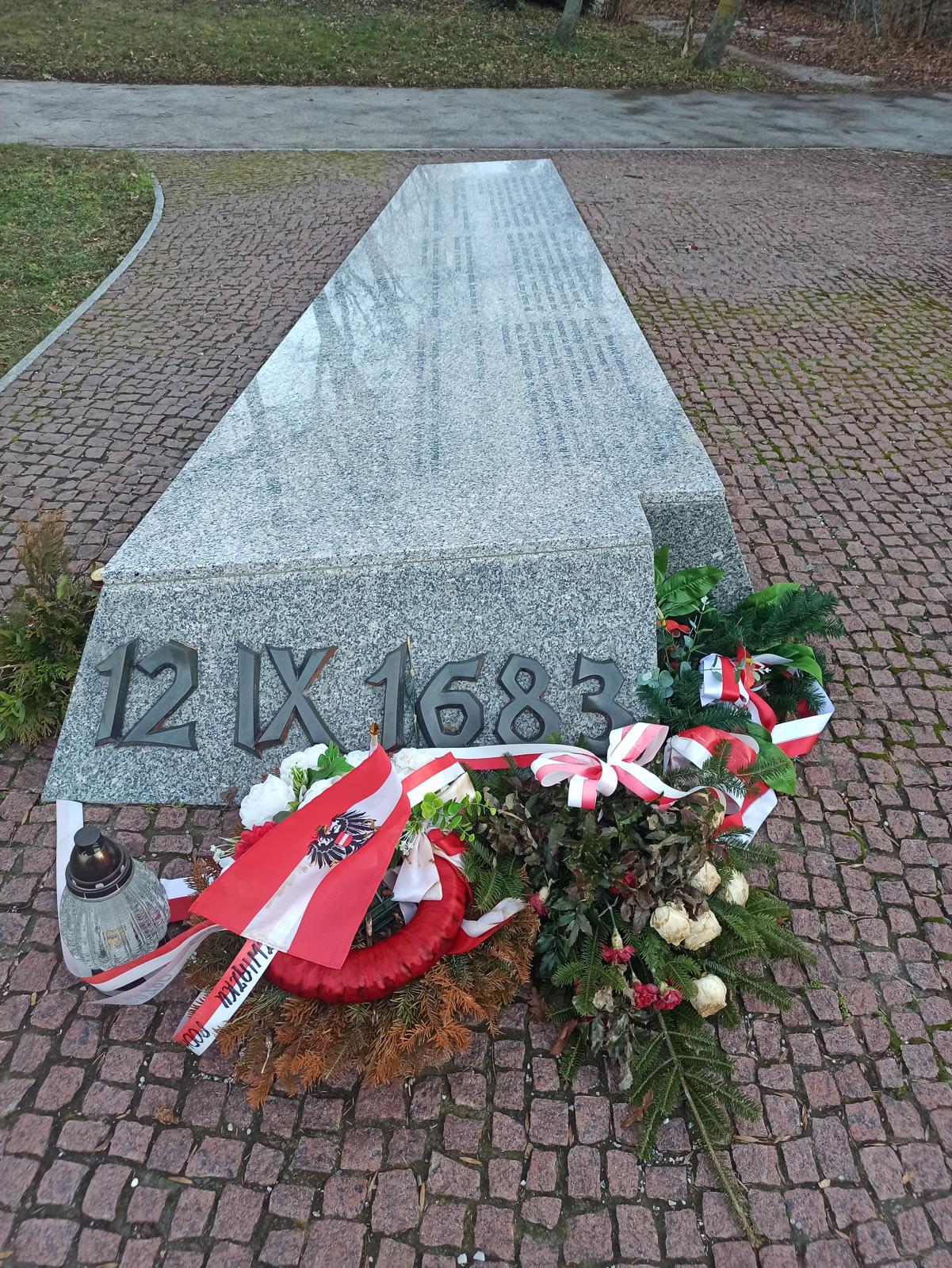
The monument on Kahlenberg was to be inaugurated in 2018, on the 335th anniversary of the Battle of Vienna, more than seven years ago. The pedestal was prepared in 2013 and inscribed with the date of the battle: September 12, 1683. However, the city did not consent to placing the monument, cast in Gliwice (Poland), upon it. Instead of reaching Austria, the monument is being exhibited across Poland starting from Krakow; it is now being transported on a special platform to various locations in the country.
Vienna will not hold a commemoration “that could be used for xenophobic agitation and to fuel Islamophobic and anti-Turkish resentment” – announced Veronica Kaup-Hasler of the Social Democratic Party of Austria (SPÖ), the councillor responsible for culture, in early November 2024. The Austrian newspaper “Der Standard” recalled that a “group of Austro-Polish experts” expressed reservations about the concept of a typical 19th-century “hero monument,” recommending “distancing from any form of heroic monument,” as if in Europe one could no longer praise Christian heroes.
Nevertheless, the promoters of the monument’s construction continued their efforts to erect it. But earlier this year, the Vienna City Council once again rejected the motion to erect a monument to John III Sobieski, with the votes of the Social Democratic councillors. Aslıhan Bozatemur, a Vienna city councillor of Turkish origin and member of the Social Democratic Party (SPÖ), firmly repeated that “there is no place in Vienna for a monument that promotes xenophobia, Islamophobia, or anti-Turkish rhetoric” and that “leads to discrimination or incites hatred.” The Turkish representative’s position was harshly criticized by politicians from the Austrian People’s Party (ÖVP) and the Freedom Party of Austria (FPÖ). “We are in Vienna; the defense against the Turkish siege is part of Vienna’s history. This must be accepted” – declared Caroline Hungerländer (ÖVP) to the newspaper Express, adding that the integration of immigrants means integrating into the country’s history and culture, and that the cancellation of Vienna’s history must not be allowed. The FPÖ parliamentary group leader, Maximilian Krauss, emphasized to the media that “the fact that the SPÖ is seriously trying to label the memory of Vienna’s liberation as ‘xenophobia’ or ‘Islamophobia’ shows how far removed it is from its own history.” “The statements of the SPÖ parliamentarians are practically unprecedented in their historical amnesia and ideological blindness. John III Sobieski was the liberator of Vienna: without his commitment, Vienna as we know it today would not exist in its current form. Dedicating a monument to him is obvious, not an act of ‘discrimination’” – affirmed Maximilian Krauss.
Piotr Zapart, president of the Committee for the Construction of the Monument to King John III Sobieski on Kahlenberg, in an interview with the Polish newspaper “Nasz Dziennik,” said that the Committee, together with the Polish ambassador in Austria, is not giving up and will continue efforts to install the monument in Vienna. “We are constantly working on this issue” – affirmed Zapart, stressing that the installation of the Sobieski monument will only be possible after a change of government in the city, given the opposition of the Social Democratic councillors. “We, as people who care about the erection of this monument in Vienna, will continue to provide updates on the situation, emphasizing that this is not a monument just for Vienna or for Austria, but a monument for Europe” – he added. He also expressed indignation that the current authorities want to call the simple pedestal a monument to King Sobieski. “We cannot accept that. It is hard for us to imagine that the victor of Vienna is treated in this way. The liberation of Vienna is considered one of the most important battles in European history, of great historical significance” – he emphasized, specifying that thanks to Sobieski, Europe preserved its values and identity.
What is happening in the Austrian capital shows a consolidated trend spreading across Europe: an alliance between the left (red-green) and political Islam. The radical left needs votes, and Islamist networks can provide them. Among the left, there are also some radical circles that judge the West as too “Judeo-Christian,” and this plays into the hands of political Islam, which ultimately wants to conquer Europe and for that must combat Christianity. Anyone who dares to denounce this fact, who uses the term “Islamization,” is accused of Islamophobia.
There is also a part of the left, supported by journalists and intellectuals, that considers Muslims the “new working class,” the “new damned of the earth,” and therefore favors Islam in society, irresponsibly going against the very values of Western freedom and secularism.
In this context, it is worth recalling the book by Mario Adinolfi titled “Wokismo e islamismo.” The book’s thesis is that wokism and Islamism, in this particular historical period, have stipulated a kind of Ribbentrop-Molotov pact. On one side, wokism “aims to materialize the suicide of Christian West through three instruments: cancel culture, (trans)gender ideology, and laws against life, starting with abortion and euthanasia.” Islam, on the other hand, which considers itself the only true religion, aims at the birth of the Islamic Umma, that is, a fully Islamized world. Islamism uses all possible weapons to penetrate the West, and the main one is woke culture, which becomes “the perfect Trojan horse to insinuate itself into the cracks of the secularizing Christian West, then using immigration as a determining instrument to place a time bomb in the very heart of the most advanced societies because they are founded on the Bible and not on the Quran.”
The result of the efforts to erect the monument to King Sobieski in Vienna will show whether Austria, and Europe in general, still has the strength to defend its history, its identity, and its values, or whether it has already surrendered to the dictatorship of wokism and Islamism.
Wlodzimierz Redzioch
Wlodzimierz Redzioch è nato a Czestochowa (Polonia), si è laureato in Ingegneria nel Politecnico. Dopo aver continuato gli studi nell’Università di Varsavia, presso l’Istituto degli Studi africani, nel 1980 ha lavorato presso il Centro per i pellegrini polacchi a Roma. Dal 1981 al 2012 ha lavorato presso L’Osservatore romano. Dal 1995 collabora con il settimanale cattolico polacco Niedziela come corrispondente dal Vaticano e dall’Italia. Per la sua attività di vaticanista il 23 settembre 2000 ha ricevuto in Polonia il premio cattolico per il giornalismo «Mater Verbi»; mentre il 14 luglio 2006 Sua Santità Benedetto XVI gli ha conferito il titolo di commendatore dell’Ordine di San Silvestro papa. Autore prolifico, ha scritto diversi volumi sul Vaticano e guide ai due principali santuari mariani: Lourdes e Fatima. Promotore in Polonia del pellegrinaggio a Santiago de Compostela. In occasione della canonizzazione di Giovanni Paolo II ha pubblicato il libro “Accanto a Giovanni Paolo II. Gli amici e i collaboratori raccontano” (Edizioni Ares, Milano 2014), con 22 interviste, compresa la testimonianza d’eccezione di Papa emerito Benedetto XVI. Nel 2024, per commemorare il 40mo anniversario dell’assassinio di don Jerzy Popiełuszko, ha pubblicato la sua biografia “Jerzy Popiełuszko. Martire del comunismo” (Edizioni Ares Milano 2024).
Related
What more could I have done for you?
Monseñor Gilberto Gómez González
02 April, 2026
3 min
Poland: President Nawrocki Under Attack
Wlodzimierz Redzioch
02 April, 2026
5 min
Cardinal Pizzaballa and the Custos of the Holy Land prevented from entering the Holy Sepulchre to celebrate Palm Sunday Mass
Exaudi Staff
30 March, 2026
2 min
Reflection by Bishop Enrique Díaz: Blessed is he who comes in the name of the Lord
Enrique Díaz
29 March, 2026
5 min