 (EN)
(EN)
 (ES)
(ES)
 (IT)
(IT)

When Heaven Bends to Embrace Human Suffering
Rogier van der Weyden's Descent from the Cross: A Flemish Masterpiece Inviting Catholic Christians to Contemplate the Mystery of the Cross, Mary's Compassion, and the Redemption That Springes from Suffering
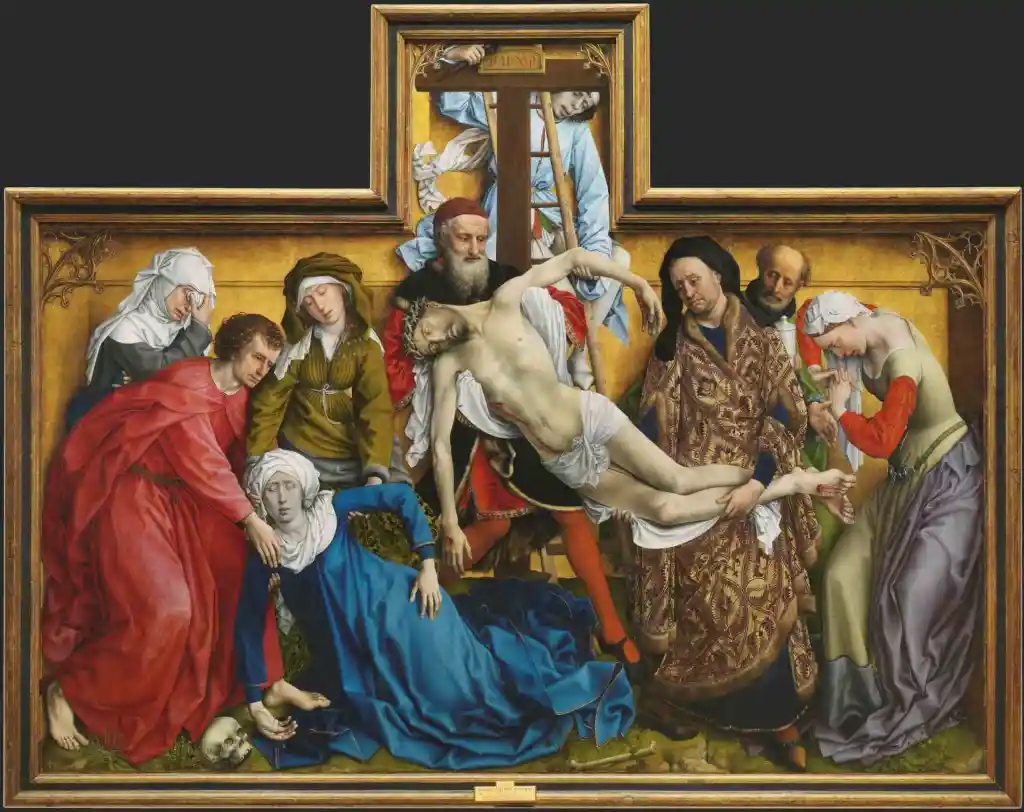

In the galleries of the Prado Museum , before a large oil painting on panel, over two meters high and almost three meters wide, the visitor inevitably pauses. It is not just a painting: it is a living altarpiece, a gilded stage where the drama of salvation is depicted with breathtaking intensity. The Descent from the Cross (before 1443), by Rogier van der Weyden , is not a distant image from the medieval past; it is an eternal invitation to enter into the very heart of the Paschal Mystery. For the Catholic believer, this work not only dazzles with its technical mastery, but becomes a true visual lectio divina , a path of contemplation that unites art with faith, beauty with salvific truth.
The historical and devotional context
Rogier van der Weyden (1399-1464), born Roger de le Pasture in Tournai and based in Brussels, was one of the great masters of Early Flemish painting. Probably trained in the workshop of Robert Campin (the Master of Flémalle), he developed a style that combined the meticulous realism of oil painting—a revolutionary technique at the time—with unprecedented emotional expressiveness. This work, commissioned by the Guild of Crossbowmen of Leuven for their chapel of Our Lady Outside the Walls, reflects the piety of the Devotio Moderna , a spiritual movement that invited the faithful to personally identify with the sufferings of Christ and Mary, as proposed by Thomas à Kempis’s Imitation of Christ .
The panel’s format—with its added upper section and the figures arranged in a kind of gilded box with Gothic tracery at the corners—deliberately evokes a polychrome sculpted altarpiece, as if van der Weyden wanted his figures to “step out” of the frame toward the viewer. In the foreground, a skull and a femur serve as a reminder that Golgotha is also the place where, according to tradition, Adam was buried: the New Adam (Christ) redeems in the same spot where the first fell. This detail is not anecdotal; it is painted theology.
A composition that captures the soul
The scene captures the precise moment when Jesus’ lifeless body is taken down from the cross. Ten nearly life-size figures are crammed into a confined space, as if the drama could not be contained. In the center, Christ’s body forms a languid, broken curve, tenderly cradled by Joseph of Arimathea (above) and Nicodemus (below). His thin, angular arms still retain the rigidity of the cross, while his grayish skin contrasts dramatically with the deathly white of the Virgin Mary, who swoons on the left, supported by Saint John the Evangelist.
This parallel between mother and child is one of van der Weyden’s most profound discoveries. Mary’s posture echoes that of Christ: both share the burden of redemption. The Virgin, dressed in blue—a symbol of her transcendence—not only suffers as a mother; she actively participates in the work of salvation. Medieval theologians, such as Dionysius the Carthusian, affirmed that Mary was on the verge of death at that moment; van der Weyden makes it visible. Her tears—painted with a microscopic precision that reveals the oil paint in all its splendor—are not generic tears: they are real, crystalline tears, sliding down a face disfigured by grief. No one before had painted weeping with such emotional force.
On the right, Mary Magdalene, kneeling, wrings her hands in a gesture of restrained despair. Other holy women complete the group, each with a distinct expression of grief: the variety of gestures and faces, dressed in contemporary clothing, makes the viewer feel they are looking at real people, not archetypes. The gold background and Gothic tracery frame the scene like a sanctuary, reminding us that this is not mere history, but a visual sacrament.
The diagonal composition—which pierces the work like a ray of light—guides the eye from the body of Christ to the skull of Adam and then to the Virgin, creating an “X” that evokes the cross itself: the intersection between human sin and divine grace. Everything converges on a message of compassio (compassion) and co-redemptio (co-redemption).
Art as theology: Beauty that saves
The Descent from the Cross transcends the aesthetic and delves into the transcendent. Van der Weyden not only depicts a Gospel episode (Jn 19:38-42); he interprets it in the light of faith. Joseph of Arimathea and Nicodemus, wealthy and discreet disciples, symbolize how grace can touch even the powerful. The presence of Mary as the Stabat Mater Dolorosa reminds us of her unique role in the economy of salvation: “Standing near the cross of Jesus were his mother” (Jn 19:25). Her fainting is not weakness, but the culmination of maternal love united to the sacrifice of her Son.
This work invites us to imitate Christ and Mary . Contemplating it, the believer can pray the Stations of the Cross or the Rosary with renewed eyes. Each tear of Mary speaks to us of God’s closeness to human suffering; each tender gesture with which they hold the body of Christ teaches us that the Church—a community of disciples—is called to welcome, console, and lovingly bury the sorrows of the world.
Flemish realism here is not cold: it is warm, human, embodied. Oil paint allows for glazes and overlays that bring life to the flesh, the fabrics, the tears. Van der Weyden achieves what few can: making pain beautiful without sacrificing it. Beauty redeems because it lifts us to Him who “for us men and for our salvation” came down from heaven and ascended the cross.
A legacy that endures in faith
From its time in the collection of Mary of Hungary, the Palace of Binche, El Pardo, and finally El Escorial—where Philip II, a great devotee and collector, placed it in a place of honor—this painting has been venerated on Spanish soil. Today, in the Prado Museum, it continues to speak to generations of Catholics. Copies such as Michiel Coxcie’s testify to its immediate impact. And its influence reaches to this day: artists, theologians, and the faithful continue to find in it an inexhaustible source of meditation.
In a world that often avoids suffering or reduces it to spectacle, the Descent from the Cross reminds us that the cross is not the end, but the throne from which Christ reigns. The lowered body anticipates the Risen One. Mary’s sorrow prefigures the joy of the Assumption. Adam’s skull announces the victory over death.
Anyone who pauses before this work will not leave unchanged. They may feel, perhaps, that Mary’s tears wash away their own; that the arms that hold Christ are ready to hold us. For in van der Weyden’s art, as in the Catholic faith, beauty is not decorative: it is sacramental. It allows us to touch the invisible. It draws us closer to the pierced Heart of Jesus and the Immaculate Heart of Mary.
To contemplate the Descent from the Cross is, ultimately, to participate in the eternal liturgy: to descend with Christ into the tomb in order to rise with Him. An experience that, beyond room 058 of the Prado Museum, can be transformed into daily prayer, comfort in sorrow, and hope in the face of each day’s cross.
A work that not only makes you want to look at it, but invites you to live it: because whoever looks at the Cross with faith, discovers that it looks at us first with infinite love.

Sonia Clara del Campo
Sonia Clara del Campo es historiadora del arte y teóloga. Se ha dedicado al estudio de la belleza como vía privilegiada de encuentro con Dios. Apasionada de la música sacra y el arte religioso, escribe desde la convicción de que la Iglesia ha sido la mayor protectora y promotora de las artes en la historia de la humanidad, y que hoy más que nunca necesitamos redescubrir ese tesoro espiritual y cultural.
Related
The Silence That Conquers the Noise: Contemplation Every City Dweller Can Experience Today
Miguel Morales Gabriel
10 April, 2026
5 min

The International Olympic Committee prohibits transgender women from competing in the women’s category
Observatorio de Bioética UCV
10 April, 2026
5 min
Abortion: The Catholic Church and the message of the last five Popes
Patricia Jiménez Ramírez
10 April, 2026
3 min
Saint Thomas More: A Non-Negotiable Conscience
Javier Ferrer García
08 April, 2026
4 min