 (EN)
(EN)
 (ES)
(ES)
 (IT)
(IT)

Way of the Cross: Make good use of the power that has been given to you and do not forget that whatever you do to one human being, you do to me
Good Friday, Passion of the Lord
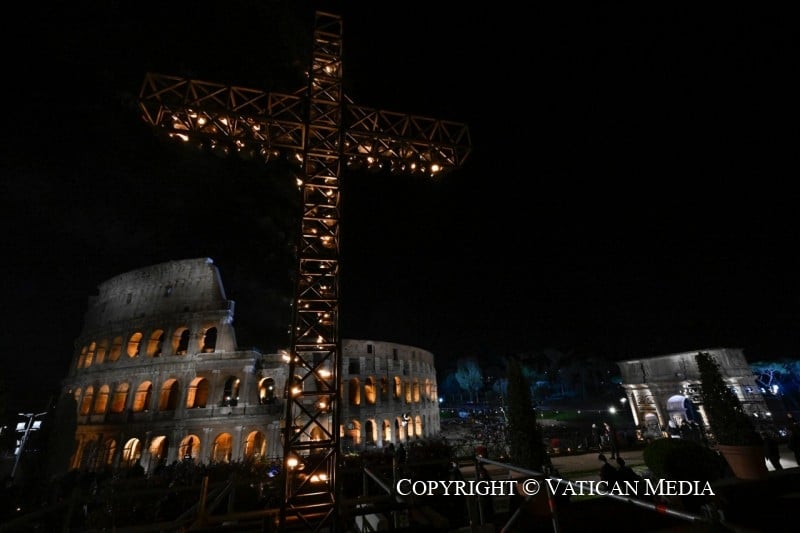

The Franciscan friar’s Stations of the Cross is a reflection on the contemporary world. In his meditations for the traditional Good Friday service at the Colosseum, he reflects on the power wielded by men: just as in Jesus’ time, some today believe they have received unlimited authority and think they can use and abuse it as they please, deciding, for example, to start a war.
***
The Via Dolorosa unfolds through the narrow streets of the Old City of Jerusalem and takes us along the path of Jesus from the place of his condemnation to that of his crucifixion and burial, which is also the place of his resurrection.
It’s not a walk through a crowd of devout, silent people. As in Jesus’ time, we find ourselves walking in a chaotic, chaotic, and noisy environment, among people who share faith in Him, but also among others who mock and insult. That’s everyday life.
The Way of the Cross is not the path of one who lives in an aseptically devout world of abstract contemplation, but the exercise of one who knows that faith, hope, and charity must be embodied in the real world, where the believer is continually challenged and must constantly make Jesus’ way his own.
Saint Francis of Assisi, whose eighth centenary of death we celebrate this year, describes our Christian life with the words of the Apostle Peter, reminding us that “our Lord Jesus Christ, whose footsteps we must follow, called his betrayer ‘friend’ and offered himself willingly to those who crucified him” ( Non-Bulled Rule XXII, 2: FF 56; cf. 1 Pet 2:21). The Little Poor Man exhorts us to fix our gaze on Jesus: “Let all of us brothers look to the Good Shepherd, who endured the passion of the cross to save his sheep” ( Admonitions VI: FF 155).
As we walk this Way of the Cross, let us accept St. Francis’ invitation to follow in the footsteps of Jesus, a journey that is not merely ritualistic or intellectual, but one that engages our whole person and our whole life: “Offer your bodies and carry his holy cross, and follow his most holy precepts to the end” ( Office of the Passion of the Lord XV,13: FF 303).
First Station:
Jesus is condemned to death
From the Gospel according to John (19:9-11)
Pilate went back inside the Praetorium and asked Jesus, “Where are you from?” But Jesus gave him no answer. Pilate said to him, “Do you refuse to speak to me? Don’t you realize I have power either to free you or to crucify you?” Jesus answered, “You would have no power over me if it were not given to you from above. Therefore, the one who handed me over to you is guilty of a greater sin.”
From the writings of Saint Francis of Assisi ( Letter to the Faithful II, 28-29: FF 191)
Those who have been given the authority to judge others should exercise mercy, just as they themselves desire mercy from the Lord. For judgment without mercy will be shown to those who have not been merciful.
In your conversation with Pilate, Lord Jesus, you expose all human presumption of power. Even today, some believe they have received unlimited authority and think they can use and abuse it as they please. Your words to the Roman governor leave no room for ambiguity: “You would have no authority over me if it were not given to you from above” ( John 19:11).
Francis of Assisi, who simply tried to follow in your footsteps, reminds us that all authority must answer to God for the way in which it exercises the power it has received: the power to judge, but also the power to start a war or to end it; the power to educate for violence or for peace; the power to fuel the desire for revenge or for reconciliation; the power to use the economy to oppress peoples or to free them from misery; the power to trample on human dignity or to protect it; the power to promote and defend life or to reject and suppress it.
Each of us is also called to account for the power we wield in our daily lives. You, Jesus, tell him: make good use of the power you have been given, and do not forget that whatever you do to a human being, especially if they are small and vulnerable, you do to me; and it is to me that you will one day have to answer for it.
Let us pray, saying: Remind me, Jesus.
| That you identify with every person judged: | Remind me, Jesus. |
| That I must not let myself be guided by prejudices: | Remind me, Jesus. |
| That true power lies in love: | Remind me, Jesus. |
| That mercy triumphs over judgment: | Remind me, Jesus. |
| That I must choose good, even if it is difficult: | Remind me, Jesus. |
Second Station:
Jesus Carries the Cross
From the Gospel according to John (19:14-17)
It was the day of Preparation of the Passover, about noon. Pilate said to the Jews, “Here is your king!” They shouted, “Away with him! Away with him! Crucify him!” Pilate said to them, “Shall I crucify your king?” The chief priests answered, “We have no king but Caesar.” Then Pilate handed him over to them to be crucified, and they took him away. Carrying his own cross, Jesus went out of the city to the place called the Skull, which in Hebrew is called Golgotha.
From the writings of Saint Francis of Assisi ( Admonitions V, 7-8: FF 154)
Even if you were the most handsome and richest of all, and even if you performed such miracles that you put demons to flight, all of that is detrimental to you, and none of it belongs to you, and you can boast of none of it. In this we can glory: in our illnesses and in bearing daily the holy cross of our Lord Jesus Christ.
The word “cross” evokes in us a reaction of rejection, rather than desire. It is easier for the temptation to flee from it to arise within us than the longing to embrace it.
Jesus, I’m sure it was the same when they placed the cross on your shoulders. In fact, in Gethsemane you had asked the Father to take that cup from you, even though you wanted with all your being to do his will. The cross was the most terrible and painful torment, reserved for slaves, irredeemable criminals, and those cursed by God.
And yet, you embraced it and carried it on your shoulders, and then you let yourself be carried by it. Not because it was beautiful or alluring, but out of love for us. Lifting its heavy burden, you knew you were taking away from us the weight of the evil that crushes us and bearing the sin that ruins our existence. Embracing the cross and carrying it on your shoulders, you embraced our fragility and took on our humanity. You bore our enslavements, our crimes, and even our curse.
Deliver us, Jesus, from the fear of the cross. Grant us the grace to follow you on your own path and to have no other glory than that of your cross.
Let us pray, saying: Deliver us, Lord.
| From the desire for human glory: | Deliver us, Lord. |
| From the temptation to ignore those who suffer: | Deliver us, Lord. |
| From worrying only about ourselves: | Deliver us, Lord. |
| From the fear of committing to fidelity: | Deliver us, Lord. |
| From fear and rejection of the cross: | Deliver us, Lord. |
Station III:
Jesus falls for the first time
From the Gospel according to John (12:24-25)
I assure you that unless a grain of wheat falls into the earth and dies, it remains alone; but if it dies, it bears much fruit. Whoever loves their life will lose it, and whoever hates their life in this world will keep it for eternal life.
From the writings of Saint Francis of Assisi ( Admonitions XXII, 3: FF 172)
Blessed is the servant who is not in a hurry to excuse himself and humbly endures the shame and rebuke for a sin he did not commit.
Your existence, Jesus, was a continuous humbling and descent. Even though you were God, you emptied yourself to become man. From being rich, you became poor. And at the end of your mission, while carrying on your shoulders the weight of all humanity, you fell upon the hard stones of the Via Dolorosa, the path that those condemned to death walked before the people of Jerusalem, who came there as if it were a spectacle.
It is a prelude to an even deeper humiliation: the descent into hell, the fall into the mystery of death, where we all fall at the end of this earthly life. But yours is the fall to earth of the grain of wheat, which is willing to die in order to bear fruit.
Help us also to choose to be below, at the feet of others, rather than seeking to be above and dominate them. Help us to learn the path of humility even through the experience of our falls and humiliations, and to know how to peacefully endure the offenses and injustices we suffer.
Let us feel you near, especially when we fall, so near that we realize it is you who lifts us up and sets us back on the path. And let us also learn to trust in the earth, like the grain of wheat, knowing that death, thanks to you, is the cradle of eternal life.
Let us pray, saying: Lift us up, Jesus.
| When we fall because of our fragility: | Lift us up, Jesus. |
| When we fall because someone trips us up: | Lift us up, Jesus. |
| When we fall because of wrong decisions: | Lift us up, Jesus. |
| When we fall into despair: | Lift us up, Jesus. |
| When we fall into the mystery of death: | Lift us up, Jesus. |
Fourth Station:
Jesus meets his Mother
From the Gospel according to John (19:25-27)
Standing near the cross of Jesus were his mother, his mother’s sister, Mary the wife of Clopas, and Mary Magdalene. When Jesus saw his mother there, and the disciple whom he loved standing nearby, he said to his mother, “Woman, here is your son.” Then he said to the disciple, “Here is your mother.” And from that time on, this disciple took her into his home.
From the writings of Saint Francis of Assisi ( Rule bullada VI, 8: FF 91)
Let them confidently express their needs to one another, for if a mother cares for and loves her fleshly child, how much more lovingly should each one love and care for his spiritual brother?
It is normal for a mother to be present at the beginning of our existence. It is not normal for a mother to be by our side when it is time to die, because that means life has been taken from us: by illness, by an accident, by violence, by despair. Mary, the woman from whom you, Jesus, were conceived, was also by your side on your way to Calvary and is with you at the foot of the cross.
You ask her to continue bearing fruit and to remain the mother of the beloved disciple, of each one of us, of the Church, of this new humanity being born precisely at the hour when you give your life and die. In the most solemn hour of your mission, before bringing everything to completion, you ask her first and foremost to welcome each one of us; and then you ask us to receive her. For the Mother always goes before. At the wedding at Cana, she had even gone before you.
O Mary, cast a tender gaze upon each of us, but above all upon the countless mothers who, even today, like you, see their own children arrested, tortured, condemned, and murdered. Look with tenderness upon the mothers who are awakened in the middle of the night by heartbreaking news, and upon those who keep vigil in hospitals over a child whose life is fading away. And grant us a mother’s heart, to understand and share the suffering of others, and to learn, in this way as well, what it means to love.
Let us pray saying: Comfort, O Mother.
| To the mothers who have lost their children: | Comfort, O Mother. |
| To orphans, especially those orphaned by wars: | Comfort, O Mother. |
| To migrants, displaced persons and refugees: | Comfort, O Mother. |
| To those who suffer torture and unjust punishment: | Comfort, O Mother. |
| To the desperate who have lost the meaning of life: | Comfort, O Mother. |
| To those who die alone: | Comfort, O Mother. |
Fifth Station:
Jesus is helped by Simon of Cyrene to carry the cross
From the Gospel according to Saint Mark (15:21)
As Simon of Cyrene, the father of Alexander and Rufus, was passing by on his way in from the country, they forced him to carry Jesus’ cross.
From the writings of Saint Francis of Assisi ( Admonitions XVIII,1: FF 167)
Blessed is the man who bears with his neighbor in his weakness, as he would wish to be borne with if he were in a similar situation.
Simon of Cyrene was not a volunteer. He didn’t take you on willingly, Jesus, offering you a hand to carry the cross. He probably barely knew who you were. Yet, by helping you carry the cross, something within him changed, to the point that he would pass on to his sons, Alexander and Rufus, the profound meaning of that journey alongside you, and they would become witnesses of your Passover in the first Christian community.
Today, there are also many people who choose to do good for others all over the world. There are thousands of volunteers who, in extreme situations, risk their lives to help those in need of food, education, medical care, and justice. Many of them don’t even believe in you; yet—without realizing it—they continue to help you carry your cross, and while they take care of other real people, they are, in reality, taking care of you once again.
O Lord, grant that we too may learn to offer our neighbor the support we would wish to receive if we were in the same situation. Help us to be empathetic and compassionate, not with words but with deeds and in truth.
Let us pray, saying: Make us attentive, Lord.
| To the people we met: | Make us attentive, Lord. |
| To the poor, to those who suffer, to the discarded: | Make us attentive, Lord. |
| To those who are alone and helpless: | Make us attentive, Lord. |
| To those who are left behind and fall: | Make us attentive, Lord. |
| To those who have no one to listen to them: | Make us attentive, Lord. |
Sixth Station:
Veronica wipes the face of Jesus
From the Gospel according to John (12:20-21)
Among those who had gone up to worship during the festival were some Greeks who approached Philip, from Bethsaida in Galilee, and said to him, “Sir, we wish to see Jesus.”
From the writings of Saint Francis of Assisi ( Exposition of the Lord’s Prayer 4: FF 269)
Thy kingdom come: that thou mayest reign in us by grace and bring us to thy kingdom, where the vision of thyself is manifest, the love of thyself perfect, the company of thyself blessed, the enjoyment of thyself everlasting.
What the Psalms had sung as “the most handsome of men” ( Ps 45:3), now has the features of the suffering Servant prophesied by Isaiah, “without form or beauty that we should look at him, without appearance that we should desire him” ( Is 53:2).
Veronica preserves your image, Jesus. She was able to obtain it thanks to that act of charity: wiping your face covered in blood and dust. Veronica does not transmit to us the memory of a posed image, but that of the Man of Sorrows, who healed us through his very wounds.
Help us, Jesus, to cultivate the desire to see your face. Grant us the grace you bestowed upon the apostles to see you luminous and transfigured. But above all, help us to have the attentive gaze of Veronica, who recognized you even in your disfigured beauty. And make us capable of wiping your face today, still covered with dust and blood, disfigured by every act that tramples upon the dignity of any human person.
Let us pray, saying: Help us to recognize you, Jesus.
| When your face is disfigured: | Help us to recognize you, Jesus. |
| In every person condemned by prejudice: | Help us to recognize you, Jesus. |
| In the poor deprived of their dignity: | Help us to recognize you, Jesus. |
| In women who are victims of trafficking and reduced to slavery: | Help us to recognize you, Jesus. |
| For children whose childhood has been stolen and whose future has been damaged: | Help us to recognize you, Jesus. |
Seventh Station:
Jesus falls a second time
From the Gospel according to John (13:3-5)
Knowing that the Father had given all things into his hands, and that he had come from God and was going back to God, Jesus rose from the table, took off his outer garment, and tied a towel around his waist. Then he poured water into a basin and began to wash the disciples’ feet and to dry them with the towel that was wrapped around his waist.
From the writings of Saint Francis of Assisi ( Rule not bullated V, 13-14: FF 20)
Let no brother do evil or speak evil to another; but, by the charity of the spirit, serve and obey one another willingly.
Your whole life, Jesus, has been a constant humbling and self-abasement. When you washed the feet of your disciples at the Last Supper, you left an example, a teaching, and a prophecy: the example of service, the teaching of brotherly love, and the prophecy of giving your life. Francis of Assisi was so deeply impressed by your self-abasement that he wanted to advise us to wash one another’s feet, that is, to always be ready to serve our brothers and sisters. And he wanted this very Gospel reading to be read to him on the evening of October 3rd, eight centuries ago, shortly before his death.
In your loving us to the extreme, even to the point of giving your life for us, the prophecy of your resurrection is already contained, because such a great love is stronger than death. Such a great love reveals the ultimate meaning of loving: to lead us to the very life of God.
When you fall, Jesus, you do so to lift us up from our falls. When you fall, you do so to lift up those who remain on the ground crushed by injustice, by lies, by all forms of exploitation and all kinds of violence, by the misery produced by an economy geared toward individual profit rather than the common good. When you fall, you do so to lift me up as well.
Let us pray, saying: Lift us up, Lord.
| When our mistakes crush us: | Lift us up, Lord. |
| When the weight of responsibility oppresses us: | Lift us up, Lord. |
| When we fall into depression: | Lift us up, Lord. |
| When we fail in our decisions: | Lift us up, Lord. |
| When we are swept away by an addiction: | Lift us up, Lord. |
Eighth Station:
Jesus meets the women of Jerusalem
From the Gospel according to Saint Luke (23:27-31)
A large crowd of people followed him, including many women who beat their breasts and wailed for him. But Jesus turned to them and said, “Daughters of Jerusalem, do not weep for me; weep for yourselves and for your children. For the time is coming when they will say, ‘Blessed are the barren, the wombs that never bore and the breasts that never nursed!’ Then they will say to the mountains, ‘Fall on us!’ and to the hills, ‘Cover us!’ For if people do these things when the wood is green, what will happen when it is dry?”
From the writings of Saint Francis of Assisi ( Exposition of the Lord’s Prayer 5: FF 270)
Thy will be done on earth as it is in heaven: that we may love you with all our heart, always thinking of you; with all our soul, always desiring you; with all our mind, directing all our intentions to you, seeking your honor in all things; and with all our strength, spending all our strength and the senses of soul and body in the service of your love and nothing else; and that we may love our neighbor as ourselves, drawing everyone to your love according to our strength, rejoicing in the good of others as in our own, and having compassion on them in their misfortunes, and giving no one any occasion of stumbling.
Jesus, women have always followed and helped you, from the very beginning of your ministry. They continue to do so now, remaining even at the foot of the cross. Wherever there is suffering or need, there are women: in hospitals and nursing homes, in therapeutic and shelter communities, in orphanages with the most vulnerable children, in the most remote mission areas to open schools and health centers, and in war zones and conflict areas to tend to the wounded and comfort the survivors. Women took you seriously, and they took your harsh words to heart. For centuries they have wept for themselves and their children: arrested and imprisoned during demonstrations, deported by heartless policies, shipwrecked on desperate journeys of hope, annihilated in war zones, and killed in extermination camps.
The women continue to weep. Grant us, Lord, a compassionate heart, a maternal heart, and the capacity to feel the suffering of others as our own. Continue to grant us tears, Lord, so that we may not lose our conscience in the darkness of indifference, so that we may continue to be human.
Let us pray, saying: Grant us tears, Lord.
| To mourn the disasters of war: | Grant us tears, Lord. |
| To mourn the massacres and genocides: | Grant us tears, Lord. |
| To cry with mothers and wives: | Grant us tears, Lord. |
| To weep at the cynicism of the arrogant: | Grant us tears, Lord. |
| To weep for our indifference: | Grant us tears, Lord. |
Station IX
Jesus falls for the third time
From the Gospel according to John (14:6-7)
Jesus answered [Thomas]: “I am the way, the truth, and the life. No one comes to the Father except through me. If you really know me, you will know my Father as well. From now on, you do know him and have seen him.”
From the writings of Saint Francis of Assisi ( Nonbullated Rule XXIII, 3: FF 64)
We give thanks to you because, just as you created us through your Son, so, through your holy love with which you loved us, you made him, true God and true man, be born of the glorious ever-Virgin, the most blessed Saint Mary, and you willed that we, captives, should be redeemed by his cross, blood, and death.
You who were born “on the way for us” (St. Francis, Office of the Passion of the Lord XV,7: FF 303), now, for the third time, you fall on the sorrowful way that leads you to Calvary.
Your threefold fall reminds us that there is no fall in which you are not by our side. Yes, because you are with us in each of our weaknesses, and you can and want to lift us up from each of our falls, because you want each of us to reach the Father with you and find life, true life, eternal life, which nothing and no one can take from us.
On the path, following in your footsteps, it doesn’t matter how many times we fall, what matters is that You are by our side and are willing to lift us up once again, countless times, because Your love, Your forgiveness, and Your mercy are infinitely greater than our fragility.
Sustain us in our unbelief and give us the grace to believe that you can lift us up.
Let us pray, saying: Use us, Jesus.
| To lift up all who fall: | Use us, Jesus. |
| To lift up those who remain fallen: | Use us, Jesus. |
| To lift up the most vulnerable people: | Use us, Jesus. |
| To lift up those we think “deserved it”: | Use us, Jesus. |
| To lift up those who seem beyond recovery: | Use us, Jesus. |
Station X:
Jesus is stripped of his garments
From the Gospel according to Saint John (19:23-24)
After the soldiers crucified Jesus, they took his clothes and divided them into four parts, one for each of them. They also took his tunic, which was seamless, woven in one piece from top to bottom. So they said to one another, “Let’s not tear it, but cast lots for it to see who gets it.” This fulfilled the Scripture that says, “They divided my garments among them and cast lots for my clothing.” This is what the soldiers did.
From the writings of Saint Francis of Assisi ( Letter to the whole Order , 28-29: FF 221)
Brothers and sisters, behold the humility of God and pour out your hearts to him; humble yourselves also, so that you may be exalted by him. Therefore, hold nothing back from yourselves, so that he who offers himself entirely to you may receive you completely.
You yourself, Jesus, had decided to strip yourself of divine glory in order to clothe yourself in “the true flesh of our humanity and frailty” (St. Francis, Letter to the Faithful II,4: FF 181). And now they tear off your garments, in the cruel attempt to humiliate you and strip you also of your human dignity.
It is an attempt that is continually repeated in our time. Authoritarian regimes do it when they force prisoners to remain half-naked in an empty cell or courtyard. Torturers do it, not only removing clothing but also tearing away skin and flesh. Those who authorize and use forms of inspection and control that disregard human dignity do it. Rapists and abusers treat their victims as objects. The entertainment industry does it when it flaunts nudity to gain more viewers. The media does it when it exploits people in the eyes of the public. And sometimes we do it too, with our curiosity that respects neither modesty, nor intimacy, nor the privacy of others.
Remind us, Lord, that when we fail to recognize the dignity of others, we obscure our own, and every time we approve of or behave inhumanely towards any person, we ourselves become less human.
Let us pray, saying: Clothe us, Jesus.
| From your infinite humility: | Clothe us, Jesus. |
| Respect for every human being: | Clothe us, Jesus. |
| From the feeling of compassion: | Clothe us, Jesus. |
| From a renewed sense of modesty: | Clothe us, Jesus. |
| From the strength to defend the dignity of every person: | Clothe us, Jesus. |
11th Station:
Jesus is nailed to the cross
From the Gospel according to John (19:17-19)
Jesus, carrying his own cross, went out of the city to the place called “The Skull,” which in Hebrew is called “Golgotha.” There they crucified him, and with him two others, one on either side, and Jesus in the middle. Pilate wrote an inscription that read: “Jesus of Nazareth, King of the Jews,” and had it placed on the cross.
From the writings of St. Francis of Assisi ( Canticle of the Creatures 23-26: FF 263)
Praised be You, my Lord, / for those who forgive for Your love, / and suffer sickness and tribulation. / Blessed are those who bear them in peace, / for by You, Most High, they will be crowned.
Nailed to the cross like a criminal, yet bearing a title that reveals your kingship, O Jesus, you show us what true power is. It is not the power of one who believes they can dispose of the lives of others by causing death, but the power of one who can truly conquer death by giving life, and who can give life even by accepting death. You reveal that true power is not that of one who uses force and violence to impose themselves, but that of one who is capable of bearing the evil of humanity—ours, mine—and nullifying it with the power of love manifested in forgiveness. You are King and you reign from the cross; you do not use the apparent power of armies, but the apparent powerlessness of love, which allows itself to be nailed to it. You are King, and your cross becomes the axis around which history and the entire universe revolve, so that we may not fall into the hell of the inability to love.
You, crucified King, remind us that, if we want to share in your kingship, we too must learn to forgive out of love for you and face life’s difficulties in peace, because what triumphs is not love by force, but the strength of love.
Let us pray, saying: Teach us to love.
| When we suffer an injustice: | Teach us to love. |
| When we desire revenge: | Teach us to love. |
| When we are tempted by violence: | Teach us to love. |
| When we consider forgiveness impossible: | Teach us to love. |
| When we feel crucified: | Teach us to love. |
12th Station:
Jesus Dies on the Cross
From the Gospel according to Saint John (19:28-30)
Then, knowing that everything was now finished, and so that Scripture would be fulfilled, Jesus said, “I am thirsty.” A jar full of sour wine was standing there, so they soaked a sponge in it, put the sponge on a stalk of hyssop, and held it to his mouth. When Jesus had received the wine, he said, “It is finished.” With that, he bowed his head and gave up his spirit.
From the writings of Saint Francis of Assisi ( Letter to the Faithful II, 11-13: FF 184)
And it was the Father’s will that his blessed and glorious Son, whom he gave us and who was born for us, should offer himself by his own blood as a sacrifice and host on the altar of the cross; not for himself, through whom all things were made, but for our sins, leaving us an example, so that we may follow in his footsteps.
“It is finished.” This does not mean that everything is over, but rather that the reason you, Jesus, became one of us has reached its fulfillment; you have accomplished the mission the Father entrusted to you, and now you can return to Him and take us with you.
From now on we know that by letting ourselves be drawn to you, by lifting our gaze to you, we find ourselves before the One who reconciles us, who cancels our “debt,” who leads us into the Sanctuary that is the very life of God. We find ourselves before the One who, by fulfilling the purpose of the Incarnation, gives us the possibility of realizing the profound meaning of our own lives: to be children of God, to be God’s masterpiece.
Help us, Lord, to welcome the gift of the Holy Spirit that you poured out upon us at the hour of your death on the cross, and grant that with you we too may pass from this world to the Father.
Let us pray, saying: Give us your Spirit, Lord.
| So that we may become new creatures and live in God: | Give us your Spirit, Lord. |
| So that we can experience that our debt is cancelled: | Give us your Spirit, Lord. |
| So that we can pray “ Abba , Father”: | Give us your Spirit, Lord. |
| So that we may welcome each person as brother and sister: | Give us your Spirit, Lord. |
| So that we may discover the ultimate meaning of life: | Give us your Spirit, Lord. |
13th Station:
Jesus is taken down from the cross
From the Gospel according to Saint John (19:38-39)
After this, Joseph of Arimathea, who was a disciple of Jesus—but secretly, for fear of the Jews—asked Pilate for permission to take away Jesus’ body. Pilate granted it, and he went and took it away. Nicodemus, who had previously visited Jesus at night, also came, bringing a mixture of myrrh and aloes, about thirty kilograms.
From the writings of St. Francis of Assisi ( Canticle of the Creatures 27-31: FF 263)
Praised be You, my Lord, / for our sister bodily death, / from which no living man can escape. / Woe to those who die in mortal sin! / Blessed are those whom she finds in Your most holy will, / for the second death will not harm them.
Jesus has just died, and his death is already bearing fruit. Joseph of Arimathea and Nicodemus, who were disciples of Jesus, but secretly, because they were afraid of exposing themselves, now have the courage to ask Pilate for his body. They thus perform an act of human compassion, taking a condemned man down from the cross and burying him with dignity and respect.
There should never be bodies left unrecovered and unburied; the mothers, relatives, and friends of the condemned should never be forced to humiliate themselves before the authorities to obtain the return of the martyred remains of a loved one. Even the body of a dead person retains the dignity of the individual and cannot be desecrated, hidden, destroyed, withheld, or denied a proper burial. Not only the body of a decent person, but also the body of a criminal deserves respect.
Oh Jesus, you were unjustly captured, tortured, tried, condemned, and killed, but your body was restored and honored; grant that our time, which has lost respect for the living, may at least retain it for the dead.
Let us pray, saying: Teach us piety.
| To feel the suffering of those imprisoned: | Teach us piety. |
| To show solidarity with political prisoners: | Teach us piety. |
| To understand the families of the hostages: | Teach us piety. |
| To mourn the dead who are under the rubble: | Teach us piety. |
| To show respect for all the deceased: | Teach us piety. |
Fourteenth Station:
Jesus is laid in the tomb
From the Gospel according to Saint John (19:40-42)
Joseph of Arimathea and Nicodemus then took the body of Jesus and wrapped it in linen cloths, adding the spices, according to the Jewish burial custom. Now in the place where he was crucified there was a garden, and in the garden a new tomb in which no one had yet been laid. Since it was the Jewish day of Preparation, and the tomb was nearby, they laid Jesus there.
From the writings of Saint Francis of Assisi ( Letter to the Faithful II, 61-62: FF 202)
And to Him who has endured so much for us, who has brought us so many blessings and will bring us in the future, to God, let every creature in the heavens, on the earth, in the sea, and in the depths render praise, glory, honor, and blessing, for He is our power and our strength, and He alone is good, He alone is Most High, He alone is omnipotent, admirable, glorious, and He alone is holy, praiseworthy, and blessed forever and ever. Amen.
It all began in a garden, Eden, which our first parents received as a gift to be cared for, and from which they were exiled for not trusting in God. It all begins again in a garden, where Jesus was buried and where he rose again; a place where the old creation, fragile and mortal, is transformed into a new creation, which shares in the very life of God. This place is the gate through which Jesus descended into hell, and it is the entrance to Paradise, no longer earthly and fleeting, but heavenly and eternal. This is the place of the last act of piety and the last tears shed over the body of the dead Christ. It is the place of the first encounter with the risen Christ, alive forever, recognizable only when he calls us by name or opens our eyes, and impossible to hold onto. The place where Mary Magdalene receives the mandate to announce that death has been conquered, because Jesus of Nazareth has risen, is the Lord, the Living One who can no longer die.
Since then, we too are buried—thanks to Baptism—along with Jesus in that same garden, with the sure hope that He who raised Christ from the dead will also give life to our mortal bodies through his Spirit who dwells in us (cf. Rom 8:11). We thank you, Lord, for you have given a sure foundation to our hope of eternal life.
Let us pray, saying: Come, Lord Jesus.
| Continue walking with us in the Garden: | Come, Lord Jesus. |
| To wipe the tears from our eyes: | Come, Lord Jesus. |
| To give us a sure hope: | Come, Lord Jesus. |
| To remove the stone that oppresses our hearts: | Come, Lord Jesus. |
| To give us a glimpse of Paradise: | Come, Lord Jesus. |
HOLY FATHER:
Final invocation and blessing
At the end of this Way of the Cross, let us make our own the prayer with which Saint Francis invites us to live our existence as a path of progressive participation in the relationship of love that unites the Father, and the Son, and the Holy Spirit.
Almighty, eternal, just, and merciful God, grant us, wretched creatures, to do for you what we know you will, and always to will what pleases you, so that, inwardly purified, inwardly enlightened, and ablaze with the fire of the Holy Spirit, we may follow in the footsteps of your beloved Son, our Lord Jesus Christ, and by your grace alone reach you, Most High, who, in perfect Trinity and simple Unity, live and reign and are glorified, almighty God, forever and ever. Amen. ( Letter to the entire Order 50-52: FF 233).
Let us conclude with the ancient biblical blessing (cf. Num 6:24-26), with which St. Francis used to bless the friars and all the people, to the point of becoming “his” blessing (cf. Blessing to Fr. Leo : FF 262).
The Lord be with you.
R. And with your spirit.
May the Lord bless you and keep you.
R. Amen.
May He show you His face and have mercy on you.
R. Amen.
May He turn His face toward you and grant you peace.
R. Amen.
And may the blessing of Almighty God,
Father, Son, and Holy Spirit,
descend upon you and remain with you forever.
Amen.

Exaudi Staff
What is Exaudi News? Exaudi News is an international Catholic media outlet that informs, shapes, and transforms daily in Spanish, English, and Italian. Through news, analytical articles, and live broadcasts of the Pope's events, Exaudi seeks to strengthen Christian unity and contribute to the evangelization of the world, always guided by the Church's social doctrine. We work to bring Christian truth and values to every corner of the planet. Help us transform the world with Exaudi! At Exaudi, we believe that evangelization and quality information can change lives. To continue our mission and expand our reach, we need your help. In addition, we are looking for committed people to join our team. With your support, we will reach more people, spread the message of Christ, and strengthen Christian unity. Will you join our mission? For more information on how to collaborate, visit Exaudi.org or contact us directly: [email protected] Exaudi: Informs, educates, and transforms.
Related
Pope Leo XIV on Holy Thursday: Christ’s Love is both gesture and nourishment
Exaudi Staff
02 April, 2026
10 min
Leo XIV, in his first Chrism Mass: “We evangelize with humility, without imposing; we are guests”
Exaudi Staff
02 April, 2026
3 min
“The laity are the Church in the world”: Leo XIV calls the faithful to be courageous witnesses of the faith in society
Exaudi Staff
01 April, 2026
4 min

Pope Leo XIV Urges World Leaders to Seek Solutions for Peace
Exaudi Staff
31 March, 2026
2 min