 (EN)
(EN)
 (ES)
(ES)
 (IT)
(IT)

The Stories That Shape Us
How Animated Films Help Us Understand Who We Are
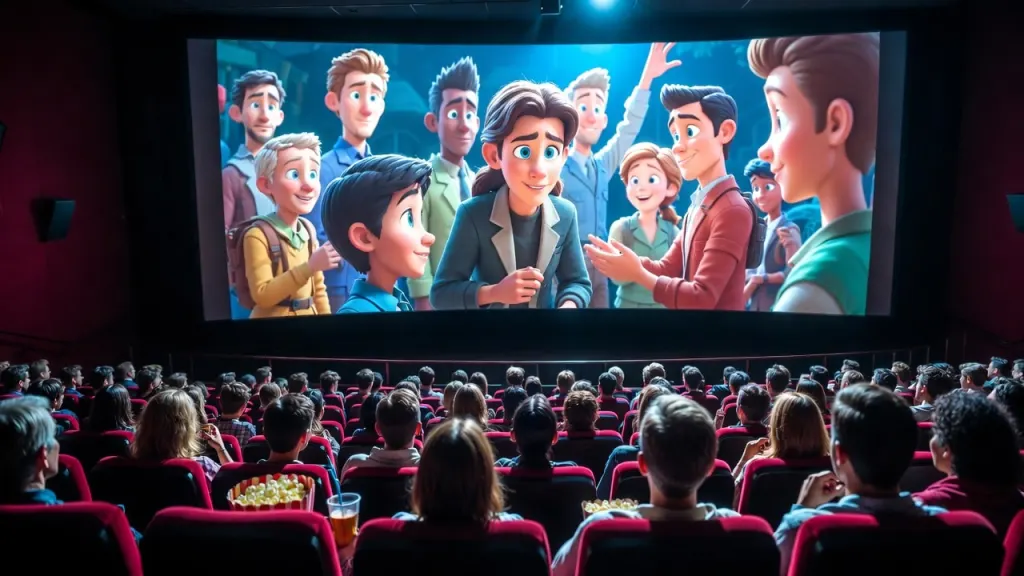

There are stories that entertain.
And there are stories that help us understand something deeper: how a person is built .
In recent months, from Marketing and Services , I have been exploring different animated films with a very specific intention: to discover what lessons they hold about life, decisions, emotions, and personal growth.
Something interesting has been appearing film by film.
We’re not just talking about film.
We’re talking about the dimensions that shape personality .
Because the stories we see, the ones we remember, and the ones that accompany us end up influencing the way we understand the world… and also the way we understand ourselves.
Root: where we come from
 The Secret of the Book of Kells Coco
There is one idea that appears strongly in these stories: nobody starts from scratch.
We all come from somewhere.
From a family, a tradition, a memory.
In The Secret of Kells , tradition is not a cage, it is a source of creativity. The past does not limit the future; it inspires it.
In Coco , family memory becomes essential to understanding who we really are.
In a time that sometimes pushes us to always start over, these stories remind us of something very simple:
Our roots don’t bind us. They sustain us.
Consciousness: learning to see the world
Growing up also means learning to see the world with our own eyes.
In Wolfwalkers , the protagonist discovers that reality is far more complex than she had been taught. What seemed like absolute truth begins to transform when direct experience emerges.
In Persepolis , freedom of thought becomes an act of courage.
Both stories speak to something fundamental:
critical awareness .
It is not enough to inherit a worldview.
At some point, one must ask oneself:
Is what I’m thinking really my own?
Interiority: understanding what we feel
Building a person also involves understanding their inner world.
In Inside Out , Pixar achieves something extraordinary: explaining with surprising clarity how our emotions work.
Joy, sadness, fear, or anger are not mistakes to be corrected. They are signals we need to understand.
In Up , another deep emotional dimension appears: grief, loss, and the ability to keep living.
These stories remind us that there is no real growth without emotional education .
Because learning to live also means learning to feel.
Responsibility: what do we do with our talent
Talent is a powerful tool.
But a tool without direction can become dangerous.
In Big Hero 6 , the protagonist discovers that intelligence alone is not enough. Something more is needed: purpose, care, and responsibility.
The question is no longer:
What am I capable of?
And it becomes:
What am I going to use what I am capable of doing for?
Connection and community: growing together with others
The Mitchells vs. the WALL-E Machines
In an age marked by technology, these stories remind us of something profoundly human.
People don’t build themselves.
In The Mitchells vs. the Machines , the conflict between generations is transformed into something valuable: a bridge to better understand each other.
In WALL·E , even in a technology-dominated future, what truly saves the world is something very simple: the ability to care.
Technology can change many things.
But the essentials remain the same:
human relations .
Five dimensions that shape us
If we look at all these stories together, a fairly clear map of what it means to grow up emerges.
Personality is not improvised.
It is built by integrating five dimensions:
- Root — knowing where we come from
- Conscience — looking at the world with one’s own judgment
- Inner life — understanding our emotions
- Responsibility — giving meaning to our talent
- Link — building together with others
When these dimensions interact with each other, something very valuable emerges: an integrated personality .
For young people, families and educators
That’s why animated film can become an extraordinary tool.
For young people, because it allows them to reflect on who they want to be.
For families, because it opens up deep conversations that sometimes we don’t know how to start.
And for educators, because it shows that stories can become a privileged space for learning.
The question that remains
Stories do more than just entertain us.
They also influence the way we understand life.
Therefore, the question that remains at the end of this journey is simple:
What stories are influencing the person you are building today?

Marketing y Servicios
Ideas para mejorar el mundo . Director: José Miguel Ponce . Profesor universitario e investigador en Marketing y Gestión de Servicios, con experiencia en cinco universidades públicas y privadas. Sevillano de origen, ha vivido en varias ciudades de España y actualmente reside en Sevilla. Apasionado por la educación, la comunicación y las relaciones humanas, considera la amistad y la empatía clave en su vida y enseñanza. Ha publicado investigaciones sobre Marketing, Calidad de Servicio y organizaciones sin ánimo de lucro. Humanista y optimista, promueve el agradecimiento y la coherencia como valores fundamentales.
Related
Saint Thomas More: A Non-Negotiable Conscience
Javier Ferrer García
08 April, 2026
4 min
Grandparents as Guardians of the Memory of Faith
Miguel Morales Gabriel
08 April, 2026
7 min

Romana Editorial releases “The Power of the Gospel” by Pope Leo XIV: Christian Faith in 10 Key Words
Exaudi Staff
08 April, 2026
2 min

From Bustle to Sacred Silence: The Fulfilled Vocation of Parents
Laetare
07 April, 2026
5 min