 (EN)
(EN)
 (ES)
(ES)
 (IT)
(IT)

The Silencing of Women’s Voices
“Forbidden” (1928) as a Warning from Frank Capra for a Personalist Bioethics
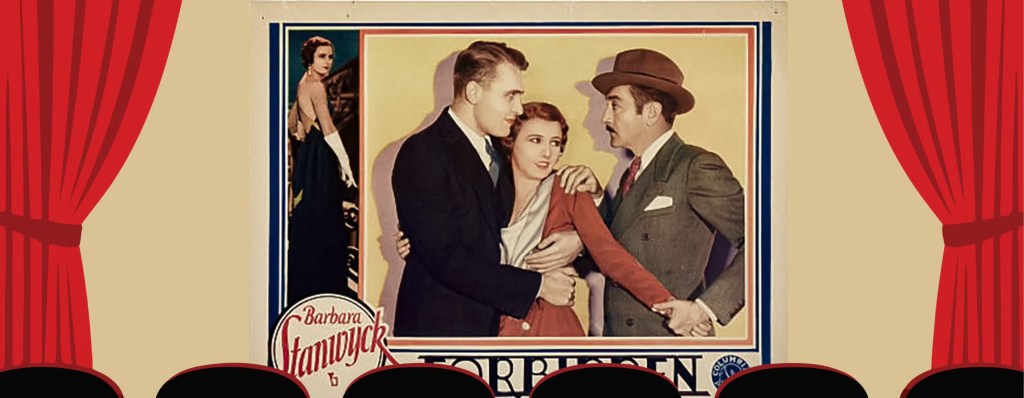

In Forbidden (1932), Frank Capra offers a prescient portrayal of the silencing of women’s voices, thanks to Barbara Stanwyck’s masterful performance. The story follows a young librarian in a rural area who longs for true love. She believes love can only be experienced romantically and is unconcerned with committing to a more serious relationship. When she discovers that the man she has fallen for and with whom she is expecting a child is married, she breaks up with him. But when he pursues her, a series of increasingly significant sacrifices unfolds. Her lover is a successful politician, married to a disabled woman whom he refuses to divorce for that very reason. She sacrifices everything for him: accepting only fleeting glimpses of him, having him adopt her daughter, and having no life beyond being a silent accomplice to his victories. And above all, she marries the editor of her newspaper, who seems to be smitten with her, but she wants to destroy the politician’s reputation for integrity, which leads her to shoot him on their wedding night when she realizes nothing will stop her. In the end, the politician, by then a very ill governor, wants to leave her half his estate. He writes it down on a piece of paper and dies. She tears up the document so that her daughter, who has never known her origins, will not be harmed. She definitively accepts her life of anonymity and poverty. Neither of the two men saw her as a whole person. They silenced her voice for the sake of their own selfishness. A stark warning for personalist bioethics.
A film that, without being optimistic, offers a counterpoint of hope.
In Capra’s filmography, Forbidden (1932) might seem a disconcerting film, one that doesn’t fit with the optimistic tone of his more famous works. But if this happens to us, we probably need to differentiate, as Gabriel Marcel [1] does , between optimism and hope. The former is deduced from events, and nothing seems to ask more of us than a kind of automatic confidence that things will turn out well. The latter is a virtue that requires the person’s own participation, as it is linked to their capacity to love.
Thus, Forbidden (1932) is presented to us—and this is not a unique case in the work of the Italian-American director—as a kind of “test case” regarding what he considers the appropriate, and therefore hopeful, way of portraying the relationship between men and women. Already in his first feature film, The Strong Man (1926) [2], with Harry Langdon, we were presented on screen with a relationship of mutual recognition and dialogue between the character he played, Paul Vergot, and his blind beloved, Mary Brown (Priscilla Bonner). And in many of his subsequent films, such as So This Is Love (1928), The Matinee Idol (1928), The Way of Strong ( 1928), and Ladies of Leisure (1930), among others, the discovery of the woman’s face [3] was the event that introduced a dimension of transcendence into the relationship. And in this way, it was ensured that mutual attraction would not be an occasion for mutual selfishness, but for true love. Karol Wojtyla/Saint John Paul II explained it very clearly.
…love is the fullest realization of human potential. It is the ultimate actualization of the person’s own potential, who finds in love the greatest fulfillment of their being, of their objective existence. […] The love of a man and a woman that did not go beyond sensual desire would also be bad, or at least incomplete, because concupiscent love does not exhaust the essence of love between persons. It is not enough to desire the person as a good for oneself, but also, and above all, to will the good for them. [4]
The advisability of giving one’s own version of Fannie Hurst’s novel Back Street
Why was Capra compelled to undertake what we have characterized as a “test case”? The explanation is biographical. It seemed a good idea for his Columbia studio to produce its own version of Fannie Hurst’s novel Back Street [5] . And in doing so, he could follow in the footsteps of the success that John M. Stahl had achieved that same year with the film of the same name, released in Spanish as La usurpadora. In his autobiography, Capra recalls this fact with profound disdain.
 Thus, with ample support from Fannie Hurst’s novel Back Street , I wrote an “original” story, Forbidden . I would have been better off staying in bed. I still had to learn that drama isn’t simply actors crying and suffering all over the place. It isn’t drama unless the audience is emotionally moved. Crocodile tears alone can’t reach their hearts. But courage, faith, love, and sacrifices for others can—if they are believable. [6]
This judgment already gives us some important clues. For Capra, melodrama, like the rest of cinema, shouldn’t manipulate emotions. It should aim in another direction: connecting with a suitable anthropological framework that is thus verified through feelings. However, there is a degree of historical inaccuracy in this statement. At the time, both the novel and John M. Stahl’s adaptation represented a significant exploration of the world of women. Being able to answer it, starting with Forbidden (1932), made perfect sense.
Indeed, Fannie Hurst’s work has been increasingly viewed through a feminist lens. Ray Schmidt, the protagonist, represents a vindication of women who had frequently been subjected to social scorn. As dependents of married men, they were considered gold diggers. But here we witness the story of a woman who sincerely loved a man, whom, by sheer chance, she could not marry, and whom she continued to love despite living a life of economic hardship and social contempt: without recognition, without children, always living in a hidden alley, a back street.
John M. Stahl, in a more austere and realistic manner than the other versions of the novel [7] , remained very faithful to the spirit that had permeated Fannie Hurst’s writing. It is not difficult to accept the message of tolerance that avoids judging the difficult lives of some women, especially in the face of the hypocrisy that could be hidden in the criteria of Victorian morality. Some may even go further and find that both the novel and Stahl’s film portrayed more love, and therefore more authenticity, in the adulterous relationship than in the marriage formally established in the eyes of society. Something that, in time, would be destined to challenge so-called legal marriage. [8]
Men who have been lost because they did not seek the true good of women
It is precisely in light of this second aspect that Capra’s work acquires its full meaning. A relationship of this kind can give a sentimental appearance of love. But it is not genuine because the man does not seek the woman’s true good, and therefore, not his own either. These are stories of men who have failed to treat the dignity of the woman with whom they have had this kind of hidden relationship with the respect it deserves. They have lost themselves, and they have caused these women to lose the possibility of knowing and experiencing true love.
That’s why in Forbidden (1932), Lulu Smith, the protagonist, is a strong-willed woman who breaks with the rural environment where she was only allowed to live as a stuffy librarian, deprived of the possibility of experiencing true marriage. She’s not like Ray Schmidt (Irene Dunne), who from the outset appears as a flirtatious young woman who enjoys teasing men, as if that were the right path to finding a good husband. But Lulu’s romantic notion of love also leads her to absolutize the feeling and let herself be guided by a flirtation in which they know nothing about each other, living a dreamlike vacation in Havana. When they return to life, Bob Grover (Adolphe Menjou), the man she had fallen for, reveals himself to be a lawyer with a successful political career, married, and unable to leave his disabled wife. With striking beauty, on the night Bob tells the truth about his situation, they play a game of putting on and taking off Halloween masks. Lulu kicks him out of her apartment before confessing that she is pregnant.
While Ray Schmidt’s lover, Walter Saxel (John Boles), prevents her from working, forcing her into a life of dependency, Lulu continues to find employment at a newspaper. Initially, until she disappears to give birth to her daughter, she works as the newspaper’s archivist, a role closely aligned with her skills as a librarian. There, reporter Al Holland (Ralph Bellamy) falls in love with her. When Bob, now the District Attorney, manages to find her and meet her daughter, whom he has named Roberta, Lulu returns to the newspaper, where Al is now the Editor-in-Chief and entrusts her with writing the love advice column.
In Back Street , Ray Schmidt had the opportunity to marry Kurt Shendler (George Meeker), a mechanic neighbor who had always been in love with her and who has now prospered as an auto businessman. The emotional blackmail Walter exerts on her prevents this, undoubtedly compounded by the fact that she sought respectability with Kurt without true love. In Forbidden , Al’s blackmail of her is constant because he is a sworn enemy of Bob Grover and suspects that Grover’s life is not honorable, that he is a hypocritical, two-faced politician. Faced with his threats, Lulu is forced to give her daughter Roberta up for Bob to adopt so that Al won’t suspect anything amiss. When the journalist continues his investigation and tries to sabotage Bob’s gubernatorial bid because of his affair with Lulu, from which he now knows his adopted daughter was born, she agrees to marry him, believing it will appease him. When this fails, in a fit of desperation, faced with the damage his revelations would cause to Bob and Roberta, she shoots him dead. An extremely protective reaction from his daughter, which Capra had already explored in the lost film Say It With Sables (1928). He doesn’t justify it, but he understands it. Lulu will spend less than a year in jail because she receives a scandalous pardon from Bob.
The melodrama of the unknown woman versus the comedy of marital renewal
Lulu would fall into what Stanley Cavell [9] termed the melodrama of the unknown woman [10] . A genre in which the woman doesn’t find a man with whom to develop a true complementarity that allows for conversation, a dialogue that  fosters her personal growth. Bob Grover was never able to understand that Lulu’s true good lay in living without division as a wife and mother, and not in being a mere extra or a beneficiary of his successes. Al Holland’s infatuation with Lulu soon became instrumental, driven by his hatred for Grover and his desire to destroy his public credibility. He never considered what was best for Lulu. Bob and Al silenced Lulu’s voice to make her serve their selfish ambitions.
At the end of Back Street, Ray dies shortly after Walter, in a romantic dream of what their love could have been had they married. At the end of Forbidden, Lulu fades away through the city streets, satisfied that she renounced Bob’s will, which would have left her wealthy but would have cast an unbearable affront upon his daughter. Thus, neither Al nor Bob managed to silence her voice. Her life appears as the counterpoint to the happy women in the marriage renewal comedies described by Cavell [11] . This is also Capra’s counterpoint. A serious warning for a personalist bioethics.
Conclusion: praise of monogamy as a criterion for a personalist bioethics
Reflecting on the Note from the Dicastery for the Doctrine of the Faith, ” One Flesh, One Dear Man: In Praise of Monogamy ” [12] , Dr. Carola Minguet has recently presented some conclusions that perfectly illuminate Capra’s work. In this way, the proposal of monogamy as a criterion for a personalist bioethics becomes clear.
There is something paradoxical about the Dicastery for the Doctrine of the Faith publishing, in the 21st century, a note entitled ” One Dear One: In Praise of Monogamy .” It sounds as if someone had dusted off a medieval codex to warn us about the dangers of the harem. And yet, the document […] is not an archaeological echo, but a surprisingly contemporary response. Because what is outdated is not monogamy itself, but the idea that desire alone is enough to found a kingdom. Civilizations are not built on fleeting emotions, but on enduring promises.
A car recalls, at its core, something profoundly human: that fidelity is not a mutilation of freedom, but rather reveals it. And that monogamy, far from being a vestige of another era, may be the boldest of cultural revolutions in our own. Perhaps that is why it is not the relic of a bygone world, but the enduring scandal of a world that refuses to believe that love can be interchangeable. The human heart may be distracted, but it does not resign itself. [13]
Technical specifications:
Original title: « Forbidden» ( “Forbidden Love”).
Year: 1932.
Duration: 1h. 25m.
Country: United States
Directed by: Frank Capra
Gracia Prats-Arolas . Professor and researcher in Philosophy and Film. Catholic University of Valencia
José Alfredo Peris-Cancio . Professor and researcher in Philosophy and Film. Member of the Bioethics Observatory. Catholic University of Valencia
***
[1] Marcel, G. (2022a). Homo viator. Prolegomena to a metaphysics of hope. (MJ Torres, Trans.). Salamanca: Sígueme, p. 56.
[2] See our comments on this same website about this film and the following ones.
[3] The most compelling philosophical reference on the density of the human face is found in the work of Max Picard, Picard, M. (1929). Dans Menschen Gesicht . Munich : Delphin-Velag. [Picard, M. (1931). The Human Face. London: Cassell and Company Limited].
[4] Wojtyla, K. (2016). Love and responsibility. (Jonio González and Dorota Szmidt, Trans.). Madrid: Palabra, pp. 102-103.
[5] Hurst, F. (1946). Back Street. New York, USA; Middlesex, In: Penguin [Spanish translation,
Hust, F. (1963). His private life. (M. Bosch Barret, Trans.) Madrid: Círculo de Lectores.
[6] Capra, F. (2007), The Name Before the Title. Autobiography. (Domingo Santos, Trans.). Madrid: T&B, p. 157
[7] Cf. Gallafent, E. (2025). Lonely Parade: Three Filmed Versions of Fannie Hurst’s Back Street. Quaterly Review of Film and Video, 42 (1), 261-281. doi:10.1080/10509208.2024.2420489
[8] Cf. Viladrich, Pedro Juan (2010), The agony of legal marriage.
An introduction to the basic conceptual elements of marriage, Pamplona: Institute for Family Sciences.
[9] Cavell, S. (1996). Contesting Tears: The Hollywood Melodrama of the Unknown Woman. Chicago: The University of Chicago Press. [Cavell, S. (2009). Beyond Tears. (D. Pérez Chico, Trans.). Boadilla del Monte, Madrid: Machadolibros].
[10] Something on which we agree with Leland Poague (1994), Another Frank Capra, Cambridge, Cambridge University Press, pp. 64-93. Cf. also Sanmartín Esplugues, J., & Peris-Cancio, J.-A. (2017b). Cuadernos de Filosofía y Cine 02. Los principios personalistas en la filmografía de Frank Capra. Valencia: Universidad Católica de Valencia San Vicente Mártir, pp. 167-197.
[11] Cavell, S. (1981). Pursuits of Happiness: The Hollywood Comedy of Remarriage. Cambridge, MA: Harvard University Press. [Cavell, S. (1999). The Pursuit of Happiness: The Hollywood Comedy of Remarriage. (E. Iriarte & J. Cerdán, Trans.). Barcelona: Paidós-Ibérica].
[12] Fernández-Card., VM, & Doctrina-de-la-fe, D.-p.-l. (2025). Una caro. Elogio de la monogamia. Nota doctrinal sobre el valor del matrimonio como unión exclusiva y pertenecer reciprocal. Rome: Vatican.va. Retrieved from https://www.vatican.va/roman_curia/congregations/cfaith/documents/rc_ddf_doc_20251125_una-caro_sp.html
[13] Minguet Civera, C. (2026b). In Praise of Monogamy. Confidential Religion , https://www.elconfidencialdigital.com/religion/author/carola-minguet-civera/ .

Observatorio de Bioética UCV
El Observatorio de Bioética se encuentra dentro del Instituto Ciencias de la vida de la Universidad Católica de Valencia “San Vicente Mártir” . En el trasfondo de sus publicaciones, se defiende la vida humana desde la fecundación a la muerte natural y la dignidad de la persona, teniendo como objetivo aunar esfuerzos para difundir la cultura de la vida como la define la Evangelium Vitae.
Related

Our Pilgrimage and Transition
Hugo Saldaña Estrada
31 March, 2026
3 min

How Big Is Your Faith?
P Angel Espinosa de los Monteros
31 March, 2026
4 min
Jesus Suffers for Us
Karl-María de Molina
30 March, 2026
5 min

You are not what you are, you are what you choose to be
Marketing y Servicios
30 March, 2026
3 min