 (EN)
(EN)
 (ES)
(ES)
 (IT)
(IT)

The Silence That Conquers the Noise: Contemplation Every City Dweller Can Experience Today
Testimonies of Finding God on the Subway, in Brief Adoration, and in Urban Retreats
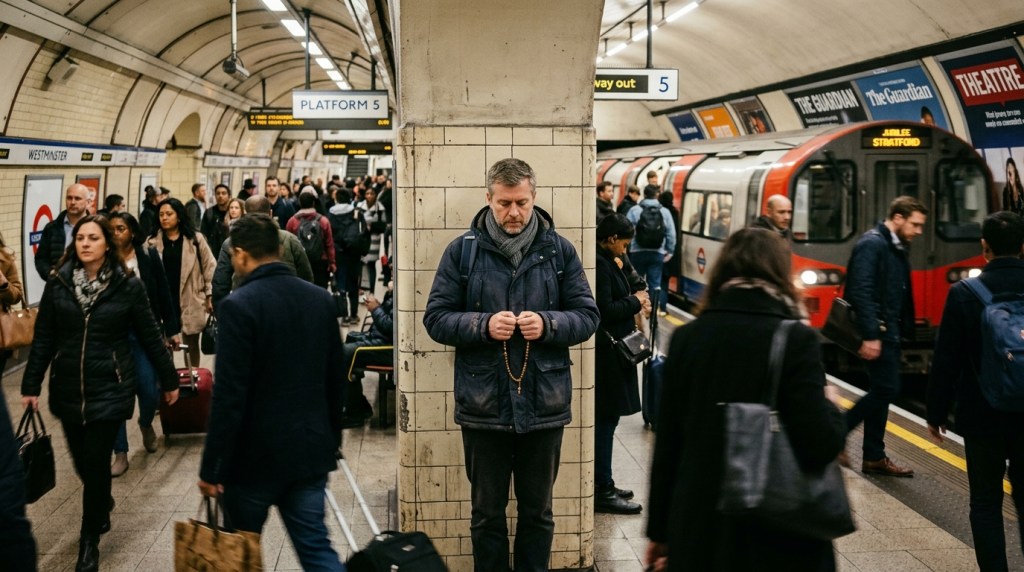

In the heart of any great city—where honking horns, notifications, and work-related stress create a constant cacophony—a silent yet irresistible invitation beats: “Come away by yourselves and rest a while” (Mark 6:31). This is not a romantic dream for monks in the desert, but a reality within reach of the modern layperson and the religious immersed in the urban environment. Contemplative prayer is not a spiritual luxury; it is the most powerful tool for resilience that the Church offers to Christians today. Far from unattainable ideals, the Catholic tradition—especially the Carmelite and Carthusian traditions—shows us how to cultivate a profound inner silence that transforms the asphalt into a sanctuary.
Urban life bombards us with distractions that not only tire the body but also scatter the soul. However, the Catechism of the Catholic Church clearly reminds us that “contemplative prayer is the prayer of the child of God, the forgiven sinner, who abandons himself to the love of his Father” (n. 2712). It does not demand perfect external conditions; it demands only a heart that turns to God with simple faith. Herein lies its anti-idealistic strength: contemplation does not compete with the active life; it illuminates and sustains it. Lay people who work in offices, mothers who balance family and career, and religious who exercise their ministry in urban parishes bear witness to this every day.
Let’s consider some concrete, relatable experiences. A lay engineer in Barcelona boards the metro at seven in the morning; instead of immersing himself in his phone, he closes his eyes and enters into a brief moment of reflection: “Lord, You are here.” In ten minutes, he recovers the peace that the day will steal from him. Another laywoman, a bank employee in Mexico City, dedicates fifteen minutes before entering the office to a brief Eucharistic adoration in the nearest tabernacle chapel; there, without complicated words, she simply looks at Jesus and allows herself to be looked upon. Carmelite friars in urban convents in Madrid or Buenos Aires, between catechism classes and serving the poor, set aside a time of absolute silence each afternoon that nourishes their apostolate. And urban retreats—a silent Saturday in a central parish guided by Carthusian spirituality—bring together professionals who discover that “the desert” can be built amidst the hustle and bustle.
These testimonies are not exceptions; they are living proof that contemplation is for everyone. Saint Teresa of Ávila, Doctor of the Church and teacher of prayer, wrote precisely for busy souls: “Do not think that it is necessary to be in a monastery to be contemplative; the Lord is everywhere.” In her Way of Perfection, she teaches “active recollection”: even when the body is amidst the hustle and bustle, the soul can withdraw inwardly as to an “inner dwelling” where God resides. It is not about fleeing from obligations, but about bringing God into them.
Saint John of the Cross, for his part, offers us the clarity of the “dark night of the soul”: external noise can become purification when we learn to walk in pure faith, without needing comforting sensations. And the Carthusian tradition, with its motto fuge, tace, quiesce (flee, be silent, rest), offers us a radically practical wisdom for lay people: “flee” does not mean abandoning the city, but rather fleeing inwardly from attachment to noise; “be silent” is to keep the heart in loving silence; “rest” is to find rest in God even though the world spins at breakneck speed. Dom Guigo, a Carthusian prior, summarized it thus: the monk’s cell is external, but the cell of the soul is within everyone’s reach.
How can we put this into practice without idealism? Here are concrete tips, adapted to real-life situations and tested by thousands of urban Christians:
- Everyday Micro-Silences : Choose three fixed moments—upon waking, on public transport, and before going to sleep—of just five minutes. Sit down (or stand on the subway), breathe calmly, and silently repeat: “Jesus, I love you.” Don’t seek feelings; just presence. Saint Teresa called it a “prayer of friendship.”
- Express Eucharistic Adoration : Find a chapel or church near your work or home. Ten or fifteen minutes is enough. Keep a short agenda: look at the Lord, tell Him what’s bothering you, and remain silent. Many lay people discover that this “quick break” increases their productivity and serenity.
- The Carthusian “inner desert” : Create a “cell” in your soul. During the day, when you feel stress rising, stop for three seconds, close your eyes inwardly, and say: “Only You, Lord.” It’s the urban version of quiesce .
- Monthly urban retreats : Many dioceses and Carmelite communities offer days of silence right in the heart of the city. You don’t need to travel far; a Saturday from 9 a.m. to 6 p.m. with Mass, adoration, and spiritual guidance can recharge your soul for the entire month.
- Integration into the agenda : Use technology to your advantage — an alarm on your mobile phone with the word “silence” — or associate the prayer with existing routines (while walking to work or waiting for the elevator).
The fruit is surprising and profoundly liberating: greater resilience in the face of anxiety, more patient charity toward others, clearer decisions, and above all, an intimate friendship with God that gives meaning to everything else. As the Church affirms, contemplation does not distance us from the world; it allows us to love it with the heart of Christ.
Brother or sister in the city: don’t expect the perfect retreat or a less busy life. Inner silence is waiting for you now, on the subway, in the coffee line, or in your tiny room. Start small, persevere with joy, and you will discover that, in the midst of the most deafening noise, God whispers: “I am your peace” (John 14:27). Your urban life can be—and in fact already is—a privileged path to holiness. All that’s missing is for you to enter into silence and let Him win you over. Are you ready to take the first step today? The noisy world needs your inner silence more than you can imagine.

Miguel Morales Gabriel
Soy un jubilado empresario católico, esposo devoto, padre esforzado, abuelo cariñoso y amigo leal; fundador de su empresa familiar donde lideró con integridad durante décadas generando empleo y desarrollo local, siempre guiado por su fe, la solidaridad comunitaria y el amor incondicional a su esposa, hijos y nietos, viviendo con el lema de servir con humildad.
Related

The International Olympic Committee prohibits transgender women from competing in the women’s category
Observatorio de Bioética UCV
10 April, 2026
5 min

Abortion: The Catholic Church and the message of the last five Popes
Patricia Jiménez Ramírez
10 April, 2026
3 min

When Heaven Bends to Embrace Human Suffering
Sonia Clara del Campo
10 April, 2026
6 min

Saint Thomas More: A Non-Negotiable Conscience
Javier Ferrer García
08 April, 2026
4 min