 (EN)
(EN)
 (ES)
(ES)
 (IT)
(IT)

The Sea of Grace that Floods the World
Divine Mercy, April 12


The embrace of Jesus that transforms sin into salvation: origin, celebration and the Chaplet that opens the gates of Heaven
Today, Sunday, April 12, 2026, the universal Church solemnly celebrates Divine Mercy Sunday , also known as the Second Sunday of Easter or Low Sunday . It is the day when the depths of God’s mercy are opened wide, just as Jesus Christ himself revealed to Saint Maria Faustina Kowalska (1905-1938), and as Saint John Paul II instituted it for the entire Church on April 30, 2000, at the very moment of his canonization. This is not just another pious devotion, but an extraordinary gift for our time: an urgent invitation to trust fully in God’s merciful love and to live it as a source of personal and ecclesial renewal. In a world marked by mistrust, pain, and division, this feast reminds us that mercy is not a secondary attribute of God, but his very essence.
The origin: the revelations of Jesus to Saint Faustina Kowalska
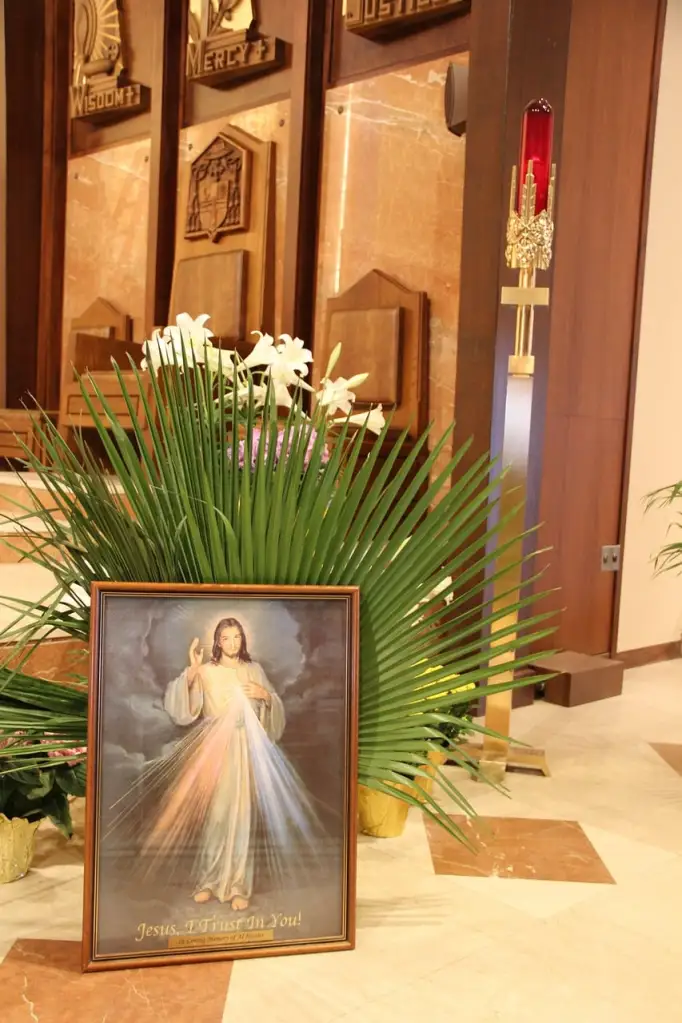
It all began with the private apparitions that Jesus Christ granted to the humble Polish nun, Sister Maria Faustina Kowalska, of the Congregation of the Sisters of Our Lady of Mercy. On February 22, 1931, in her cell in Płock, Poland, Faustina saw Jesus dressed in a white robe, with one hand raised in blessing and the other touching his breast. From his heart emanated two rays: one red (symbolizing blood) and the other pale (symbolizing water). Jesus told her: “Paint an image according to the pattern you see, and sign it: Jesus, I trust in You . I desire that this image be venerated first in your chapel and then throughout the world.”
In her Diary —a work approved by the Church and considered a spiritual treasure—Jesus entrusted Faustina with three great tasks: to proclaim to the world the truth about God’s merciful love, to obtain divine mercy for souls (especially sinners) through new forms of devotion, and to inspire an apostolic movement of Divine Mercy. These forms are precisely the image with the inscription “Jesus, I trust in You,” the feast of the first Sunday after Easter, the Chaplet of Divine Mercy, and the prayer at the Hour of Mercy (three o’clock in the afternoon, the hour of Christ’s death).
Jesus repeatedly insisted: “I desire that the Feast of Mercy be a refuge and shelter for all souls, and especially for poor sinners. On that day the very depths of My mercy are open” ( Diary , 699). It is no coincidence that it is celebrated on the Sunday following the Resurrection: Easter culminates in mercy, and the wounds of the risen Christ (as in the Gospel of Thomas) become an inexhaustible source of forgiveness.
Saint John Paul II, deeply connected to this message by his Polish origins and his own experience of the 20th century (wars, totalitarian regimes), elevated it to a universal liturgical feast. In his homily at his canonization, he declared: “It is important that we fully embrace the message that the Word of God conveys to us on this Second Sunday of Easter, which from now on throughout the Church will be designated as ‘Divine Mercy Sunday.’” Since then, the entire Church has celebrated it, confirming that mercy is the beating heart of the Gospel.
What is Divine Mercy?
Divine Mercy is not a vague sentiment or a cheap indulgence. It is the love of God that goes out to meet the sinner, that forgives without measure, and that transforms. In Scripture, from the Old Testament (Exodus 34:6: “The Lord, the Lord, the compassionate and gracious God…”) to the New (the parable of the prodigal son, the Samaritan woman, the adulterous woman), God reveals himself as the One who prefers mercy to sacrifice. Jesus himself is Mercy incarnate.
In the message to Faustina, mercy is presented as a response to divine justice: it does not negate it, but rather transcends it. Jesus explained that souls who trust in Him receive unimaginable graces, even if their sins were “scarlet.” Mistrust, on the other hand, “tears at My heart” (Diary, 50). Theologically, this devotion restores our divine filiation: God is not a distant judge, but a most loving Father who asks for childlike trust and, at the same time, calls us to be merciful to others (cf. Mt 5:7; Lk 6:36).
In today’s world—marked by crises of faith, wars, family breakdowns, and despair—Divine Mercy is prophetic: it reminds us that no sin is greater than the blood of Christ, and that the Church is a “field hospital” where everyone can find healing. As Saint Josemaría Escrivá taught, trust in mercy enlarges our hearts, enabling us to feel compassion for the suffering of others and to act through concrete acts of charity.
How to celebrate Divine Mercy Sunday
The liturgical celebration is simple yet profound:
- Participate in Holy Mass with the readings proper to the Second Sunday of Easter (Acts 5:12-16; Psalm 117; Revelation 1:9-13, 17-19; John 20:19-31). The Gospel of Thomas invites us to touch the wounds of the risen Christ and exclaim with faith: “My Lord and my God!”
- Approaching the sacrament of Reconciliation (confession) and receiving Holy Communion in a state of grace.
- Pray the Chaplet of Divine Mercy , especially at three in the afternoon (Hour of Mercy).
- To venerate the image of Jesus the Merciful and spread the message.
- Practice corporal and spiritual works of mercy : a phone call, a visit, forgiveness, a gesture of service.
The Church grants a plenary indulgence to those who, fulfilling the usual conditions (confession, communion, prayer for the Pope’s intentions, and detachment from sin), participate in the celebrations or pray the Chaplet of Divine Mercy in the presence of a dying person. Jesus promised: “Whoever believes in Me, I will give such confidence in My mercy that, even if their sins are as red as scarlet, if they have recourse to My mercy, they will be forgiven.”
The Chaplet of Divine Mercy: the prayer dictated by Jesus
The Chaplet of Divine Mercy is the powerful weapon that Jesus entrusted to Faustina between September 13 and 14, 1935, in Vilnius, to appease God’s wrath and obtain mercy for the world. It is prayed using an ordinary rosary. According to official Vatican sources:
- Sign of the Cross: In the name of the Father, and of the Son, and of the Holy Spirit. Amen.
- Our Father.
- Hail Mary.
- Creed (Apostles’ Creed).
In the larger grains (where the Lord’s Prayer is said):
Eternal Father, I offer You the Body, Blood, Soul and Divinity of Your dearly beloved Son, Our Lord Jesus Christ, in atonement for our sins and those of the whole world.
In the smaller grains (where the Hail Mary is said):
Through His sorrowful Passion, have mercy on us and on the whole world.
At the end of the five decades, pray three times:
Holy God, Holy Mighty One, Holy Immortal One, have mercy on us and on the whole world.
Concluding sentence (optional):
O Eternal God, in whom mercy is infinite and the treasury of compassion inexhaustible, turn Your merciful gaze upon us and increase Your mercy within us, so that in difficult times we may not despair or become discouraged, but with great confidence submit ourselves to Your holy will, which is Love and Mercy itself. Amen.
Jesus promised Faustina: “Whoever recites this Chaplet will receive great mercy at the hour of death. Priests will recommend it to sinners as their last hope of salvation. Even if the most hardened sinner has recited this Chaplet at least once, he will receive the grace of My infinite Mercy” (Diary) . “When you pray this Chaplet in the presence of the dying, I will stand between the Father and the dying soul, not as the just Judge, but as the merciful Savior.”
Other prayers for today and always
- Prayer at the Hour of Mercy (3 pm) : “O Blood and Water which flowed from the Heart of Jesus as a fount of mercy for us, I trust in You.”
- Constant short prayer : “Jesus, I trust in You.”
- Offertory Prayer : You expired, Jesus, but the source of life gushed forth for souls, and the ocean of mercy opened up for the whole world. O Fount of Life, unfathomable Divine Mercy, envelop the whole world and pour Yourself out upon us.
Today is the day of hope
April 12, 2026, is not just another Sunday. It is the day Jesus tells us: “Do not be afraid. My heart of mercy is open.” Approach without fear, go to confession, receive Holy Communion, pray the Divine Mercy Chaplet, and be merciful to others. As Faustina wrote: “My holiness and perfection consist in a close union of my will with the will of God” ( Diary , 1107).
May the Virgin Mary, Mother of Mercy, help us to live this message. May Divine Mercy flood your life, your family, and the whole world. Jesus, I trust in You . Amen.

Javier Ferrer García
Soy un apasionado de la vida. Filósofo y economista. Mi carrera profesional se ha enriquecido con el constante deseo de aprender y crecer tanto en el ámbito académico como en el personal. Me considero un ferviente lector y amante del cine, lo cual me permite tener una perspectiva amplia y diversa sobre el mundo que nos rodea. Como católico comprometido, busco integrar mis valores en cada aspecto de mi vida, desde mi carrera profesional hasta mi rol como esposo y padre de familia
Related
Reflection by Bishop Enrique Díaz: The Lord’s mercy is eternal. Alleluia
Enrique Díaz
12 April, 2026
5 min
“In Search of the Messiah”: The documentary that reveals how Judaism finds its fulfillment in Christ
Exaudi Staff
11 April, 2026
4 min
On the Eighth Day Jesus Arrived: Commentary by Fr. Jorge Miró
Jorge Miró
11 April, 2026
3 min

René ZZ’s Soul Map: From a Tattooed Body to a Heart Restored by God
Se Buscan Rebeldes
10 April, 2026
7 min