(EN)
(EN)
 (ES)
(ES)
 (IT)
(IT)

The New Leviathans
From Hobbesian Fear to the Post-Liberal Void
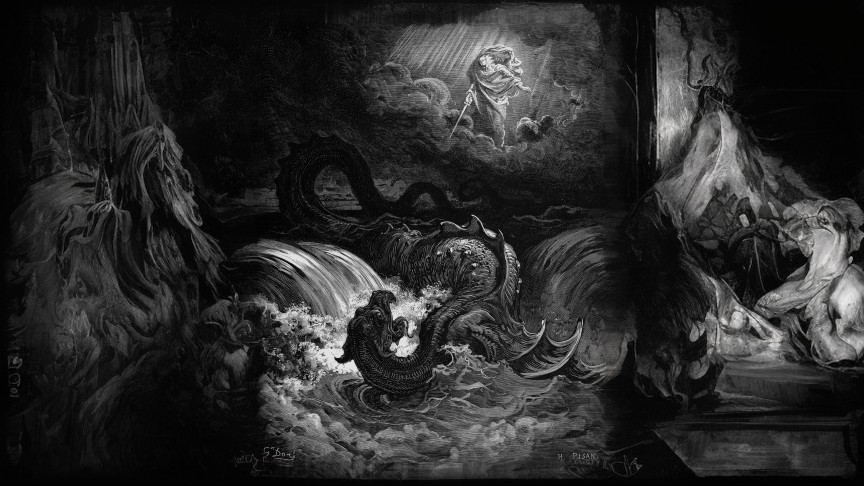

Thomas Hobbes (1588-1679) said that his twin brother was fear. He lived in a turbulent era of wars and political instability. In his book Leviathan, he conceived the political construct (the State) to provide security for subjects against their fellow citizens and against external enemies. This construct, in a geometric fashion, was strong enough to achieve security and peace among men in the state of nature, quarrelsome and constantly at war with one another, subject to the dominion of the powerful. Hobbes considered the existence of a social contract essential for the self-preservation of human beings, for which purpose a strong Leviathan was needed—a benevolent ogre that generated order and peace. The Soviet Union, Nazi Germany, and communist China of the 20th century are tragic examples of these Leviathans that, in their deranged quest to perfect “humanity,” sacrificed millions of human beings in their failed attempt to create a new man. Their lesser imitators have also left us with desolation and death.
The myth of Leviathan has not disappeared; it remains alive in the 21st century. This is the argument made by John Gray in his book * The New Leviathans: Reflections for After Liberalism* (Sexto Piso, 2024). Today’s neo-totalitarian states are more ambitious than their predecessors of the last century. In an era where the future seems profoundly uncertain, their aim is no longer simply to achieve security, but rather to provide meaning to the lives of their subjects. However, like the totalitarian regimes of the 20th century, the new Leviathans remain engineers of souls and seek to liberate citizens from the burdens of freedom (see pp. 23-27). Examples of these new totalitarianisms include Putin’s Russian Orthodox Leviathan and Xi Jinping’s Chinese panopticon. The latter, Gray points out, is based less on Confucian values of social harmony than on Mao Zedong, who destroyed civilization to impose a horrific Western utopia. Xi is closer to Carl Schmitt than to Hobbes; a mixture of Marx, Schmitt, and Jeremy Bentham, inventor of the all-seeing panopticon (see pp. 51-60).
Gray’s reading of the global political landscape is thought-provoking. When discussing Russia, he turns to Russian and Eastern European writers. This provides an enriching intellectual window into authors he hadn’t previously encountered: Rozanov, Leontiev, Kirilov, Boldirev, Czapsky, Tiffi, and Zamyatin (whose dystopian novel , We, is a precursor to Orwell’s 1984 ). Gray is also a sharp critic of the woke movement and asserts, contrary to what its right-wing critics claim, that woke thought is not a variant of Marxism (see pp. 128-129). Rather, he characterizes it as a manifestation of what he calls hyperliberalism, pure, unbridled puritanical moral fury, “for it is not restrained by divine mercy or the forgiveness of sins: there is no tolerance for those who refuse to be saved” (p. 140).
Gray argues that the backdrop of liberalism is Christianity, a framework that, over time, has become distorted, to the point of being reduced to mere words without spirit. Gray does not expect to save the world, nor does he believe it is within our power to find “the best political regime,” partly because he believes there is no sense of history, no final destination. What we have is a global drift, hence, for him, the great task of our time is not to tie the hands of the new Leviathans, but to bring them closer to what Hobbes believed the Leviathan could be: the bearer of a peaceful existence amidst the mosaic of diverse regimes. A peace, of course, understood as a partial and temporary truce (see pp. 176-177).
In Gray there is much skepticism and a fragile hope. Everything is at stake here, but without purpose or meaning in global history and in personal biography, how to face the future? Gray’s answer is fragile and inconsistent. He says: “Inner nothingness can move us to action in the service of life (…). If we go on, it is because we cannot do anything else. It is life that pulls us; life is the helmsman that steers us toward the storm (p. 178).”
Gray’s diagnosis sheds light on understanding the political and social moment of our time, but his anthropology is very precarious. Human beings are reduced to a feather floating in the globalized world. There is no appeal in getting up each morning to continue living simply because one is alive… A person is dust, certainly, but dust in love, as the poet says. We are wanderers with origin and destination. The city of men requires the city of God.

Francisco Bobadilla
Francisco Bobadilla es profesor principal de la Universidad de Piura, donde dicta clases para el pre-grado y posgrado. Interesado en las Humanidades y en la dimensión ética de la conducta humana. Lector habitual, de cuyas lecturas se nutre en gran parte este blog. Es autor, entre otros, de los libros “Pasión por la Excelencia”, “Empresas con alma”, «Progreso económico y desarrollo humano», «El Código da Vinci: de la ficción a la realidad»; «La disponibilidad de los derechos de la personalidad». Abogado y Master en Derecho Civil por la PUCP, doctor en Derecho por la Universidad de Zaragoza; Licenciado en Ciencias de la Información por la Universidad de Piura. Sus temas: pensamiento político y social, ética y cultura, derechos de la persona.
Related

Loneliness skyrockets
Exaudi Staff
12 March, 2026
2 min
The transformation of the latin american religious map
Academia de Líderes Católicos
12 March, 2026
5 min
Cardinal Arizmendi: Humanism, Transhumanism, and Posthumanism
Cardenal Felipe Arizmendi
11 March, 2026
5 min

Are you aware of the weight you carry?
Hugo Saldaña Estrada
10 March, 2026
3 min