(EN)
(EN)
 (ES)
(ES)
 (IT)
(IT)

The Mind versus Reality
Between What We Perceive and What We Understand
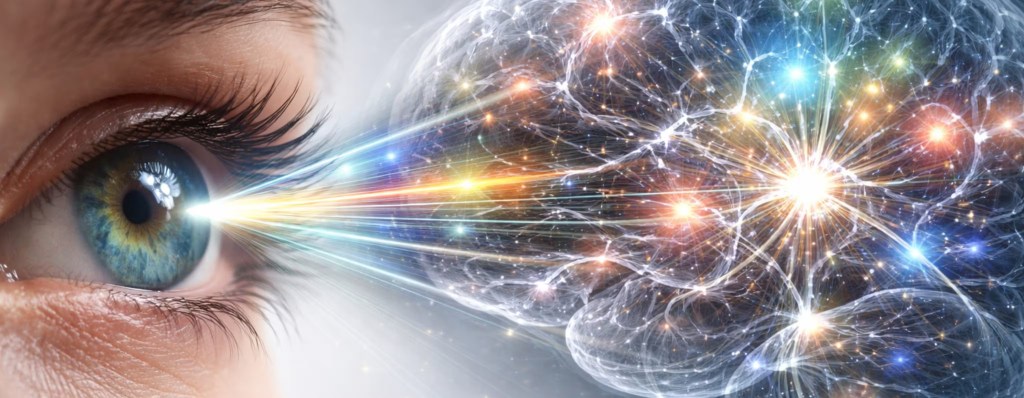

What is reality, really: what do we see or what do we understand? Drawing on Stephen Hawking’s provocative insight, this article explores the distance—and the link—between sensory experience and the deep structures that describe the universe. From the limits of our senses to the revelatory power of mathematics, we discover that what we perceive is merely a partial interpretation, while the human mind, capable of abstraction and the formulation of laws, becomes the most sophisticated instrument for accessing a reality that remains, to a large extent, invisible.
What is reality?
Stephen Hawking was not only a first-rate scientist, but also an exceptional popularizer who managed to synthesize his intellectual journey into a phrase that defines our intuition: “I have spent my life traveling around the universe inside my mind” [1] . It is paradoxical that a person whose physical existence was mostly confined to a wheelchair could claim such ubiquity. What reality is Hawking talking about? What is the difference between the mathematics we use to describe nature and nature itself? In physics, the concept of reality applies to something that accurately explains our observations. We cannot see elementary particles with our own eyes; However, we affirm their existence because the mathematical structures that describe them accurately predict the behavior of matter. Here, the distinction between nature and the mathematics that describes it begins to blur.

We perceive reality through our five senses
In the process of visual perception, it is imperative to distinguish between seeing and perceiving. While the act of seeing is a physical process of receiving light stimuli, perceiving is the cognitive and subjective interpretation of that information. The flow of light that impacts the retina is translated into electrical signals processed by various brain areas, each specialized in a specific attribute: color, orientation, contrast, movement, and spatial frequency. The result: a yellow tennis ball in motion, for example, is a mental construct.
In our relationship with the environment, we depend on five main senses: sight, hearing, touch, taste, and smell. In all of them, the same distinction must be made between stimulus and perception. These senses, when compared to the reality we know, turn out to be quite limited. Our eyes detect only a small fraction of the electromagnetic spectrum. Infrared, ultraviolet, and countless other wavelengths exist beyond our perception, creating an invisible world around us. Our ears capture sounds within a narrow frequency range, but infrasonic and ultrasonic vibrations exist, beyond what we can perceive. Our sense of touch detects pressure, temperature, and texture, but it cannot capture the deeper molecular and energetic exchanges that occur at a microscopic level. Evolution has adapted our senses to perceive what is necessary for survival and nothing more.
In this context, language acts as an extension of our senses. Noam Chomsky defines language as a biological faculty that allows us to access layers of reality invisible to other animals: complex causality, future time, and pure abstraction. As Bertrand Russell stated: “Language serves not only to express thoughts, but also to make possible thoughts which could not exist without it” [2] .
The discovery of reality through mathematics
Scientific progress has revealed that what our senses perceive is merely the surface layer of the universe. We are blind to the trillions of neutrinos that pass through our bodies every second, and our intuition fails us when trying to imagine the curvature of spacetime. However, we have developed a “sense” capable of grasping this expanded reality: mathematics.
While Einstein’s field equations describe the very texture of the cosmic fabric, Heisenberg’s uncertainty principle explains the energy fluctuations of the vacuum. Everything we know about the infinitesimal and the immeasurable is thanks to these logical structures. Thus, sensory perception anchors us to immediate and practical reality, but mathematics represents the objective and immutable truth of natural laws.
What, then, does it mean that Hawking “traveled through the universe”? Hawking’s claim about his mental journeys is not, therefore, poetic license, but a declaration about the power of the human mind as a higher-order sensory organ. Through mathematics, thought becomes a form of exploration.
The mental perception of mathematics
Neuroscience has shown that the brain has not developed new areas for mathematics—a cultural milestone too recent on the evolutionary scale—but rather has “recycled” neural circuits originally designed for the perception of physical shapes and spaces. According to Stanislas Dehaene, high-level mathematical expertise and basic number sense share common roots in a non-linguistic brain circuit [3] . This architecture suggests that the brain processes abstract mathematical structures following precisely the same protocol it uses to identify an ordinary object.
From birth, we possess innate mechanisms for individualizing objects and extracting their quantities; for our nervous system, number is a dimension of analysis as fundamental and intrinsic as color or shape. As Dehaene explains: “Just as we cannot avoid seeing objects in color… and in defined locations in space… in the same way, numerical quantities are effortlessly imposed upon us” [4]
This functional equivalence explains why, to perceive a jug, the brain analyzes symmetries, edges, and volumes, and why it employs that same visuospatial machinery to unravel complex abstractions. The brain does not treat mathematics as intellectual data, but as a geometric entity. In fact, the crucial difference between a novice and an expert lies in this point: while the former attempts to decode an equation sequentially, as if it were language, the expert manages to “see” it and manipulate it mentally as a tangible geometric structure, granting the abstraction the same physical and spatial entity possessed by an object in the tangible world.

Hawking’s travels
In this context, it makes sense to say that Hawking traveled repeatedly throughout the universe for over forty years. I have crossed the event horizon of invisible black holes and remained there, in the realm of pure abstraction, unraveling the connections between relativity, thermodynamics, and quantum physics. Similarly, years earlier, a very young Einstein had resorted to a similar experiment when, at sixteen, he asked himself: What happens if we chase a beam of light at the speed of light? An inner inquiry that led him to the formulation of special relativity.
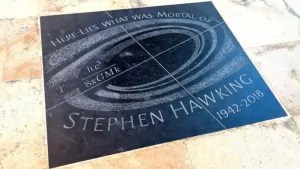
Hawking’s travel experiences marked him so deeply that he wanted to take a moment to his grave, one he was particularly proud of. Therefore, the equation describing the temperature of black holes is engraved on his tombstone in Westminster Abbey:

This formula, which relates the five fundamental constants of nature [5] , is the map of its most famous discovery: the black holes of the universe are not completely black, but emit a glow known as Hawking radiation.
The mind as the final frontier
Ultimately, Stephen Hawking’s journey reveals a profound truth about our species: we are not prisoners of our biology. While evolution endowed us with limited senses, those necessary to ensure our survival on the savanna, it also bequeathed us a mind with the astonishing capacity to advance our understanding of the cosmos.
Manuel Ribes . Institute of Life Sciences. Bioethics Observatory
***
[1] Stephen Hawking Brief Answers to the Big Questions Editorial Planeta SA, 2018 ISBN: 978-84-9199-058-1 (epub)
[2] https://quoteinvestigator.com/2016/09/09/language/#7b00d116-d3e2-4149-a739-f8913649a3d1-link
[3] Marie Amalric and Stanislas Dehaene Origins of the brain networks for advanced mathematics in expert mathematicians PNAS | May 3, 2016 | vol. 113 | No. 18 |
[4] Stanislas Dehaene The Number Sense How the Mind Creates Mathematics Oxford University Press 1997 ISBN 0-19-511004-8
[5] T : Hawking temperature.
ħ : Reduced Planck constant (the quantum world).
c : Speed of light (relativity).
π : Pi (geometry).
G : Gravitational constant (gravity).
M : Mass of the black hole.
k : Boltzmann constant (thermodynamics).

Observatorio de Bioética UCV
El Observatorio de Bioética se encuentra dentro del Instituto Ciencias de la vida de la Universidad Católica de Valencia “San Vicente Mártir” . En el trasfondo de sus publicaciones, se defiende la vida humana desde la fecundación a la muerte natural y la dignidad de la persona, teniendo como objetivo aunar esfuerzos para difundir la cultura de la vida como la define la Evangelium Vitae.
Related