 (EN)
(EN)
 (ES)
(ES)
 (IT)
(IT)

The Dicastery for Promoting Christian Unity
The task of this Dicastery is to foster the growth of a genuine ecumenical spirit within the Catholic Church and to promote ecumenical dialogue with other Churches and ecclesial communities, with the aim of restoring unity among Christians
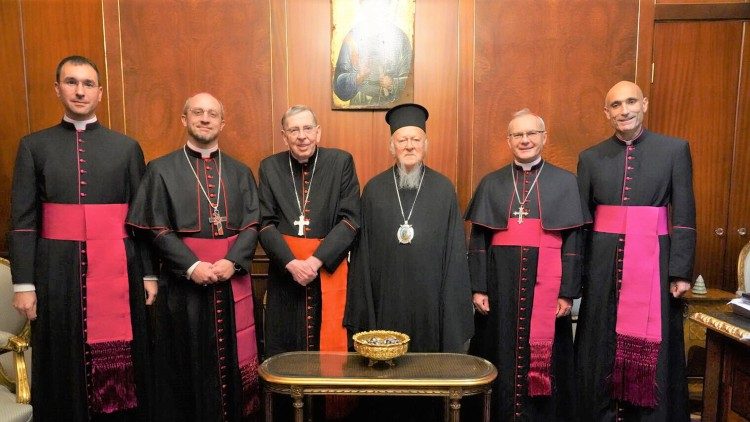

The mission of the Dicastery for Promoting Christian Unity is to foster, within the Catholic Church, the growth of a genuine ecumenical spirit. It is active in all areas that can contribute to promoting Christian unity, through fraternal relations, collaborations, and theological dialogues with other Churches and Christian communions. The Prefect is Cardinal Kurt Koch, and the Secretary is Archbishop Flavio Pace.
Relations with other Churches and ecclesial communities are managed through two sections:
- The Eastern section , for the Orthodox Churches of Byzantine tradition and the Eastern Orthodox Churches (Coptic, Syrian, Armenian, Ethiopian and Malankara), as well as for the Assyrian Church of the East.
- The Western section , for the different Churches and ecclesial communities of the West.
Brief historical notes
On June 5, 1960, Pope John XXIII established the Secretariat for Promoting Christian Unity as one of the preparatory commissions for the Council. This marked the beginning of the Catholic Church’s official commitment to the ecumenical movement.
The Secretariat prepared and presented to the Council the documents on ecumenism ( Unitatis redintegratio ), on non-Christian religions ( Nostra ætate ), on religious freedom ( Dignitatis humanae ) and, in collaboration with the doctrinal commission, the dogmatic Constitution on divine revelation ( Dei Verbum ).
In 1966, at the close of the Council, Pope Paul VI confirmed the Secretariat as a permanent body of the Holy See. That same year, the Faith and Order Commission of the World Council of Churches and the Secretariat for Promoting Christian Unity decided to jointly prepare the official text for the Week of Prayer for Christian Unity each year.
With the Apostolic Constitution Pastor Bonus in 1988, Pope John Paul II transformed the Secretariat into the Pontifical Council for Promoting Christian Unity . In 2022, with the Apostolic Constitution Praedicate Evangelium , Pope Francis changed its name to the Dicastery for Promoting Christian Unity .
Skills
As the Apostolic Constitution Praedicate Evangelium reminds us , the Dicastery is responsible for the ecumenical commitment, both within the Catholic Church and in relations with other Churches and ecclesial communities, to restore unity among Christians.
The Dicastery applies the teachings on ecumenism of the Second Vatican Council and the subsequent magisterium of the pontiffs, and is concerned with their correct interpretation in order to guide, coordinate and develop ecumenical activity.
It fosters national and international meetings and events to promote Christian unity. It coordinates the ecumenical initiatives of other institutions of the Roman Curia, offices and institutions linked to the Holy See, and relations with other Churches and ecclesial communities.
The Dicastery deals with relations with other Churches and ecclesial communities —presenting the issues to the Pope beforehand— and promotes theological dialogue and conversations aimed at fostering unity.
It is also the responsibility of the Dicastery to choose Catholic members for theological dialogues, observers and delegates for the various ecumenical meetings, and to invite observers or “fraternal delegates” from other Churches and ecclesial communities to the most significant meetings and events of the Catholic Church.
The Commission for Religious Relations with Judaism is part of the Dicastery , whose task is to promote the progress of relations between Catholics and Jews, and which is headed by the prefect.
Walking together in the search for truth
“The dialogue among Christians over the past sixty years has allowed for more progress than ever before in history,” Cardinal Prefect Koch noted. He cited, for example, “the Christological declarations with the Eastern Orthodox Churches that put an end to fifteen hundred years of controversy, and the joint declaration on the doctrine of justification that resolved the fundamental problems at the heart of the 16th-century Reformation. No less important is the fact that Christians no longer see each other as enemies, but as brothers and sisters in Christ.”
Pope Francis, concluding his speech at the plenary assembly of the then Pontifical Council for Promoting Christian Unity in 2022, invited everyone to “move forward, to walk together. It is true that theological work is very important and we must reflect, but we cannot wait to make progress on the path to unity until theologians agree.”
“Once,” he continued, “a great Orthodox theologian told me that he knew when theologians would agree. When? The day after the final judgment, he told me. And in the meantime? Walking together as brothers, praying together, doing works of charity, searching for the truth. As brothers. And this fraternity is for all of us.”

Exaudi Staff
What is Exaudi News? Exaudi News is an international Catholic media outlet that informs, shapes, and transforms daily in Spanish, English, and Italian. Through news, analytical articles, and live broadcasts of the Pope's events, Exaudi seeks to strengthen Christian unity and contribute to the evangelization of the world, always guided by the Church's social doctrine. We work to bring Christian truth and values to every corner of the planet. Help us transform the world with Exaudi! At Exaudi, we believe that evangelization and quality information can change lives. To continue our mission and expand our reach, we need your help. In addition, we are looking for committed people to join our team. With your support, we will reach more people, spread the message of Christ, and strengthen Christian unity. Will you join our mission? For more information on how to collaborate, visit Exaudi.org or contact us directly: [email protected] Exaudi: Informs, educates, and transforms.
Related
Pasolini: A free life consists of always loving and enduring pain without being defeated
Exaudi Staff
27 March, 2026
4 min
Pope Leo XIV receives the King and Queen of Spain in audience
Exaudi Staff
20 March, 2026
2 min
The Christian mission is born from a transformed life
Exaudi Staff
20 March, 2026
2 min

The Dicastery for the Causes of Saints
Exaudi Staff
19 March, 2026
6 min