 (EN)
(EN)
 (ES)
(ES)
 (IT)
(IT)

The Cross
The cross that weighs not because of the wood, but because of what it reveals about us
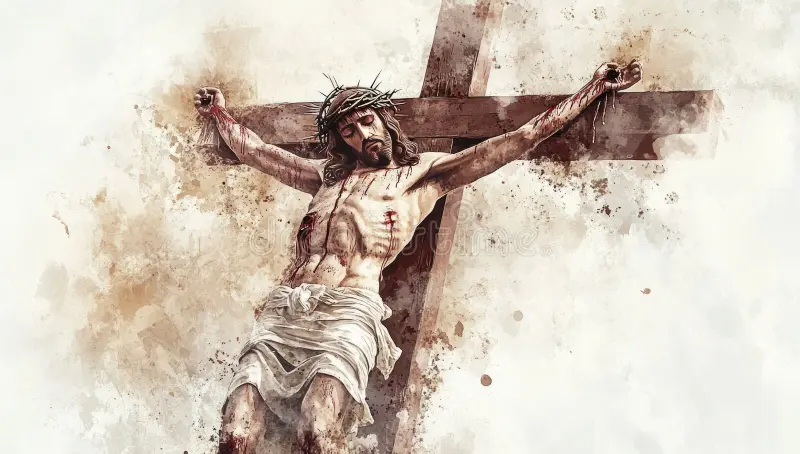

The cross was no ordinary instrument of execution. It was the slowest, most humiliating, most public death the Romans had ever devised to remind the subjugated who was in charge. And there they nailed him.
They nailed to the cross a man who had no golden crown, they nailed a man with a crown of thorns. He wasn’t a common criminal, but the only one who had never committed a crime. And yet, the cross doesn’t weigh because of the wood, it weighs because of what it reveals. Because on that cross, everything we are is laid bare.
On the cross we find the silence of God, which hurts more than the nails. On the cross is abandonment: “My God, my God, why have you forsaken me?” We find fear, burning physical pain, the mockery of passersby, the betrayal of friends, the utter loneliness of one who gave everything and now receives not a drop of comfort. Jesus does not die like a movie hero, with an epic line and background music; he dies like a real man: sweating blood beforehand, crying out with thirst on the cross, feeling how every breath becomes a battle.
He died carrying not only his own nails, but ours: Judas’s, Peter’s, mine, yours. Because that’s the most unsettling thing about Good Friday: it’s not that an innocent person died, it’s that this innocent person died for the guilty, and the guilty ones were us. Hanging there is the real price. Not those thirty pieces of silver, not a potter’s field. The price was his entire being: his broken body, his trampled dignity, his rejected love. And he paid it without haggling, without coming down from the cross to prove he could, without asking to be believed first. He simply gave everything, to the very end.
And meanwhile, the sky darkens, as if creation itself could not bear to witness what man was doing to his Creator, as if the sun were ashamed to continue shining upon such cruelty. There is something brutally honest about that cross: no embellishment, no pretty speech, just a naked man, bleeding, dying slowly, surrounded by thieves, soldiers, and onlookers. And in the midst of that horror, he utters words that defy all human logic: “Father, forgive them, for they do not know what they are doing.” Forgive them: those who shout “Crucify him!”, those who wash their hands, those who flee, those who stand by and watch from afar, you, me.
That is the most painful difference between the cross and any other death in history: he did not die cursing, he died forgiving; he did not die defeated, he died surrendered. And there, in that instant when all seems lost, when the Messiah hangs dead like a tombstone, the most insane part of the story is being written: that victory will not come with swords, nor with multitudes, nor with visible power, but precisely through this absurd path of love that allows itself to be killed without defending itself, through this obedience to the extreme, through this total surrender.
Good Friday doesn’t end with easy hope. It ends with a cold body, a sealed tomb, and a silence that weighs a ton. But that silence is sacred, because within it beats the most uncomfortable and liberating truth at the same time: that God didn’t love us when we were good, he loved us when we were exactly this—those who asked for his death, those who washed their hands of it, those who watched from afar, those who remained silent. And yet he stayed on the cross, he didn’t come down, he didn’t leave us halfway. That’s why today, Good Friday, we don’t look at the cross only with sadness; we look at it with shame, yes, but also with a wonder that cannot be explained in words, because where everything was broken, that’s where everything began to heal.

Juan Francisco Miguel
Juan Francisco Miguel es comunicador social, escritor y coach. Se especializa en liderazgo, narrativa y espiritualidad, y colabora con proyectos que promueven el desarrollo humano y la fe desde una mirada integral
Related
The “steps” that EASTER asks of us all
Mario J. Paredes
04 April, 2026
4 min
Messages for everyone from the Cross
Mario J. Paredes
03 April, 2026
5 min
Cardinal Arizmendi: Meeting of Indigenous Translators
Cardenal Felipe Arizmendi
03 April, 2026
4 min
How to Cope with Pain?
María José Calvo
02 April, 2026
6 min