 (EN)
(EN)
 (ES)
(ES)
 (IT)
(IT)

Spain: Funeral for the Victims of the Adamuz Train Accident
The Church of Huelva, gathered around the altar, offers its prayers for the victims and accompanies their families in their grief
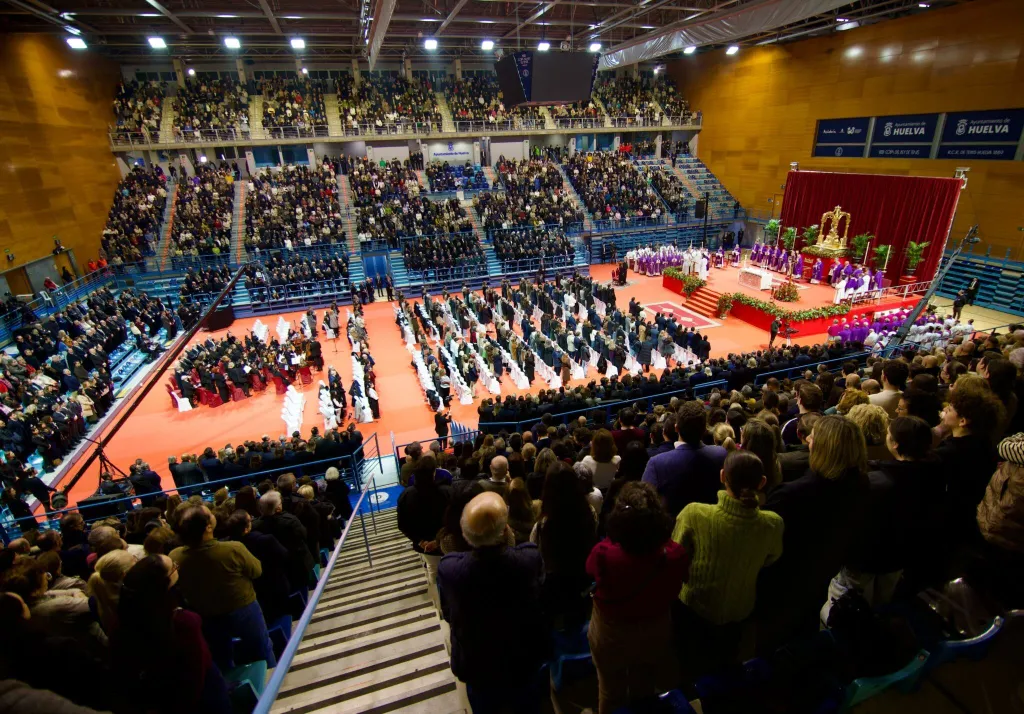

The funeral was attended by Their Majesties the King and Queen of Spain, Felipe VI and Letizia, along with relatives of the victims, civil and ecclesiastical authorities, and thousands of faithful who joined in the prayer of the Church.
The Carolina Marín Sports Palace hosted a funeral Mass on Thursday, January 29th, for the victims of the train accident in Adamuz. The service was marked by solemnity, profound spirituality, and intense emotion. Their Majesties King Felipe VI and Queen Letizia of Spain attended, along with family members of the victims, civil and ecclesiastical authorities, and thousands of faithful who joined in the Church’s prayer.
The Eucharist was presided over by the Bishop of Huelva, Bishop Santiago Gómez Sierra, and concelebrated by Bishop Luis Javier Argüello García, President of the Spanish Episcopal Conference; Bishop José Vilaplana Blasco, Bishop Emeritus of Huelva; and Bishop Jesús Fernández González of Córdoba, along with more than one hundred diocesan priests and priests from other dioceses, including the parish priest of Adamuz, Rafael Prados. The Gospel was proclaimed by the diocesan deacon Marcelo Zeballos.
A total of 4,350 worshippers participated in the service, in an atmosphere of profound respect and reflection. The 336 family members of the victims occupied a prominent space in the arena of the Sports Palace, which was furnished with more than 500 chairs thanks to the collaboration of the Huelva Provincial Council. The Merced Polyphonic Choir provided musical accompaniment to the liturgy, underscoring the prayerful dimension of the celebration with their singing.
The altar, presided over by the image of Our Lady of the Ribbon, patron saint of Huelva, and the crucifix venerated by Saint John Paul II during his pastoral visit in 1993, has become a spiritual focal point for those present. From there, the Bishop of Huelva delivered a homily marked by pastoral closeness and Christian hope amidst suffering.
“Today we gather with heavy hearts. The tragedy of the train accident in Adamuz has struck our lives like an unexpected blow… To you, their loved ones, we wish to embrace you with respect and express our closeness and our condolences.”
Monsignor Santiago Gómez Sierra reminded us that faith does not eliminate suffering, but it does accompany and illuminate it:
“Questions, complaints, even silence, have a place in the believing heart. God does not disapprove of our tears or our questions; on the contrary, He welcomes them. The pain of the victims and their families is not anonymous: it has been seen, heard, and received by the Lord.”
The most emotionally charged moment came just before the final blessing, when Liliana Sáenz, daughter of the late Natividad de la Torre, spoke on behalf of all the victims and their families. With a calm and steady voice, she delivered a deeply grateful and moving reading that resonated throughout the building.
In her remarks, Liliana first expressed her gratitude to the Diocese of Huelva for hosting the funeral, emphasizing that “the only presence we wanted by our side was that of God, who today made himself present in the bread and wine, under the gaze of his Mother, in her title of Our Lady of Cinti.” She also recalled the faith of the Andalusian people and the solace found “in embracing the cross.”
The speech also included words of gratitude towards the people of Adamuz, the emergency teams, the security forces, the Andalusian health service, the Red Cross, public institutions, and the city of Huelva, highlighting the humanity, compassion, and dedication received during the most difficult times. It also included a serene reference to the need for truth as an essential path to healing from pain.
Especially moving was his personal remembrance of his mother, Natividad, whom he described as a profoundly generous woman, and his assertion that the victims “are not just a number,” but lives full of stories, dreams, virtues, and hopes:
“They are not just the 45 on the train… they were our fathers, mothers, brothers, sons or grandsons… they were the joy of our awakenings and the refuge of our sorrows.”
The reading culminated in a lengthy and heartfelt poetic prayer to the Virgin, invoking the various Marian advocations so beloved in Andalusia, and concluding with a firm proclamation of Christian hope: that love may conquer hate, that life may conquer death, and that the day of the definitive reunion in God may come.
The celebration received extensive media coverage, with over 160 accredited individuals, allowing numerous faithful to join in spiritually from their homes. Additionally, more than two hundred religious communities from various Spanish dioceses offered simultaneous prayers.
The funeral was made possible thanks to the collaboration of the Huelva City Council and the Provincial Council. The City Council, through Emtusa (the city’s bus company), activated a special free urban transport service, and a mobile 061 emergency medical team with an ambulance and medical personnel was on hand throughout the ceremony.
The presence of Their Majesties the King and Queen of Spain, Felipe VI and Letizia, throughout the celebration, has been an eloquent gesture of closeness and solidarity with the families and with the society wounded by this tragedy.
The diocesan funeral concluded in profound prayerful silence, a sign of a Church that accompanies, consoles and waits, and of a community that, even though pierced by pain, is sustained by faith, communion and Christian hope.
Homily of Bishop Santiago Gómez Sierra, Bishop of Huelva
Your Majesties,
Brother Bishops, priests and deacons,
families of the deceased and injured,
national, regional, provincial and local civil authorities, military, judicial and academic authorities,
Brothers and sisters, loved by the Lord:
Today we gather with heavy hearts. The tragedy of the train accident in Adamuz has struck us like an unexpected blow, leaving us grieving for the victims and deeply concerned for the injured and their families. To you, their loved ones, we extend our heartfelt condolences and deepest sympathy. We pray for those who have died, that God may grant them eternal rest and embrace them in His infinite love.
Your Majesties, we acknowledge your presence as a gesture of closeness and solidarity with the families of the victims and with the entire community of Huelva. We also extend our gratitude to the other authorities and all those who serve the community for their presence during these days of shared grief.
We are here because human suffering needs to be accompanied, and because we believe that, even in the darkest night, by lifting our eyes to God we can glimpse a ray of light and hope. God speaks to us on many occasions and in many ways, as he did to his chosen people, and now he addresses us through his Son, our Lord Jesus Christ, the Word made flesh.
The Word of God does not ignore the suffering of his people. The Book of Lamentations, which we heard in the first reading, springs from the experience of a devastated, bewildered people: “ I have lost peace, I have forgotten joy… Remembering my affliction is like wormwood and poison; I keep thinking about it, I am desolate ,” says the prophet. These words could be our own today. They are the tears of those who have lost a loved one; the sentiment of many Christian communities and of Spanish society itself, which finds neither easy explanations nor quick answers.
But in the midst of this lament, Sacred Scripture offers us a message: pain is not a lack of faith. Questions, complaints, even silence, have a place in the believing heart. God is not scandalized by our tears or our questions; on the contrary, He welcomes them. The pain of the victims and their families is not anonymous: it has been seen, heard, and received by the Lord. God is not indifferent to suffering; He walks with us when we pass through dark valleys. Therefore, as the Word we have heard continues, there is something I remember, and therefore I will wait: For the goodness of the Lord never ceases, his mercy never comes to an end .
Today, the Gospel according to Saint Mark also leads us to Calvary. At noon, darkness came over the whole land until three in the afternoon . The Gospel does not conceal the darkness, does not shorten the end, does not soften the drama. There is darkness, there is a cry, there is death. Jesus’ exclamation, ” My God, my God , why have you forsaken me?” is the voice of every human being who experiences unexpected loss and the emptiness left by death. God himself, in his Son, has uttered that cry.
And it was precisely there, at the foot of the cross, that a centurion, a pagan man, seeing Jesus die, said: “Truly this man was the Son of God .” This confession of faith did not arise from contemplating the success or glory of the Nazarene, but from glimpsing in the Crucified One love taken to the extreme, discovering it even when all seemed lost.
But the Gospel does not end with the death of Jesus. We have also heard the proclamation that changes history: Do not be afraid. Are you looking for Jesus of Nazareth , the crucified one ? He has risen. He is not here . The Risen One is the same one who was crucified. He is not someone else. He carries with him the wounds, the pain he endured, the life he gave up. And this concerns all of us, for as the Apostle Saint Paul tells us: If we have died with Christ, we believe that we will also live with him (Romans 6:8) . Therefore, we believe that the people for whom we pray today have not been lost, trapped in the senselessness of an unexpected death. Their lives, their names, and their stories are now and forever in the hands of the God of Life, who has revealed himself to us in the death and resurrection of Jesus Christ, our Lord.
Today, at this diocesan funeral, we do not come to deny the wound you have suffered, dear families of the victims, nor to cover it with beautiful words. We come to incorporate the names of those who have lost their earthly lives and your own grief into the sacrifice of Christ. So that, even in suffering, as the Letter to the Hebrews says: we may be strengthened and encouraged by the hope that is in him, which is an anchor for the soul, firm and secure. It enters the curtain behind the curtain of earthly death (Hebrews 6:18-19).
In this moment of sorrow, we also want to pause to give thanks. Thanks to those who were the first to arrive, to the residents of Adamuz, to the emergency teams, healthcare workers, security forces, volunteers, and support staff. Thanks to those who have offered their support with a discreet and close presence: to the priests and so many others who have offered their time, a listening ear, resources, and prayers. In every act of help, we have been able to perceive a reflection of God’s compassion.
And alongside gratitude comes a commitment. Because the suffering of these families will not end when the spotlights fade or the news of this tragic event dies down. Accompanying them in their grief and repairing the damage they have suffered will be a long and demanding task. It involves the entire society and also those who hold public office. It is necessary to uncover the truth of what happened and act justly, so that their sacrifice is not forgotten and so that, as far as possible, similar tragedies are prevented in the future.
Before concluding, we place all that we are and all that hurts us today under the maternal gaze of Mary, the Virgin of the Ribbon, our Mother and Patron Saint, to whom Huelva has always turned in moments of joy and affliction.
Holy Mary, Virgin of the Ribbon,
Mother of the Crucified and Risen One,
take under your protection those who have lost their lives
and present them to your Son.
Comfort the grieving families,
support those who feel downcast,
and give us an attentive and compassionate heart
to accompany with respect and closeness.
Faithful Virgin, who stood at the foot of the cross,
teach us to trust, even in the night of sorrow,
in God’s promise.
Holy Mary of the Ribbon,
pray for us.
Amen.
Full reading by Liliana Sáenz on behalf of the victims
Your Majesties, most excellent civil and ecclesiastical authorities who accompany us…
Today, as the storm raging within us seems to be calming down, we want to begin these words by giving thanks.
First of all, thanks to our Diocese for this funeral, the only funeral that fit in this farewell, because the only presidency we want by our side is that of the God who today has made himself present here in the bread and wine, under the gaze of his Mother, in her Cinti advocation.
Huelva is a Marian land, Andalusia is a believing people and it is by embracing its cross that we find the greatest consolation.
Thank you to those who join us out of love, compassion, empathy… thank you even to those who do it because of their schedule.
Thanks to the people of Adamuz, that little corner that we will never forget and that will never forget, as well as to the city of Cordoba, to whom we feel and will feel united forever… without thinking of the consequences, they did not hesitate to plunge into the chaos of twisted iron, blood, pain and tears.
They accompanied our wounded until they were sure they were safe and then they accompanied us in our grief… they provided us with sustenance and shelter during those bitter days, but above all, they gave all their love, dedication and desire to make that difficult moment hurt a little less.
Thanks to the security and emergency services who responded promptly, as always, to the call… they did what they could with the information and resources they had… thank you for your empathy, your support and your affection in the days that followed.
Thanks to the Andalusian healthcare system, undoubtedly sustained by the professionals who work within it. I know what it’s like to come home from a bad shift and hug your children because you know someone else will never be able to do that with theirs again. I know what it’s like to try to heal the body of someone whose soul is mortally wounded… it must have been incredibly hard, colleagues, thank you.
Thanks to the Red Cross staff and volunteers, who never let go of our hand…
If you can’t cure, relieve…
If you can’t relieve pain, comfort it…
If you can’t console, accompany…
Thanks to our regional institutions, which stepped up from the very beginning, enduring the chaos and the onslaught of our own anxiety… allow me, however, to criticize the slowness of the information because, believe me, it is better to know than to imagine.
Thanks also, of course, to the small local corporations whose neighbors were spreading the word that something serious was shaking the foundations of the community and felt our hardship as their own… dear Pilar, dear mayors… you have shown that you have to be great as people to be great as public servants.
And thank you, infinite thanks to Huelva, our beloved city blessed by the sun, which has never stopped embracing us in an extraordinary way, conveying to us the greatness of its love and its own pain, thus trying to make ours a little less heartbreaking.
And so the days have passed and the pain is giving way to memories and our heart, still with the same sword stuck in it, begins to sketch small and timid smiles when a thousand past images continually burst into our mind.
I was just a few years old when one day I asked my mother, “Mommy, how much money do you earn?” I suppose it was something we kids talked about.
“Just enough, darling,” she told me, “because what’s left in my account at the end of the month isn’t mine.”
“And whose is it, Mom?” I asked because I didn’t understand.
“From the others,” she told me.
That’s how my mother was… generous with everything she had, generous with her desires, generous with her time, generous with her smiles… that’s how she was.
What we lost on that fateful Sunday, January 18th, was not just a number… it was train cars full of virtues and defects, train cars full of triumphs and defeats, train cars full of longings and silences… it was train cars full of hope.
Because they are not just the 45 on the train…
They were our fathers, mothers, brothers, sons or grandsons…
They are not just the 45 from the train…
They were the joy of our awakenings and the refuge from our sorrows…
They are not just the 45 from the train…
They were the hope of seeking a better future, the joy of enjoying moments with family, or the desire to return to our loved ones… they were what will never be again…
Because they are not just the 45 on the train,
They were part of a society so polarized that it began to crack a long time ago and we are not realizing it.
They are not just the 45 on the train…
But it’s the 45 on the train…
And we…
We are the 45 families whose clocks stopped at 7:45 on that fateful afternoon.
We are the 45 families who embraced each other in that civic center, where the passage of time was flooded with silence and the silence gave way to tears when we began to understand, in the slow advance of the hours, that we would return without them.
We are the 45 families who have learned, with too much cruelty, that the call that is not made remains unmade and the kiss that we do not give is the one we remember the most.
We are the 45 families who would trade all the gold in the world, which is now worthless, to be able to move the hands of the clock by just 20 seconds.
And we are also the 45 families who will fight to know the truth, because only the truth will help us heal this wound that will never close.
We will know the truth, we will fight to ensure there is never another train, but we will do so with serenity, with relief, with the peace of knowing that…
In the arms of the Virgin
now they sleep
and the lap of a Mother who loves them
is the one who rocks them.
Little Virgin of the Ribbon,
Patron saint of this great town,
Give them peace, serenity,
eternal rest.
Beautiful Virgin, lovely Virgin,
Don’t let them go from your side,
so they don’t feel the pain,
that they do not feel misery.
That love and truth
shelter them forever
and in the embrace of God
life triumphs over death.
Mother of Almudena,
Virgin who guides the way,
Take them the silent kiss,
that goodbye we didn’t give them.
Remedios, dear Mother,
Queen of the Aljaraqueño,
Give them your firm hands,
that they will never be afraid again.
Mother of Beautiful Love,
Queen of Victory,
Sorrows of black mourning,
Grant them glory.
And guide our lives as well,
humble Virgin of the Sun,
and that mercy
can in our hearts.
Make this pain stop,
Dark-skinned Virgin of Carmen,
Take this cruel sword away
with the foam of the seas.
And you, Virgin of El Rocío,
the one who illuminates my sleepless nights,
the one who is always with me
when I break down inside,
embrace their hearts
and take them a sigh
with a love song
for the years we shared.
Tell them we have peace.
and that we will be brave,
that hatred will not be born
in the rage that grows within us.
That smiles will return
and we will continue living,
And this love will not die,
He will live off his memories.
Tell them, White Dove,
Shepherdess of Rocina,
that we will always feel them
with the sun or with the breeze.
And that with faith we will wait.
until that moment arrives
in which God embraces us
and so we may meet again.
Rest in peace…

Exaudi Staff
What is Exaudi News? Exaudi News is an international Catholic media outlet that informs, shapes, and transforms daily in Spanish, English, and Italian. Through news, analytical articles, and live broadcasts of the Pope's events, Exaudi seeks to strengthen Christian unity and contribute to the evangelization of the world, always guided by the Church's social doctrine. We work to bring Christian truth and values to every corner of the planet. Help us transform the world with Exaudi! At Exaudi, we believe that evangelization and quality information can change lives. To continue our mission and expand our reach, we need your help. In addition, we are looking for committed people to join our team. With your support, we will reach more people, spread the message of Christ, and strengthen Christian unity. Will you join our mission? For more information on how to collaborate, visit Exaudi.org or contact us directly: [email protected] Exaudi: Informs, educates, and transforms.
Related
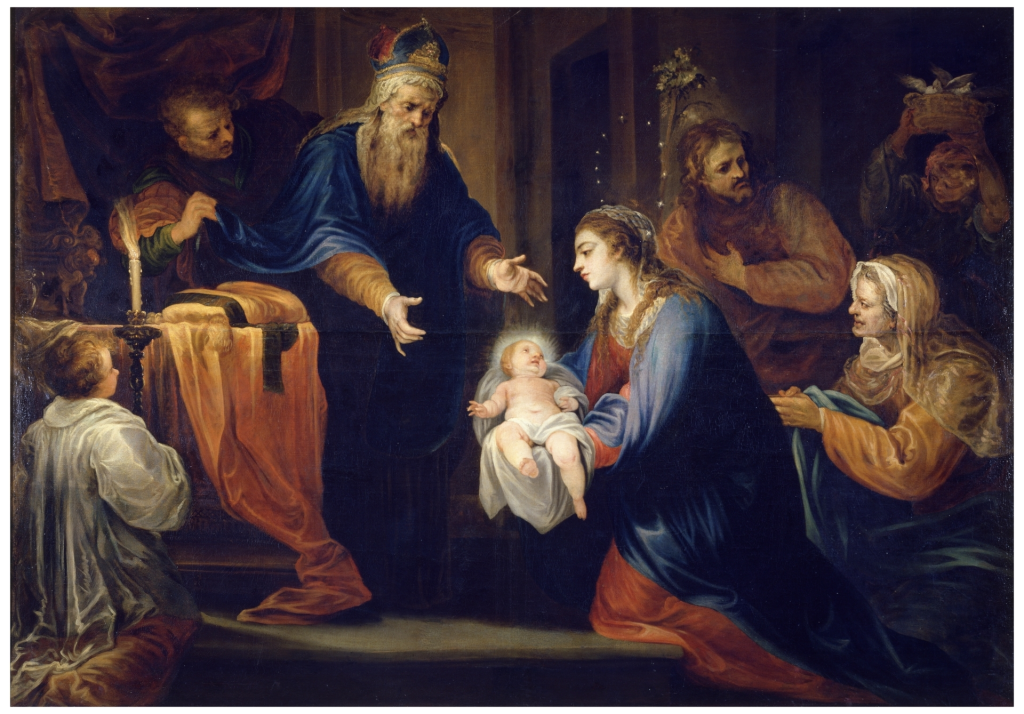
The Presentation of Jesus in the Temple and the Purification of the Virgin
Manuel González
02 February, 2026
8 min

Reflection by Bishop Enrique Díaz: Rejoice and leap for joy…
Enrique Díaz
01 February, 2026
5 min
The Pain of Saint Joseph’s Doubts and the Joy of the Angel’s Message
Miguel Morales Gabriel
01 February, 2026
2 min

Four teachings of Don Bosco
Exaudi Staff
31 January, 2026
3 min