 (EN)
(EN)
 (ES)
(ES)
 (IT)
(IT)

Saint Thomas More: A Non-Negotiable Conscience
A man of faith who demonstrated that politics is only noble when it serves the truth
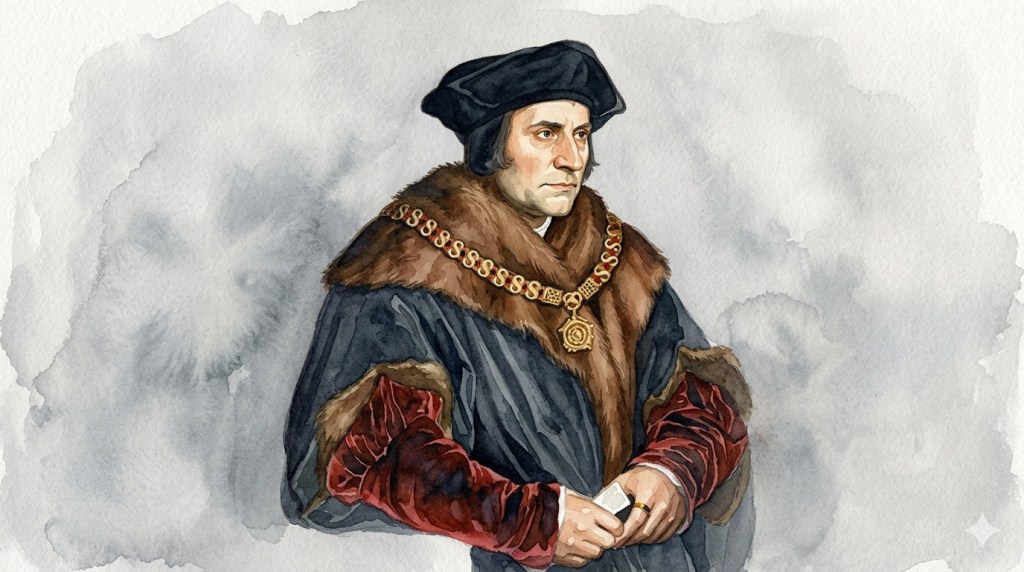

There are historical figures who never age. Not because they belong to the past, but because they seem written for the future. Saint Thomas More is one of them. His life was not that of an idealist detached from the world, but rather that of a man immersed in power, political tensions, religious conflicts, and the pressures of authority. Precisely there, in the midst of it all, he chose fidelity to his conscience. That is why today, when politics is suffering a profound moral crisis, his figure appears as a clear, demanding, and deeply hopeful reference point.
He was neither a revolutionary nor an agitator. He was something more difficult: a man of principle.
Man: a formed, not improvised, conscience
To understand Thomas More, it is not enough to look at his martyrdom. We must look at his daily life. He was a loving father, a prestigious jurist, a refined intellectual, and a Christian deeply rooted in prayer. Catholic sources highlight his spiritual discipline: daily Mass, long hours of silence, reading Scripture, and a personal austerity that contrasted sharply with his social standing.
His ultimate consistency did not emerge at the last moment; it was the consequence of an inner life cultivated over years. More knew that conscience is not a feeling, but a judgment that must be formed in the light of truth. That is why he never allowed himself to be swayed by the emotion of the moment or by political pressure.
There is a quote of his that illuminates this attitude:
“A right conscience is a fortress that no power can tear down.”
It wasn’t about obstinacy, but about fidelity. Not about pride, but about obedience to God. This distinction is key to understanding his character: More didn’t confront power out of rebellion, but because he couldn’t betray what he had recognized as true.
The politician: when power demands inner renunciation
As Chancellor of England, Thomas More was no naive politician. He was familiar with court intrigues, shifting alliances, and the fragility of power. However, he understood politics as service to the common good, not as the absolute exercise of authority.
When the king demanded recognition of his religious supremacy, More chose the quietest and most resolute path: he refused to swear allegiance. He did not organize opposition, he did not publicly attack, he did not provoke open conflict. He simply refused. His resistance was internal, legal, and moral.
This silence was interpreted as dangerous. Because those in power tolerate noisy opposition better than quiet consistency. Moro didn’t need to convince anyone; it was enough for him not to betray himself.
In that context he wrote one of his most famous phrases, which sums up his entire political stance:
“I die being a good servant of the king, but first of God.”
This statement is not a dramatic gesture. It is a summary of his thinking. Political power is legitimate, but not absolute. Civil obedience is necessary, but it cannot replace obedience to the truth. Authority deserves respect, but not worship.
Today, when politics tends to absolutize consensus or utility, this idea is profoundly relevant: there are decisions that cannot be made simply because they are convenient.
Inner freedom versus fear
One of the most impressive aspects of Thomas More is his serenity. During his imprisonment, he maintained his sense of humor, wrote affectionate letters to his family, and rejected any form of resentment. There is no bitterness in him, only peace.
This can only be understood from the perspective of his inner freedom. Moro had already renounced what many consider essential: prestige, security, influence. When the ultimate test arrived, he simply continued on the path he had been following for years.
In prison he wrote to his daughter Margaret:
“Nothing can happen to me that God does not want. And everything He wants, however bad it may seem to us, is actually for the best.”
It wasn’t a pious remark, but a profound conviction. Faithfulness to his conscience didn’t take his life; it gave it meaning.
An example for the present
Saint Thomas More speaks particularly to our time. Not because he offers technical solutions, but because he reminds us of something more essential: politics depends on the moral character of those who practice it.
His example teaches that conscience is not an obstacle to governing, but its foundation. It teaches that truth does not change with the majority. It teaches that unlimited power ultimately demands man’s inner renunciation.
But it also teaches something more hopeful: that it is possible to live politics without losing your soul.
Moro did not seek martyrdom. He sought consistency. He did not want to confront the king. He wanted to remain faithful to God. He did not pretend to be a hero. He simply did not want to lie.
That’s why his life remains relevant. Because in a world where everything seems negotiable, he reminds us that some things are not: the dignity of conscience, moral truth, and fidelity to God.
His testimony remains a silent but firm call: politics needs free men. Free from fear, self-interest, and ambition. Men capable of serving without selling their conscience.
Saint Thomas More was one of them. And that is why, centuries later, his voice continues to resonate with a clarity that is both unsettling and illuminating.
Javier Ferrer García
Soy un apasionado de la vida. Filósofo y economista. Mi carrera profesional se ha enriquecido con el constante deseo de aprender y crecer tanto en el ámbito académico como en el personal. Me considero un ferviente lector y amante del cine, lo cual me permite tener una perspectiva amplia y diversa sobre el mundo que nos rodea. Como católico comprometido, busco integrar mis valores en cada aspecto de mi vida, desde mi carrera profesional hasta mi rol como esposo y padre de familia
Related

Grandparents as Guardians of the Memory of Faith
Miguel Morales Gabriel
08 April, 2026
7 min
Romana Editorial releases “The Power of the Gospel” by Pope Leo XIV: Christian Faith in 10 Key Words
Exaudi Staff
08 April, 2026
2 min

From Bustle to Sacred Silence: The Fulfilled Vocation of Parents
Laetare
07 April, 2026
5 min
Poland: Another Step in the Coup d’État
Wlodzimierz Redzioch
07 April, 2026
5 min