(EN)
(EN)
 (ES)
(ES)
 (IT)
(IT)

Remembering is Another Way to Love
Coco


Some families talk a lot.
And some families keep long silences.
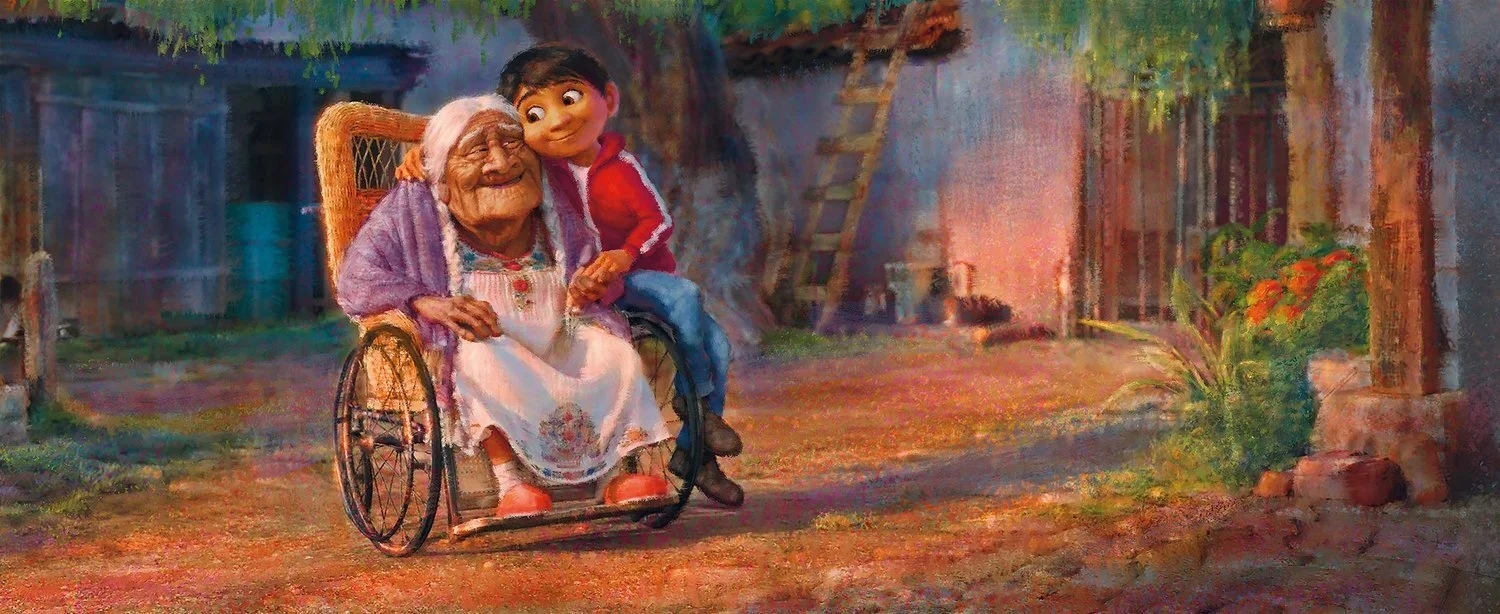
In Coco , music is forbidden. Not on a whim, but because of an old wound. And that’s where it all begins: when love and fear become so intertwined that they are no longer distinguishable.
Miguel doesn’t want to break away from his family.
He wants to understand them.
And, at the same time, he wants to be himself.
Does that tension sound familiar?
It’s not about choosing between sleep or family.
The film could have remained a simple conflict:
“pursue your dream even if no one understands you.”
But it goes much further.
What Miguel discovers is not just his talent.
He discovers that his story doesn’t begin with him.
This connects with The Secret of Kells :
tradition is not a cage.
It is a legacy that can live on if we learn to engage with it.
The question isn’t whether you should break with what you’ve inherited.
The question is:  what do you do with it?
For young people: not every conflict is a breakup
If you’re growing up, you might feel like your family doesn’t understand you.
That your interests don’t fit in.
That your dreams seem too different.
Coco suggests something important:
sometimes conflict isn’t a lack of love.
It’s a lack of communication.
Before breaking up, it’s wise to ask.
Before running away, it’s wise to listen.
What if the story that weighs you down is also the one that sustains you?
For families: tradition is not prohibition
There is something very delicate in the film:
Miguel’s family does not act out of malice, but out of fear.
And that is profoundly real.
How often do we forbid something because we believe that in doing so we are protecting others?
How often do we turn a painful experience into a permanent norm?
Coco reminds us that honoring memory is not about freezing it.
It’s about allowing it to evolve.
As in Persepolis , tradition can become rigid when driven by fear.
But it can also become a source of strength when sustained by love.
To remember is to keep alive
The film’s great emotional lesson isn’t in the music.
It’s in the memory.
In a fast-paced world where the new replaces the old, Coco proposes something almost revolutionary:
As long as someone remembers you, you remain part of history.
That changes the way we understand death.
And also the way we understand life.
For educators: identity is also memory
Working on identity isn’t just about talking about the future.
It’s about talking about the past.
Coco allows you to open conversations about:
- family memories
- mourning and celebration
- vocation and belonging
- culture as a shared space
And, above all, about reconciliation.
Not all growth implies rupture.
Sometimes it implies integration.
The question that remains
What part of your family history are you rejecting…
without realizing that it is also shaping you?

Marketing y Servicios
Ideas para mejorar el mundo . Director: José Miguel Ponce . Profesor universitario e investigador en Marketing y Gestión de Servicios, con experiencia en cinco universidades públicas y privadas. Sevillano de origen, ha vivido en varias ciudades de España y actualmente reside en Sevilla. Apasionado por la educación, la comunicación y las relaciones humanas, considera la amistad y la empatía clave en su vida y enseñanza. Ha publicado investigaciones sobre Marketing, Calidad de Servicio y organizaciones sin ánimo de lucro. Humanista y optimista, promueve el agradecimiento y la coherencia como valores fundamentales.
Related