 (EN)
(EN)
 (ES)
(ES)
 (IT)
(IT)

Pope Leo XIV: The Church hierarchy is born of Christ to proclaim the Gospel
General Audience: The hierarchical structure is not a human construct, but a divine institution at the service of the unity, mission, and sanctification of the People of God
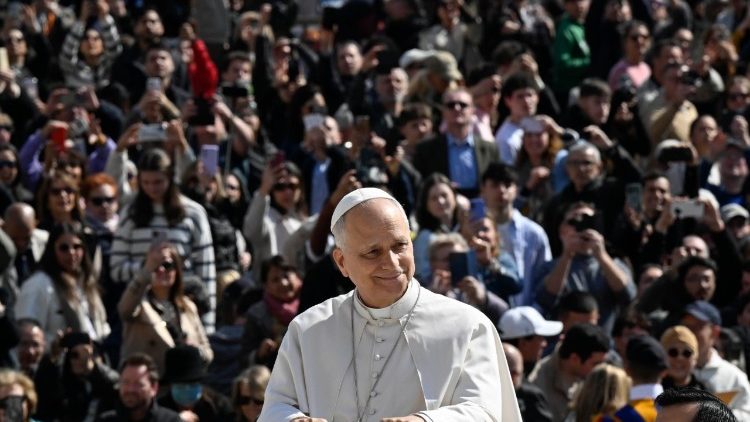

In the traditional General Audience held in St. Peter’s Square, Pope Leo XIV continued his cycle of catechesis on the documents of the Second Vatican Council, focusing this time on Chapter III of the Dogmatic Constitution Lumen gentium , dedicated to “The hierarchical constitution of the Church and in particular of the episcopate.”
The Holy Father recalled that the Church finds its foundation in the Apostles, chosen by Christ as “living pillars” of his Mystical Body. This hierarchical dimension is not a later element or an addition to the People of God, but rather has accompanied the community of the redeemed from its very beginning. As the Pope explained, the Apostles were simultaneously “the seed of the new Israel and the origin of the sacred hierarchy.”
“The Council teaches that the hierarchical structure is not a human construct, functional to the internal organization of the Church as a social body, but a divine institution destined to perpetuate the mission given by Christ to the Apostles until the end of time,” Leo XIV emphasized.
A ministry of service, not of power.
The Pope emphasized that the Church hierarchy operates in service to the unity , mission , and sanctification of all members of the Church. Through apostolic succession, the Apostles transmit their ministry to men who, until the return of Christ, continue to sanctify, guide, and instruct the People of God.
Leo XIV clearly distinguished between the common priesthood of all the faithful and the ministerial or hierarchical priesthood , which “differs essentially and not only in degree” from the former, although both participate in the one priesthood of Christ and are mutually ordered. Bishops, priests, and deacons receive sacra potestas (sacred power) and munera (tasks) to serve the faithful, thus shaping their authority as true “diaconate” or service.
“Lumen Gentium repeatedly reminds us of the collegial and communal nature of this apostolic mission,” the Pope noted, citing the fact that the office entrusted to pastors is a true service. He also recalled the words of Saint Paul VI, who described the hierarchy as “a reality born of the charity of Christ, to fulfill, spread, and guarantee the complete and fruitful transmission of the treasure of faith, examples, precepts, and charisms left by Christ to his Church.”
Closing prayer for new ministers
At the conclusion of his catechesis, the Holy Father invited those present to pray with these words:
“Let us pray to the Lord that He may send to His Church ardent ministers of evangelical charity, dedicated to the good of all the baptized and courageous missionaries in all parts of the world.”
The audience on March 25, presided over by the Pope under a sunny sky in St. Peter’s Square, brought together thousands of faithful and pilgrims who attentively followed the reflection on the divine and service-oriented nature of the hierarchical structure of the Catholic Church.
This catechesis is part of the series dedicated to Lumen gentium , in which Pope Leo XIV has been deepening the identity of the Church as the People of God, its holiness and now its hierarchical constitution, always with the horizon of the evangelizing mission in the world today.
Full text of the catechesis:
LEO XIV
GENERAL AUDIENCE
St Peter’s Square
Wednesday, 25 March 2026
_________________
Catechesis. The Documents of Vatican Council II. II. Dogmatic Constitution Lumen gentium. 5. On the foundation of the Apostles. The Church in her hierarchical dimension”
Dear brothers and sisters, good morning and welcome!
We will continue our catecheses on the Documents of the Second Vatican Council, commenting on the Dogmatic Constitution Lumen gentium on the Church (LG). After presenting her as the People of God, today we will consider her hierarchical form.
The Catholic Church is founded on the Apostles, whom Christ appointed as the living pillars of His mystical Body, and possesses a hierarchical structure that works in the service of the unity, mission and sanctification of all her members. This sacred Order is permanently founded on the Apostles (cf. Eph 2:20; Rev 21:14), as authoritative witnesses to the resurrection of Jesus (cf. Acts 1:22; 1 Cor 15:7) and sent by the Lord Himself on mission into the world (cf. Mk 16:15; Mt 28:19). Since the Apostles are called to faithfully preserve the Master’s salvific teaching (cf. 2 Tim 1:13–14), they hand on their ministry to men who, until Christ’s return, continue to sanctify, guide and instruct the Church “through their successors in pastoral office” (Catechism of the Catholic Church, no. 857).
This apostolic succession, founded on the Gospel and in the Tradition, is explored further in Chapter III of Lumen gentium, entitled “On the hierarchical structure of the Church and in particular on the Episcopate”. The Council teaches that the hierarchical structure is not a human construct, functional to the internal organization of the Church as a social body (cf. LG, 8), but a divine institution whose purpose is to perpetuate the mission given by Christ to the Apostles until the end of time.
The fact that this theme is addressed in Chapter III, after the first two chapters have considered the very essence of the Church (cf. Acta Synodalia III/1, 209–210), does not imply that the hierarchical constitution is a subsequent element with respect to the People of God: as the Decree Ad gentes notes, “the Apostles were the first budding-forth of the New Israel, and at the same time the beginning of the sacred hierarchy” (no. 5), inasmuch as they were the community of those redeemed by Christ’s Paschal Mystery, established as a means of salvation for the world.
To understand the Council’s intention, it is advisable to read carefully the title of Chapter III of Lumen gentium, which explains the fundamental structure of the Church, received from God the Father through the Son and brought to fulfilment by the outpouring of the Holy Spirit. The Council Fathers did not want to present the institutional elements of the Church, as the noun “constitution” might imply if understood in the modern sense. The Document concentrates instead on the “ministerial or hierarchical priesthood”, which differs “in essence and not only in degree” from the common priesthood of the faithful, recalling that the latter are “nonetheless interrelated: each of them in its own special way is a participation in the one priesthood of Christ” (LG, 10). The Council thus addresses the ministry conferred upon men endowed with sacra potestas, sacred power (cf. LG, 18) for service in the Church: it focuses in particular on the episcopate (LG, 18–27), then on the priesthood (LG, 28) and the diaconate (LG, 29) as degrees of the one sacrament of Holy Orders.
By the adjective “hierarchical”, therefore, the Council intends to indicate the sacred origin of the apostolic ministry in the action of Jesus, the Good Shepherd, as well as its internal relationships. The Bishops, first and foremost, and through them the priests and deacons, have received tasks (in Latin munera), which lead them to the service of “all those who belong to the People of God”, so that, “working toward a common goal freely and in an orderly way, [they] may arrive at salvation” (LG, 18).
Lumen gentium repeatedly and effectively recalls the collegial and communal nature of this apostolic mission, reaffirming that the “duty which the Lord committed to the shepherds of His people is a true service, which in sacred literature is significantly called ‘diakonia’ or ministry” (LG, 24). We can therefore understand why Saint Paul VI presented the hierarchy as a reality “born of the charity of Christ, to fulfil, spread and ensure the intact and fruitful transmission of the wealth of faith, examples, precepts and charisms bequeathed by Christ to His Church” (Address, 14 September 1964, in Acta Synodalia III/1, 147).
Dear sisters and dear brothers, let us pray to the Lord that He may send to His Church ministers who are ardent with evangelical charity, dedicated to the good of all the baptized, and courageous missionaries in every part of the world.
____________________________________________________
Special greetings:
I extend a warm welcome to all the English-speaking pilgrims and visitors taking part in today’s Audience, especially those coming from England, Ireland, Tanzania, Israel, Saudi Arabia and the United States of America. I greet in particular the students of the University of Dallas Rome Program. As we continue our Lenten journey, let us ask the Lord to grant us the grace to imitate Our Blessed Mother in her total “yes” to the Lord, and so open our hearts to his will for our lives. Upon all of you and your families, I invoke the joy and peace of our Lord Jesus Christ. God bless you all!
_____________________________
Summary of the Holy Father’s words:
Dear brothers and sisters,
In our ongoing catechesis on the Second Vatican Council, today we reflect on the teachings of the Dogmatic Constitution Lumen Gentium concerning the hierarchical structure of the Church. In this regard, it is helpful to bear in mind that the Church is not something we invented, but is a divine institution established by Jesus himself. Christ appointed the apostles, placing Peter at their head, and sent them out to continue his salvific mission until his return in glory. To perpetuate this same mission, ministers were invested with sacred power to be the successors of the Apostles as Bishops, in whose ministry priests and deacons likewise participate through the Sacrament of Holy Orders. Sharing in the ministry of Jesus, the Good Shepherd, they are consecrated to serve the faithful, build up the Church and ensure the fruitful transmission of the faith. Let us therefore ask the Lord to continue to bless his Church with shepherds after his own heart.

Exaudi Staff
What is Exaudi News? Exaudi News is an international Catholic media outlet that informs, shapes, and transforms daily in Spanish, English, and Italian. Through news, analytical articles, and live broadcasts of the Pope's events, Exaudi seeks to strengthen Christian unity and contribute to the evangelization of the world, always guided by the Church's social doctrine. We work to bring Christian truth and values to every corner of the planet. Help us transform the world with Exaudi! At Exaudi, we believe that evangelization and quality information can change lives. To continue our mission and expand our reach, we need your help. In addition, we are looking for committed people to join our team. With your support, we will reach more people, spread the message of Christ, and strengthen Christian unity. Will you join our mission? For more information on how to collaborate, visit Exaudi.org or contact us directly: [email protected] Exaudi: Informs, educates, and transforms.
Related
Leo XIV: “Cease fire and work for peace through dialogue”
Exaudi Staff
25 March, 2026
1 min
“Airplanes must always be carriers of peace, never of war”
Exaudi Staff
24 March, 2026
5 min
Pope Leo XIV: “Come out!” from the tomb of selfishness and materialism
Exaudi Staff
22 March, 2026
6 min
“The unity of all in God is an evangelical sign that constitutes a prophetic force for the world.”
Exaudi Staff
22 March, 2026
6 min