 (EN)
(EN)
 (ES)
(ES)
 (IT)
(IT)

Pope Leo XIV on Holy Thursday: Christ’s Love is both gesture and nourishment
The Pope presides over his first Mass of the Lord's Supper at St. John Lateran and washes the feet of twelve priests, recalling that God's greatness is revealed in humble service
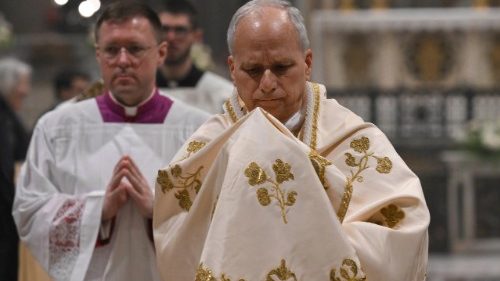

In the Basilica of St. John Lateran, the cathedral of the Bishop of Rome, Pope Leo XIV celebrated the Mass of the Lord’s Supper this Holy Thursday, beginning the Easter Triduum. It was a celebration marked by fervent gratitude and genuine fraternity, in which the Pontiff recalled that the love of Christ becomes concrete action and spiritual nourishment, purifying false images of God and humanity.
During his homily, Leo XIV emphasized that at the Last Supper, Jesus’ love becomes “gesture and food.” “In the world, precisely where evil prevails, Jesus loves definitively, forever, with his whole being,” he affirmed. The washing of the feet is not only a moral example, but the very offering of Christ’s life: “What the Lord shows us, taking the water, the basin, and the apron, is much more than a moral model. He gives us his own way of life; washing feet is a gesture that sums up God’s revelation, an exemplary sign of the Word made flesh.”
The Pope, dressed in a simple white vestment, knelt before twelve priests of the Diocese of Rome and humbly washed their feet. Among them were eleven young priests ordained by him on June 27, 2025—Andrea Alessi, Gabriele Di Menno Di Bucchianico, Francesco Melone, Clody Merfalen, Federico Pelosio, Marco Petrolo, Pietro Hieu Nguyen Huai, Matteo Renzi, Giuseppe Terranova, Simone Troilo, and Enrico Maria Trusiani—and Father Renzo Chiesa, his spiritual director at the Pontifical Roman Major Seminary.
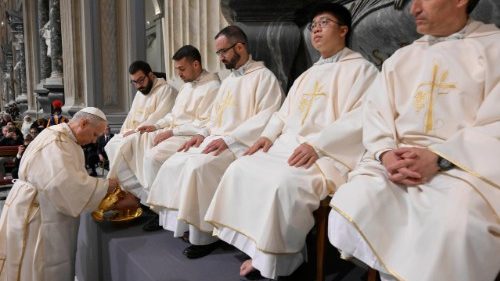
With this gesture, Leo XIV returned to a more classical tradition, celebrating Mass in the cathedral of Rome and choosing priests from his diocese, in contrast to the pastoral choices of his predecessor. In doing so, he wished to emphasize the link between the Eucharist and the priesthood: both sacraments express the total self-giving of Jesus, “High Priest and living Eucharist.”
In his reflection, the Pope quoted Benedict XVI to remind us that “we systematically desire a God of success and not of passion.” True divine omnipotence is not manifested in domination, but in free and humble service: “God serves us, yes, but with the free and humble gesture of washing feet: therein lies the omnipotence of God.”
Leo XIV insisted that this act purifies both the image of God—stained by idolatry and blasphemy—and the image of man, who often considers himself great when he dominates, conquers, or is feared. “Christ, true God and true man, gives us instead an example of self-giving, service, and love.” He added: “By washing our flesh, Jesus purifies our soul. In him, God has given an example not of how to dominate, but of how to liberate; of how to give life, not how to destroy it.”
Addressing the priests in particular, he reminded them of their mission: “to carry on their shoulders those who are lost, to offer forgiveness to those who have erred, and to seek out those who have strayed.” Service, he emphasized, is not something abstract, but a “duty of the heart,” an act of obedient love that must be performed “not out of convenience, malice, or hypocrisy, but solely out of love.”
At the conclusion of the Liturgy of the Word and the Eucharist, the Pope carried the Blessed Sacrament in procession to the Chapel of St. Francis for its repositioning, marking the beginning of the silence and adoration that characterize these holy hours. The celebration, concelebrated by Cardinal Vicar Baldo Reina and other cardinals, brought together numerous faithful, bishops, and priests from the Curia and the Vicariate of Rome.
With this first Holy Thursday of his pontificate, Leo XIV invited the entire Church to cross the threshold of the Paschal Triduum not as mere spectators, but as guests at the Supper in which the bread and wine become the Sacrament of salvation. It was a call to kneel before our suffering brothers and sisters, imitating the Master who knelt to wash the feet of his disciples.
“Therefore, before a humanity brought to its knees by so many examples of brutality, let us also bow down as brothers and sisters to the oppressed,” the Pope concluded. A message of service, purification, and love that resonates powerfully this Holy Week of 2026.
Full text of the homily:
MASS OF THE LORD’S SUPPER
HOMILY OF POPE LEO XIV
Basilica of Saint John Lateran
Holy Thursday, 2 April 2026
Dear brothers and sisters,
This evening’s solemn liturgy marks our entry into the Holy Triduum of the Lord’s Passion, Death and Resurrection. We cross this threshold not as mere spectators, nor out of habit, but as those personally invited by Jesus himself as guests at the Supper in which bread and wine become for us the sacrament of salvation. Indeed, we take part in a banquet at which Christ “having loved his own who were in the world, loved them to the end” (Jn 13:1). His love becomes both gesture and nourishment for all, revealing the justice of God. In this world, and particularly in those places where evil abounds, Jesus loves definitively — forever, and with his whole being.
During this Last Supper, he washes the feet of his apostles, saying: “I have given you an example, that you also should do as I have done to you” (Jn 13:15). The Lord’s gesture is inseparable from the table to which he has invited us. This gesture is a concrete example that flows from the sacrament: while revealing the meaning of the Eucharistic mystery, it also entrusts to us a task — a mission that we are called to take up as nourishment for our lives. John the Evangelist chooses the Greek word upódeigma to describe the event he witnessed: it means “that which is shown before your eyes.” What the Lords shows us — taking the water, the basin and the towel — is far more than a moral example. He entrusts to us his very way of life. The washing of the feet is a gesture that encapsulates the revelation of God: an exemplary sign of the Word made flesh, his unmistakable memorial. By taking on the condition of a servant, the Son reveals the Father’s glory, overturning the worldly standards that so often distort our conscience.
Along with the silent astonishment of his disciples, even human pride cannot remain blind to what is taking place. Like Peter, who at first resisted Jesus’ initiative, we too must “learn repeatedly that God’s greatness is different from our idea of greatness… because we systematically desire a God of success and not of the Passion” (Homily at Mass of the Lord’s Supper, 20 March 2008). These words of Pope Benedict XVI candidly acknowledge that we are always tempted to seek a God who “serves” us, who grants us victory, who proves useful like wealth or power. Yet we fail to perceive that God does indeed serve us through the gratuitous and humble gesture of washing feet. This is the true omnipotence of God. In this way, his desire to devote himself to those whose very existence depends upon his gift is fulfilled. Out of love, the Lord kneels to wash each one of us, and his divine gift transforms us.
Indeed, through this act, Jesus purifies not only our image of God — from the idolatry and blasphemy that have distorted it — but also our image of humanity. For we tend to consider ourselves powerful when we dominate, victorious when we destroy our equals, great when we are feared. In contrast, as true God and true man, Christ offers us the example of self-giving, service and love. We need his example to learn how to love, not because we are incapable of it, but precisely to teach ourselves and one another what true love is. Learning to act like Jesus — the living sign that God has placed within the history of the world — is the work of a lifetime.
He is the true measure, the “Teacher and Lord” (Jn 13:13) who removes every divine and human mask. He offers his example not when all are content and devoted to him, but on the night he was betrayed, in the darkness of incomprehension and violence. In this way, it becomes clear that the Lord’s love precedes our own goodness or purity; he loves us first, and in that love, he forgives and restores us. His love is not a reward for our acceptance of his mercy; instead, he loves us, and therefore cleanses us, thereby enabling us to respond to his love.
Let us, then, learn from Jesus this reciprocal service. He does not ask us to repay him, but to share his gift among ourselves: “You also ought to wash one another’s feet” (Jn 13:14). As Pope Francis once remarked: this “is a duty which comes from my heart: I love it. I love this and I love to do it because that is what the Lord has taught me to do” (Homily at Mass of the Lord’s Supper, 28 March 2013). He was not speaking of an abstract imperative, nor of a formal and empty command, but expressing his heartfelt obedience to the charity of Christ, which is both the source and the model of our own charity. Indeed, the example given by Jesus cannot be imitated out of convenience, reluctance or hypocrisy, but only out of love.
Allowing ourselves to be served by the Lord is therefore the necessary condition for serving as he did. “Unless I wash you”, Jesus said to Peter, “you have no share in me” (Jn 13:8): unless you accept me as your servant, you cannot truly believe in me or follow me as Lord. By washing our bodies, Jesus purifies our souls. In him, God has given us an example — not of how to dominate, but of how to liberate; not of how to destroy life, but of how to give it.
As humanity is brought to its knees by so many acts of brutality, let us too kneel down as brothers and sisters alongside the oppressed. In this way, we seek to follow the Lord’s example, fulfilling what we have heard from the book of Exodus: “This day shall be a day of remembrance for you” (12:14). Indeed, the whole of biblical history converges in Jesus, the true Passover lamb. In him, the ancient figures find their fulfilment, for Christ the Savior accomplishes the Passover of humanity, opening for all the passage from sin to forgiveness, from death to eternal life: “This is my body which is for you. Do this in remembrance of me” (1 Cor 11:24).
By renewing the Lord’s gestures and words this very evening, we commemorate the institution of the Eucharist and of Holy Orders. The intrinsic bond between these two sacraments reveals the perfect self-gift of Jesus, the High Priest and living, eternal Eucharist. For in the consecrated bread and wine lies “a sacrament of love, a sign of unity, a bond of charity, a paschal banquet in which Christ is received, the mind is filled with grace, and a pledge of future glory is given to us” (Dogmatic Constitution Sacrosantum Concilium, 4 December 1963, 47). Through bishops and priests, constituted as “priests of the New Covenant” according to the Lord’s command (Council of Trent; De Missae Sacrificio, 1), there is made present the sign of his charity towards the whole People of God. Beloved brothers in the priesthood, we are called to serve the People of God with our whole lives.
Holy Thursday is therefore a day of fervent gratitude and authentic fraternity. May this evening’s Eucharistic adoration, in every parish and community, be a time to contemplate Jesus’ gesture, kneeling as he did, and to ask for the strength to imitate his service with the same love.

Exaudi Staff
What is Exaudi News? Exaudi News is an international Catholic media outlet that informs, shapes, and transforms daily in Spanish, English, and Italian. Through news, analytical articles, and live broadcasts of the Pope's events, Exaudi seeks to strengthen Christian unity and contribute to the evangelization of the world, always guided by the Church's social doctrine. We work to bring Christian truth and values to every corner of the planet. Help us transform the world with Exaudi! At Exaudi, we believe that evangelization and quality information can change lives. To continue our mission and expand our reach, we need your help. In addition, we are looking for committed people to join our team. With your support, we will reach more people, spread the message of Christ, and strengthen Christian unity. Will you join our mission? For more information on how to collaborate, visit Exaudi.org or contact us directly: [email protected] Exaudi: Informs, educates, and transforms.
Related
Leo XIV, in his first Chrism Mass: “We evangelize with humility, without imposing; we are guests”
Exaudi Staff
02 April, 2026
3 min
“The laity are the Church in the world”: Leo XIV calls the faithful to be courageous witnesses of the faith in society
Exaudi Staff
01 April, 2026
4 min
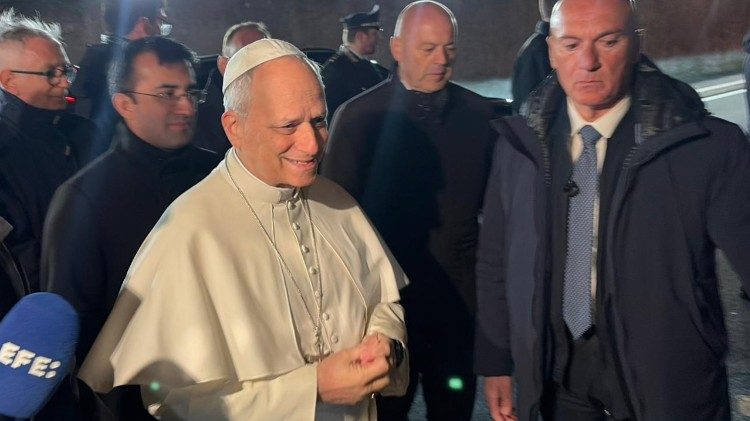
Pope Leo XIV Urges World Leaders to Seek Solutions for Peace
Exaudi Staff
31 March, 2026
2 min
Pope Leo XIV invites us to pray for priests in crisis
Exaudi Staff
31 March, 2026
2 min