 (EN)
(EN)
 (ES)
(ES)
 (IT)
(IT)

Pope Leo XIV calls the Roman Curia to be more missionary and a sign of communion in a divided world
Audience of Pope Leo XIV to the Roman Curia on the occasion of Christmas greetings
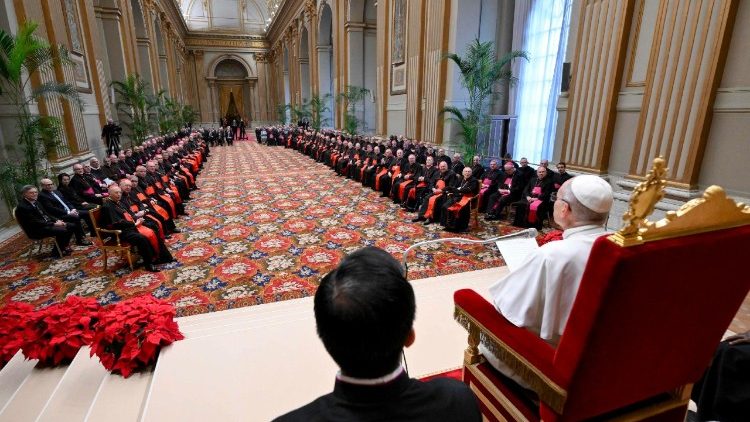

In the traditional Christmas greetings meeting in the Hall of Blessings, Pope Leo XIV addressed the members of the Roman Curia with a speech focused on the need for a Curia increasingly oriented towards mission and the building of communion, inspired by the teaching of his predecessors and the spirit of the Gospel.
The Pope expressed his gratitude to Pope Francis, highlighting his prophetic voice, pastoral style, and rich teachings, which have shaped the path of the modern Church. “His emphasis on God’s mercy, his drive for evangelization, and his building of a joyful Church, welcoming to all and especially close to the poorest, have been a guiding light,” Leo XIV affirmed.
Recalling the teachings of the apostolic exhortation Evangelii Gaudium, he reminded everyone that the Church is by nature extroverted and missionary, “open to the world” and in a permanent state of mission. “The mission of Jesus on earth must become the fundamental criterion for discerning our life, our faith, and ecclesial practices, including the service we perform in the Curia,” he noted.
The Pope emphasized that mission and communion are inextricably linked: the former propels the Church outward, while the latter strengthens its internal bonds. “The Father’s love empowers us to be a sign of a new humanity, not based on selfishness, but on mutual love and solidarity,” he explained.
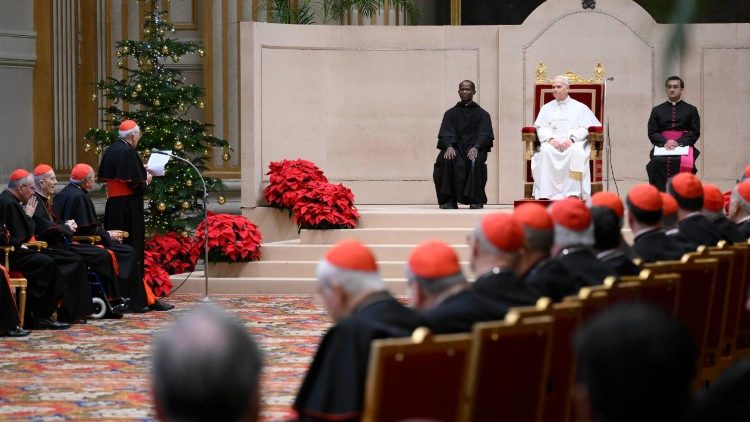
Within the Church, Leo XIV called for ongoing conversion in daily relationships, promoting a synodal Church where differences are valued without falling into uniformity or exacerbating divisions. He warned against ideological rigorism, power dynamics, and the “specters of division” that can lurk behind an appearance of tranquility. Quoting St. Augustine, he emphasized the beauty of friendship and fraternity: “It is beautiful when we find friends in whom we can confide, when masks fall away, when there is mutual support and the value of each person is recognized.”
The Holy Father asked: “Is it possible to be friends in the Roman Curia? To have genuine fraternal relationships?” He asked that working relationships reflect the love of Christ, without using people or creating resentment, so that the Curia may be a true witness of communion.
Furthermore, in a world marked by conflict, aggression, and fragmentation—fueled by the digital and the political—the Curia must be a catalyst for universal fraternity among peoples, religions, and cultures. “We are not petty gardeners tending our own gardens, but disciples and witnesses of the Kingdom of God,” he affirmed.
Leo XIV emphasized that the Curia should not be limited to ordinary administration, but should be oriented toward the great ecclesial, pastoral, and social challenges of the time. “We need an increasing missionary Roman Curia, where institutions and offices are at the service of evangelization and do not hinder it,” he concluded.
The speech concluded with references to the recently concluded Jubilee, dedicated to hope, the 1700th anniversary of the Council of Nicaea and the 60th anniversary of the Second Vatican Council, as well as the 50th anniversary of St. Paul VI’s exhortation Evangelii Nuntiandi, which reminds us that the witness of an authentic Christian life—in communion with God and given to one’s neighbor—is the primary means of evangelization.
He concluded with a prayer for peace: “May the Lord bring us his light and grant peace to the world.” As a gift, he presented those present with the book * The Practice of the Presence of God* by Friar Lorenzo de la Resurrección.
Full text:
ADDRESS OF THE HOLY FATHER LEO XIV
TO THE ROMAN CURIA FOR THE EXCHANGE
OF CHRISTMAS GREETINGS
Hall of Benediction
Monday, 22 December 2025
____________________________________
Your Eminences,
Venerable brothers in the Episcopate and the priesthood,
Dear brothers and sisters,
The light of Christmas comes to meet us, inviting us to rediscover the newness that, from the humble grotto of Bethlehem, runs throughout human history. Drawn by this newness, which embraces all creation, let us walk in joy and hope, for a Savior has been born for us (cf. Lk 2:11): God has become flesh, has become our brother, and remains forever God-with-us.
With this joy in our hearts, and with deep gratitude, let us look upon the events that unfold, also in the life of the Church. In this way, as we approach the Christmas festivities, in sharing my heartfelt greeting with all of you, and thanking the Cardinal Dean for his words – always full of enthusiasm: today, the Psalm tells us that our years are seventy, or eighty for the strongest, so we also celebrate with you – I wish first of all to remember my beloved predecessor, Pope Francis, who this year concluded his earthly life. His prophetic voice, pastoral style and rich magisterium have marked the Church’s journey in recent years, encouraging us above all to place God’s mercy at the center, to give renewed impetus to evangelization, and to be a joyful Church, welcoming to all and attentive to the poorest.
Taking inspiration from his Apostolic Exhortation Evangelii Gaudium, I would like to reflect on two fundamental aspects of the Church’s life: mission and communion.
By her very nature, the Church is outward-looking, turned toward the world, missionary. She has received from Christ the gift of the Spirit in order to bring to all people the good news of God’s love. As a living sign of this divine love for humanity, the Church exists to invite and gather all people to the festive banquet that the Lord prepares for us. In this gathering, every person can discover their identity as a beloved child, a brother or sister to their neighbor, and a new creation in Christ. Transformed by this discovery, they become witnesses to truth, justice and peace.
Evangelii Gaudium encourages us to make progress in the missionary transformation of the Church, who draws her inexhaustible strength from the mandate of the Risen Christ. “Jesus’ command to ‘go and make disciples’ echoes in the changing scenarios and ever new challenges to the Church’s mission of evangelization, and all of us are called to take part in this new missionary ‘going forth’” (no. 20). This missionary character flows from the fact that God himself first set out toward us and, in Christ, came in search of us. Mission begins in the heart of the Most Holy Trinity. Indeed, God consecrated and sent his Son into the world, so that “everyone who believes in him might not perish but may have eternal life” (Jn 3:16). The first great “exodus,” then, is God’s own — his going forth from himself to meet us. The mystery of Christmas proclaims precisely this: the Son’s mission consists in his coming into the world (cf. Saint Augustine, The Trinity, IV, 20, 28).
In this way, the mission of Jesus on earth, which continues in the Holy Spirit through the Church, becomes a criterion for discernment in our lives, in our journey of faith, in ecclesial practices, and also in the service we carry out in the Roman Curia. Structures must not weigh down or slow the progress of the Gospel or hinder the dynamism of evangelization; instead, we must “make them more mission-oriented” (Evangelii Gaudium, 27).
In the spirit of our baptismal co-responsibility, therefore, we are all called to cooperate in Christ’s mission. The work of the Curia, too, must be animated by this spirit and foster pastoral solicitude in service to the particular Churches and their pastors. We need an ever more missionary Roman Curia, in which institutions, offices and tasks are conceived in light of today’s major ecclesial, pastoral and social challenges, and not merely to ensure ordinary administration.
At the same time, in the life of the Church, mission is closely linked to communion. While the mystery of Christmas celebrates the mission of the Son of God among us, it also contemplates its purpose, namely that God has reconciled the world to himself through Christ (cf. 2 Cor 5:19) and in him made us his children. Christmas reminds us that Jesus came to reveal the true face of God as Father, so that we might all become his children and therefore brothers and sisters to one another. The Father’s love, embodied and revealed by Jesus in his liberating actions and preaching, enables us, in the Holy Spirit, to be a sign of a new humanity — no longer founded on selfishness and individualism, but on mutual love and solidarity.
This task is urgent both ad intra and ad extra.
It is urgent ad intra, because communion in the Church always remains a challenge that calls us to conversion. At times, beneath an apparent calm, forces of division may be at play. We can fall into the temptation of swinging between two opposite extremes: uniformity that fails to value differences, or the exacerbation of differences and viewpoints instead of seeking communion. Thus, in interpersonal relationships, in internal office dynamics, or in addressing questions of faith, liturgy, morality and more besides, there is a risk of falling into rigidity or ideology, with their consequent conflicts.
Yet we are the Church of Christ, his members, his body. We are brothers and sisters in him. And in Christ, though many and diverse, we are one: In Illo uno unum.
We are called, especially here in the Curia, to be builders of Christ’s communion, which is to take shape in a synodal Church where all cooperate in the same mission, each according to his or her charism and role. This communion is built not so much through words and documents as through concrete gestures and attitudes that ought to appear in our daily lives, including in our work. I would like to recall what Saint Augustine wrote in his Letter to Proba: “In all human affairs, nothing is truly cherished without a friend.” Yet he asked, with a note of bitterness: “But how seldom in this life is such a person found whose spirit and conduct may be trusted with full confidence?” (Letter to Proba, 130, 2,4).
At times this bitterness finds its way among us as well, when, after many years of service in the Curia, we observe with disappointment that certain dynamics – linked to the exercise of power, the desire to prevail, or the pursuit of personal interests – are slow to change. We then ask ourselves: is it possible to be friends in the Roman Curia? To have relationships of genuine fraternal friendship? Amid daily toil, it is a grace to find trustworthy friends, where masks fall away, no one is used or sidelined, genuine support is offered, and each person’s worth and competence are respected, preventing resentment and dissatisfaction. Such relationships call for a personal conversion, so that Christ’s love, which makes us brothers and sisters, may shine through.
This becomes a sign also ad extra, in a world wounded by discord, violence and conflict, where we also witness a growth in aggression and anger, often exploited by both the digital sphere and politics. The Lord’s birth brings the gift of peace and invites us to become its prophetic sign in a human and cultural context that is too fragmented. The work of the Curia and of the Church as a whole must be conceived within this broader horizon: we are not mere gardeners tending our own plot, but disciples and witnesses of the Kingdom of God, called in Christ to be leaven of universal fraternity among different peoples, religions and cultures. This happens if we ourselves live as brothers and sisters and allow the light of communion to shine in the world.
Dear brothers and sisters, mission and communion are possible if we place Christ at the center. This year’s Jubilee reminded us that he alone is the hope that does not disappoint. This Holy Year also marked two significant anniversaries. It recalled the Council of Nicaea, which brings us back to the roots of our faith, and the Second Vatican Council, which, by fixing its gaze on Christ, strengthened the Church and sent her forth to engage the modern world, remaining attentive to the joys, hopes, griefs and anxieties of the people of our time (cf. Gaudium et Spes, 1).
Lastly, I would recall that fifty years ago, on the Solemnity of the Immaculate Conception, Saint Paul VI promulgated the Apostolic Exhortation Evangelii Nuntiandi, written after the Third Ordinary General Assembly of the Synod of Bishops. Among others, it emphasizes two essential realities: first, that “it is the whole Church that receives the mission to evangelize, and the work of each individual member is important for the whole” (no. 15). Second, it affirms that “the first means of evangelization is the witness of an authentically Christian life, given over to God in a communion that nothing should destroy and at the same time given to one’s neighbor with limitless zeal” (no. 41).
Let us remember this also in our curial service: the work of each is important for the whole, and the witness of a Christian life, expressed in communion, is the first and greatest service we can offer.
Your Eminences, Excellencies, dear brothers and sisters, the Lord descends from heaven and humbles himself toward us. As Bonhoeffer wrote, reflecting on the mystery of Christmas: “God is not ashamed of the lowliness of human beings. God marches right in… God is near to lowliness; he loves the lost, the neglected, the unseemly, the excluded, the weak and broken” (D. Bonhoeffer, Riconoscere Dio al centro della vita, Brescia 2004, 12). May the Lord grant us his own humility, his compassion and his love, so that we may become his disciples and witnesses each day.
I wholeheartedly wish you all a holy Christmas. May the Lord bring us his light and grant peace to the world.

Exaudi Staff
What is Exaudi News? Exaudi News is an international Catholic media outlet that informs, shapes, and transforms daily in Spanish, English, and Italian. Through news, analytical articles, and live broadcasts of the Pope's events, Exaudi seeks to strengthen Christian unity and contribute to the evangelization of the world, always guided by the Church's social doctrine. We work to bring Christian truth and values to every corner of the planet. Help us transform the world with Exaudi! At Exaudi, we believe that evangelization and quality information can change lives. To continue our mission and expand our reach, we need your help. In addition, we are looking for committed people to join our team. With your support, we will reach more people, spread the message of Christ, and strengthen Christian unity. Will you join our mission? For more information on how to collaborate, visit Exaudi.org or contact us directly: [email protected] Exaudi: Informs, educates, and transforms.
Related
Pope Leo XIV in Africa: Pilgrim Among “Different Peoples and Worlds”
Exaudi Staff
10 April, 2026
3 min
Pope Leo XIV calls for a prayer vigil for peace at the Vatican
Exaudi Staff
08 April, 2026
2 min
Pope Leo XIV: “Holiness is not a privilege for the few, but a gift that commits every baptized person”
Exaudi Staff
08 April, 2026
9 min
Pope Leo XIV: “The entire Iranian people cannot be condemned”
Exaudi Staff
08 April, 2026
2 min