 (EN)
(EN)
 (ES)
(ES)
 (IT)
(IT)

Poland: Young Catholics Defend the Memory of Pope Wojtyła
Appeal in Defense of the “Memory and Identity” Museum of John Paul II
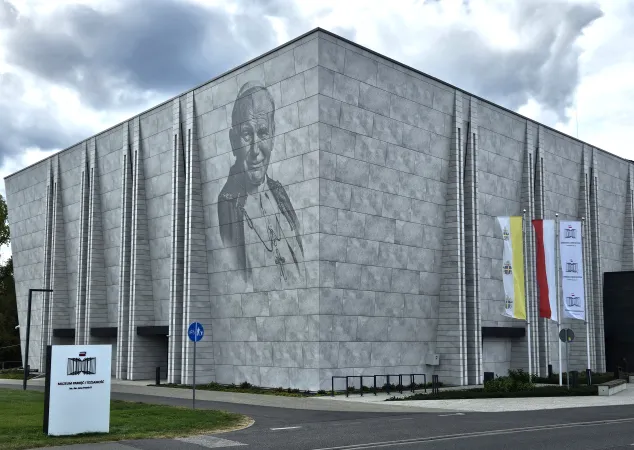

The communist regime in Poland always fought against the Church, which it perceived as an enemy of communist ideology and its materialist vision of the world and man. The communist secret services targeted priests and bishops above all, starting with charismatic pastors such as Cardinals Wyszyński and Wojtyła. After Cardinal Wojtyła’s election as Pope, the communist regime prepared various kinds of provocations and tried at all costs to discredit him—all in order to diminish the impact of the Pope’s pastoral action in his homeland. But the same ex-communist forces continued to criticize John Paul II even after the democratic turning point in 1989, allying themselves with liberal anti-clerical circles and with “open” Catholics who could not tolerate the “conservative” line of Wojtyła’s Church. Today, the same forces want to make people forget the great legacy of the Pope who gave so much to his homeland. A glaring example: the attempt by the Tusk government to destroy the “Memory and Identity” Museum of Saint John Paul II.
When the idea arose in Poland to create a museum dedicated to the intellectual heritage of Saint John Paul II, it was decided to name it the “Memory and Identity” Museum, after the title of his last book: it was meant to be a museum of Polish history seen through the eyes of Pope Wojtyła. This museum, built in the city of Toruń, had two co-founders: the Ministry of Culture and National Heritage and the Lux Veritatis Foundation. Today, when the museum is nearly completed, the Ministry of Culture under the current government is trying to destroy this great initiative—as it is doing with many similar ones aimed at keeping the memory of the Polish Pope alive. The Tusk government, the most anti-clerical in recent decades, is doing this for purely ideological reasons, even at the cost of not respecting signed agreements and lying about the terms of the contract with the Lux Veritatis Foundation.
Many people have mobilized in defense of this museum, which symbolizes John Paul II’s legacy for Poland. Poles continue to collect signatures to prevent the government from closing the facility. There are already half a million, and more are coming in. But the Ministry of Culture under the Tusk government, blinded by ideology, is turning a deaf ear for now.
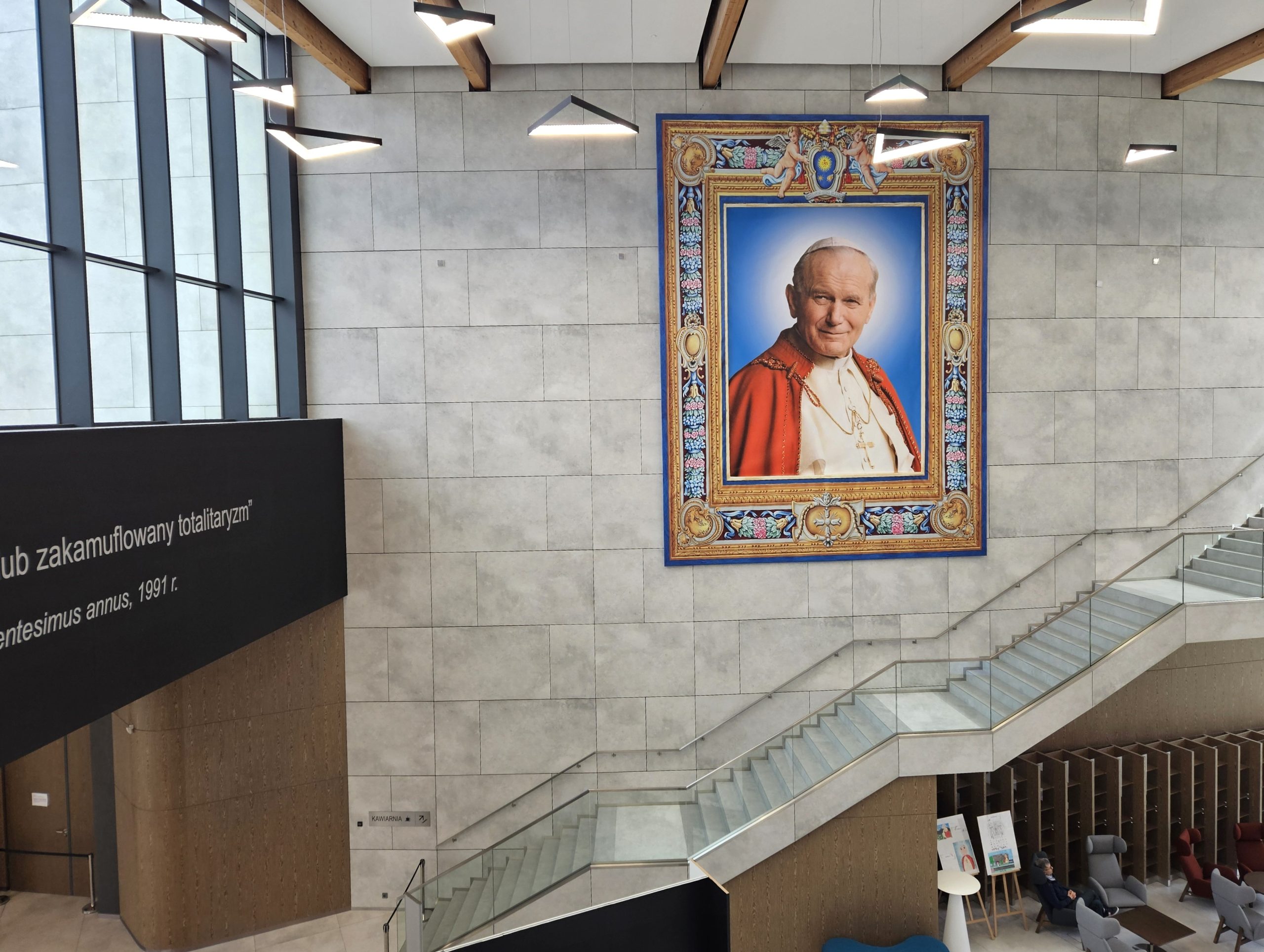
Recently, on December 23, the Polish Catholic Youth Association also issued a protest statement against the attempts to sabotage the museum’s operation. As explained at the beginning of the appeal, the Association, “aware of its own history, mission, and responsibility for the formation of younger generations, firmly opposes any attempt to suspend or limit the activities of the ‘Memory and Identity’ Museum of Saint John Paul II in Toruń.”
The young Poles explain that this is not just a matter of a cultural institution: “It is an attack on the foundations of national memory, on the legacy of Saint John Paul II, on the truth about Poland and its spiritual identity.” And this is all the more serious because today young people “experience manipulation, the relativization of values, and a culture of oblivion”; therefore, “depriving them of a space for formation and historical education would be a profoundly harmful act for the future of the nation.”
The document recalls that John Paul II, as a young priest, was an assistant to the Catholic Youth Association. His concern for young people in communist Poland, for their spiritual development and their responsibility toward the Church, became a reason for repression by the regime.
In this context, the famous 1953 trial of the priests of the Kraków Curia is remembered: it was one of the first attempts to intimidate the Church and combat the ecclesiastical hierarchy in Poland. Four priests and three laypeople were accused of espionage for the United States and of “having sold their homeland for Judas’s money.” The communist prosecutor Stanisław Zarakowski described the defendants as “a gang of traitors, spies, and outcasts.” He claimed that the Kraków Curia was “a hotbed of reaction linked to espionage and sabotage centers.” Three people were sentenced to death in this show trial. In this way, the communists wanted to intimidate the entire Polish clergy and the laypeople connected to the Church.
In the trial of the Kraków Curia, the Catholic Youth Council of the time was accused of “anti-state activities,” and young Catholics were persecuted and marginalized. “Today,” the document reads, “as a community of young people, we remember with gratitude John Paul II as our educator and guide, who taught us courage, responsibility, and love for our homeland. The attempts to limit the museum’s activities bear the hallmarks of a return to those times—attempts to silence the voice of the Church, of young people, and of national memory.”
As the young Poles denounce, all of this is happening in an era of “cancel culture,” so “closing the museum would be a symbolic ‘cancellation’ of John Paul II from national memory.”
Poland today faces not only a cultural crisis but also one of values; therefore, “depriving young people of a space for formation is a severe blow to the future of the nation. The attempts to limit the museum’s activities are an attack on citizens’ right to historical memory and education, guaranteed by the Constitution of the Republic of Poland.”
The young people write that in times of disinformation and social polarization, “the museum should serve as a place of dialogue and community-building beyond divisions.” They emphasize that “an attack on the museum is also an attack on Catholic youth, who have the right to know the truth about their roots and their heroes.”
The Association then expresses “gratitude to Saint John Paul II, who, as an assistant to the Catholic Youth Association and later as Pope, taught us responsibility for formation and bearing witness to the faith,” while expressing “solidarity with the creators and employees of the ‘Memory and Identity’ Museum and with all citizens who wish to defend national memory.”
The young Polish Catholics declare that they promote educational, formative, and social activities among their fellow citizens in defense of Saint John Paul II’s legacy. They particularly want to “spread knowledge of the trial of the priests of the Kraków Curia as a lesson for younger generations, so that attempts to silence the voice of the Church and of young people never happen again.” Today’s attempts to prevent the activity of the “Memory and Identity” Museum are “an act of cultural cancellation and an attack on the future of younger generations.”
The document ends with a solemn and strong commitment that also shows the gravity of the situation: “The Catholic Youth Association, remembering its history, the persecutions, and its gratitude toward Saint John Paul II, will not allow the communist era to return again.”
Wlodzimierz Redzioch
Wlodzimierz Redzioch è nato a Czestochowa (Polonia), si è laureato in Ingegneria nel Politecnico. Dopo aver continuato gli studi nell’Università di Varsavia, presso l’Istituto degli Studi africani, nel 1980 ha lavorato presso il Centro per i pellegrini polacchi a Roma. Dal 1981 al 2012 ha lavorato presso L’Osservatore romano. Dal 1995 collabora con il settimanale cattolico polacco Niedziela come corrispondente dal Vaticano e dall’Italia. Per la sua attività di vaticanista il 23 settembre 2000 ha ricevuto in Polonia il premio cattolico per il giornalismo «Mater Verbi»; mentre il 14 luglio 2006 Sua Santità Benedetto XVI gli ha conferito il titolo di commendatore dell’Ordine di San Silvestro papa. Autore prolifico, ha scritto diversi volumi sul Vaticano e guide ai due principali santuari mariani: Lourdes e Fatima. Promotore in Polonia del pellegrinaggio a Santiago de Compostela. In occasione della canonizzazione di Giovanni Paolo II ha pubblicato il libro “Accanto a Giovanni Paolo II. Gli amici e i collaboratori raccontano” (Edizioni Ares, Milano 2014), con 22 interviste, compresa la testimonianza d’eccezione di Papa emerito Benedetto XVI. Nel 2024, per commemorare il 40mo anniversario dell’assassinio di don Jerzy Popiełuszko, ha pubblicato la sua biografia “Jerzy Popiełuszko. Martire del comunismo” (Edizioni Ares Milano 2024).
Related
“Lift Up Your Eyes”: The Pope’s Trip to Spain is Being Prepared with Transparency and Social Support
Exaudi Staff
08 April, 2026
2 min
A Journey in the Light of Gaudí: Santiago Prepares for a Magical Afternoon of Literature and Art
Exaudi Staff
07 April, 2026
2 min
Poland: Another Step in the Coup d’État
Wlodzimierz Redzioch
07 April, 2026
5 min
Reflection by Bishop Enrique Díaz: “This is the day of the Lord’s triumph”
Enrique Díaz
05 April, 2026
6 min