(EN)
(EN)
 (ES)
(ES)
 (IT)
(IT)

Poland: Another Step in the Coup d’État
The Constitutional Court in Tusk’s Crosshairs
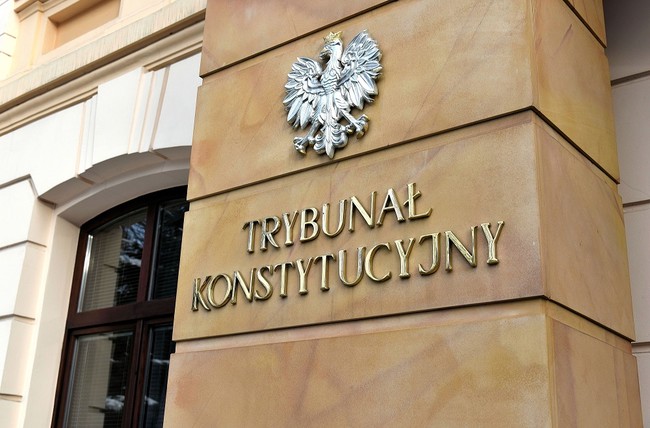

Already a year ago, the President of the Polish Constitutional Court, Bogdan Święczkowski, publicly declared that a **white coup** was taking place in Poland, orchestrated by the “pro-European” Prime Minister Donald Tusk. “That what is happening in Poland is a coup d’état is clear and evident. Naturally, it is not a coup involving the army in the streets (…) it is a creeping and systemic coup d’état. It consists of the continuous abuse of power by the executive and legislative branches over the judiciary and other constitutional bodies” – denounced Święczkowski.
As an example of such abuses, the President cited “the blocking of funds for the functioning of the Constitutional Court or the National Council of the Judiciary, which constitutes a violation of the law and the Constitution.”
For over two years, the ruling coalition has refused to recognize the rulings of the Constitutional Court, “bypasses” presidential vetoes through decrees, and issues its own illegitimate “guidelines” that contradict the Constitution. In practice, the current rulers, since taking power (on December 13, 2023), have not recognized the Constitutional Court and have not replaced its members who gradually retired, until the Court was left with six vacancies. Only then did the government and the Sejm (the lower house of Parliament), violating their own rules and ignoring the President’s objections, begin maneuvers to take control of the Court. Obviously, once they have filled it with their own appointees, they will immediately recognize the Court’s rulings, which will then become “valid, legitimate, and independent.” In this way, with the Court’s rulings serving the government, the path would open to the next stage of the coup d’état: the banning of opposition parties and even the stripping of the President of his prerogatives or even his removal from office, which is frequently discussed in government circles.
It should be noted that the Sejm has elected six politically engaged judges to the Constitutional Court. These individuals participated in demonstrations and events that were clearly political, obviously directed against the previous conservative government. Moreover, none of the chosen candidates is a constitutional law expert. Instead, the group includes: the former president of the Iustitia association (a left-wing judges’ association comparable to Magistratura Democratica in Italy), a member of the board of a similar association, Themis, the former Deputy Minister of Justice, and even a scholar whose application for a professorship received a negative evaluation. In addition, some of the selected candidates are members of the ministerial commission under Minister Waldemar Żurek. All of them are politically aligned and openly pro-government.
According to the law of November 30, 2016, on the status of judges of the Constitutional Court, a person elected by the Sejm does not automatically assume office. An indispensable condition is to take the oath before the President of the Republic of Poland. The regulation goes even further: refusal to take the oath before the President – since there is no other legal possibility – results in resignation from the position. Without this act, one cannot speak of assuming the role of judge. Only after taking the oath does the judge appear before the Court and effectively begin to perform his or her duties.
Nevertheless, the coalition is putting pressure on the President to administer the oath to these individuals as soon as possible. Justice Minister Żurek himself is threatening to activate a “Plan B,” about which little is known today. For example, there is talk of the oath being taken before both chambers of Parliament. In the past, however, Waldemar Żurek supported the absurd idea of taking the oath before a notary.
However, it was difficult to predict what the President’s attitude would be toward the six candidates selected by the ruling coalition. Zbigniew Bogucki, head of the Presidential Chancellery, explained that for now there is no one who can take the oath. “It seems that the Sejm has committed elementary but very serious formal errors by failing to comply with the successive provisions of the Sejm’s rules of procedure and possibly also a provision of the Constitution” – emphasized Bogucki. But, unexpectedly, the President summoned two of the six candidates to the presidential palace to take the oath. As was later clarified, since Nawrocki became President of Poland, two judges of the Constitutional Court have retired; therefore, the intention was to fill only these two vacant positions.
In any case, the attempt to “occupy” the Constitutional Court is another stage of the creeping coup d’état that its president, Święczkowski, has been talking about for some time. But Tusk and his allies are already thinking about the next move: the appointment of judges to the National Council of the Judiciary. Although citizens have collected over 500,000 signatures in support of civic candidacies for the Council, the ruling coalition nevertheless intends to place it under the control of judges supported by a small clique within the judiciary through the so-called primaries, which not only have no legal basis but were also boycotted by the majority of judges.
The dictatorial concentration of power in the hands of one man and his coalition has led Poland to a crisis of the rule of law and the degradation of the judicial system. The European Commission, which was so concerned about the rule of law in Poland when it was governed by conservatives, now shamefully remains silent or hypocritically declares that “this is a matter for the Member States and their courts.” Evidently, the rule of law does not matter when those who violate it profess the “pro-European creed.”
The article was originally published in Italian in La Nuova Bussola Quotidiana
Wlodzimierz Redzioch
Wlodzimierz Redzioch è nato a Czestochowa (Polonia), si è laureato in Ingegneria nel Politecnico. Dopo aver continuato gli studi nell’Università di Varsavia, presso l’Istituto degli Studi africani, nel 1980 ha lavorato presso il Centro per i pellegrini polacchi a Roma. Dal 1981 al 2012 ha lavorato presso L’Osservatore romano. Dal 1995 collabora con il settimanale cattolico polacco Niedziela come corrispondente dal Vaticano e dall’Italia. Per la sua attività di vaticanista il 23 settembre 2000 ha ricevuto in Polonia il premio cattolico per il giornalismo «Mater Verbi»; mentre il 14 luglio 2006 Sua Santità Benedetto XVI gli ha conferito il titolo di commendatore dell’Ordine di San Silvestro papa. Autore prolifico, ha scritto diversi volumi sul Vaticano e guide ai due principali santuari mariani: Lourdes e Fatima. Promotore in Polonia del pellegrinaggio a Santiago de Compostela. In occasione della canonizzazione di Giovanni Paolo II ha pubblicato il libro “Accanto a Giovanni Paolo II. Gli amici e i collaboratori raccontano” (Edizioni Ares, Milano 2014), con 22 interviste, compresa la testimonianza d’eccezione di Papa emerito Benedetto XVI. Nel 2024, per commemorare il 40mo anniversario dell’assassinio di don Jerzy Popiełuszko, ha pubblicato la sua biografia “Jerzy Popiełuszko. Martire del comunismo” (Edizioni Ares Milano 2024).