(EN)
(EN)
 (ES)
(ES)
 (IT)
(IT)

Pasolini calls for radical humility: “Peace is born from becoming small and renouncing violence”
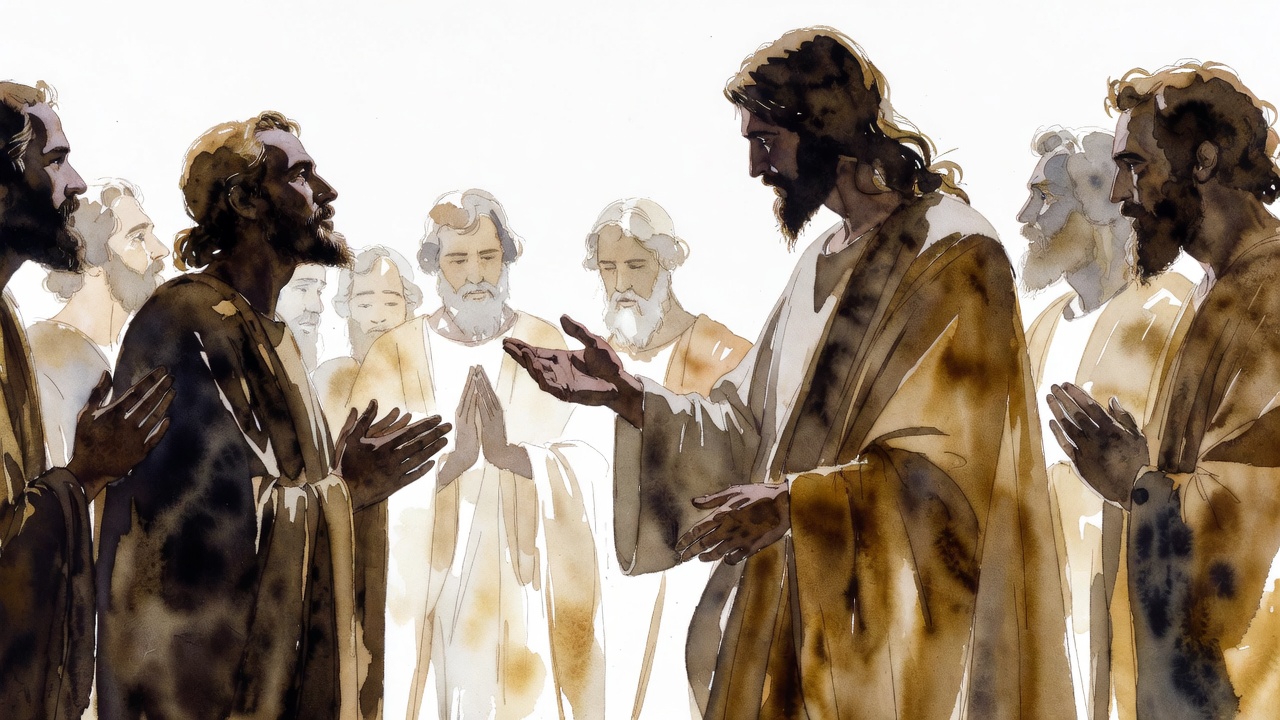
In his first Lenten meditation of 2026, the Preacher of the Papal Household, Friar Roberto Pasolini, before Pope Leo XIV and the Roman Curia, proposed conversion as a path of evangelical humility inspired by St. Francis of Assisi, calling for disarming the heart amidst global conflicts
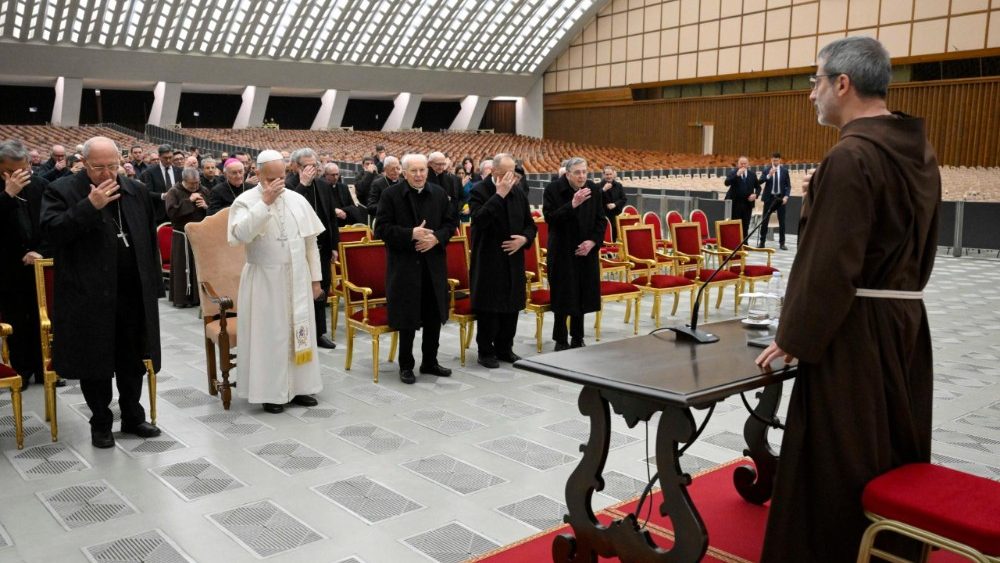

In the Paul VI Hall, under the watchful eye of Pope Leo XIV and the members of the Roman Curia, Friar Roberto Pasolini, preacher of the Papal Household and Capuchin friar, inaugurated the cycle of Lenten meditations this Friday with a powerful message: true peace does not arise from political agreements or military strategies, but from the courage to “make oneself small,” to renounce violence in all its forms and to opt for dialogue even in the most adverse circumstances.
The reflection, entitled “Conversion: Following the Lord Jesus on the Path of Humility,” focuses on the verse from 2 Corinthians 5:17: “Therefore, if anyone is in Christ, the new creation has come.” Pasolini links this idea to the figure of Saint Francis of Assisi—in the context of the eightieth anniversary of his death and the Jubilee Year—presenting him as a “man pierced by the fire of the Gospel” capable of rekindling in each person the longing for a new life in the Spirit.
The preacher emphasized the need to reaffirm the vitality of Baptism in a world marked by wars and violence. “Sin, conversion, and grace are intertwined in real life,” he affirmed, describing conversion as a divine initiative that requires human freedom to awaken the “image of God” in the inner silence. This entails a “change of sensibility”: looking at others with evangelical mercy, sweeping away accumulated bitterness, and recognizing sin—not as mere weakness, but as a destructive power against freedom—in order to open oneself to profound healing.

A central theme of the speech was humility as a baptismal path. Pasolini emphasized that this virtue does not impoverish the human being, but rather restores him to his true greatness, counteracting the original sin born from the rejection of smallness. “Humility does not diminish: it restores one to true greatness,” he said, recalling that the greatness of man lies in making himself small, like the “little ones” whose fragility awakens mercy, “perhaps the most precious energy in the world.”
In a context of global conflicts, the friar insisted that evangelical humility is especially necessary in times of difficulty: “We often think it’s only possible when everything is going well. In reality, the opposite is true: it is precisely in conflicts that it becomes most necessary.” Herein lies the implicit call to “spiritual disarmament”—or verbal disarmament, in terms of respectful dialogue—renouncing revenge, oppression, and hurtful words, in order to build relationships of equality and listening.
The meditation, which will continue every Friday until March 27, invites us to a continuous conversion where weakness becomes the very essence of baptized life, according to St. Paul. Pasolini concluded by invoking St. Francis and asking us to follow in the footsteps of Jesus, in a Lenten season that, under the pontificate of Leo XIV, presents itself as an opportunity for radical and fraternal evangelical renewal.
The following meditations will explore themes such as freedom, hope, mission and fraternity, always under the motto “If anyone is in Christ, he is a new creation,” with Saint Francis as a concrete guide towards a more human and evangelical life.
Full text of the meditation:
Lenten Meditation 2026 – 1
Conversion
Following the Lord Jesus on the path of humility
After the Spiritual Exercises guided by the figure of Saint Bernard of Clairvaux, this year’s Lenten meditations could only be inspired by the Christian experience of Francis of Assisi. The two saints are not far removed from one another: Bernard died in 1153, Francis was born in 1181, less than thirty years apart. It is as if the torch of the Gospel legacy were passed from hand to hand through the centuries, never extinguished.
This year marks the eight hundredth anniversary of Francis’s death, and the Holy Father has chosen to mark the occasion with a special jubilee, inviting the entire Church to once again be touched by God’s grace through the witness of the Little Poor Man of Assisi. Francis is not merely a saint to remember or admire: he is a man consumed by the fire of the Gospel, capable of rekindling in each of us the longing for a new life in the Spirit.
To trace his spiritual path, the first meditation focuses on his conversion and unfolds in five steps: the change of taste that grace works in the sensibility; the alteration produced by sin and the need for radical healing; humility as the true measure of human greatness; the choice to become smaller as the proper form of baptismal life; finally, the continuous nature of conversion, which is not accomplished once and for all, but always begins again.
1. The change of taste
What do we mean when we talk about conversion? It is a question that deserves to be asked honestly, because the possible answers are many and not all equally faithful to the Gospel.
Traditional catechesis describes it as a return to God after turning away from sin. Moral theology emphasizes its dimension of behavioral change. The ascetic tradition insists on the need for penitential practices that discipline the body and the will. Scripture, for its part, uses a term that transcends all these perspectives: *metanoia*, a change of mind, of heart, of the profound way in which reality is perceived. Not a simple course correction, but a transformation of perspective. Not just a revision of behaviors, but a revolution of sensibility.
Who is right? To some extent, everyone. But there is an order to respect. Understanding where conversion truly begins—its starting point—is not a theoretical question. It is the most concrete problem there is. If we choose the wrong starting point, we risk building on fragile foundations.
We know that evangelical conversion is first and foremost God’s initiative, in which man is called to participate with all his freedom. It is neither pure passivity nor pure conquest. It is a response: the most fitting response a human being can give to the grace that precedes and calls him.
Conversion occurs in the innermost part of our nature, where the image of God imprinted within us awaits awakening. It is as if something, long silent, suddenly begins to vibrate again.
It is here that the experience of Francis of Assisi proves invaluable. In his Testament, dictated a few months before his death, he writes: “The Lord granted me, Brother Francis, to begin to do penance in this way. When I was in sin, it seemed too bitter to me to see the lepers; and the Lord himself led me among them and I showed mercy to them. And when I left them, what seemed bitter to me was changed into sweetness of mind and body” (Testament, Franciscan Sources 110).
Recalling the essential stages of his journey, Francis affirms first and foremost that the initiative is entirely the Lord’s. It is God who has given him the opportunity to begin doing penance, that is, to embark on a path of conversion. The “doing penance” of which Francis speaks should not be understood as an ascetic exercise by which to merit the grace of a new relationship with God. Rather, it alludes to a complete change of sensibility: a new way of looking at oneself, at others, and at reality in the light of the Gospel.
This change begins in a very concrete way: when he begins to have mercy on others. It is the heart of his story. In that encounter with the lepers, the young Francis experiences a definitive shift in perspective: he discovers an unexpected sweetness precisely where he was not looking for it and where he did not even expect to find it.
The moment he freely gave himself to the poorest in society, forgetting himself for the first time, Francis found the answer to the unease that dwelt in his heart: the bitterness of a life full of many things but still empty of its essential value. That encounter caused an inner earthquake within him: what had once seemed bitter had become sweet.
This is the heart of conversion: not primarily an act of the will, but an inner transformation, a mysterious change of sensibility. This change does not eliminate our participation; it makes it truer, freer, and more joyful. The effort does not disappear, but its nature changes. Conversion is no longer an attempt to straighten out one’s life through one’s own strength, but a response to a grace that has redefined the parameters of how we perceive, judge, and desire.
Let us consider, instead, what happens when this step is missing. If we were forced to eat food every day whose flavor we had never appreciated, we could do so out of discipline, for a certain time, but without joy and with increasing fatigue. If someone cultivated a passion without ever having experienced its pleasure and inner resonance, they would soon experience it as a burden. If someone built a life with another person without ever having tasted true love, that relationship would risk becoming a form of coercion. And if a religious person wore habits, performed gestures, and uttered words in the name of a God known only by hearsay, without having a real personal experience, they would end up experiencing a profound inner turmoil, which could also affect those in their care.
These are situations that are difficult to sustain in the long term. And something similar happens when conversion is approached incorrectly: when we ask ourselves—or even others—to adhere to a morality without having first tasted the sweetness of the new life in Christ.
The “doing penance” that Francis speaks of is not a program of willful austerity, but the beginning of a struggle to defend and safeguard the treasure of a renewed zest for life, finally recovered. It is faithfully nurturing the seed of a new life that God has planted in the soil of our hearts.
2. The alteration of sin
To understand why conversion must be so radical—why it is not enough to correct some behaviors, but that a true renewal of sensitivity is needed—we must probe the depth of the furrow that sin has carved in us.
We are talking about that odious distance from ourselves, that weariness in truly wanting the good that we recognize as such, that split between what we are and what we would like to be. Saint Paul expresses it with disarming honesty in the Letter to the Romans: “I do not even understand my own actions. For what I want to do I do not do, but what I hate I do. When I do what I do not want, I acknowledge that the law is good. But then it is no longer I who do it, but sin that dwells within me. For I know that nothing good dwells in me, that is, in my flesh. I have the desire for what is good, but not the ability to carry it out” (Romans 7:15-18).
These words do not describe the condition of a sinner who does not want to change, but of one who desires good and yet finds himself doing the evil he does not want. That is why conversion requires a lifetime: because the wound of sin does not concern only a few wrong choices, but touches more deeply the very way in which we are made.
To understand the origin of this condition, we must return to the beginning. The account in Genesis 3 does not simply speak of a transgression, but rather documents a profound transformation that occurred in humankind after the act of disobedience. Even before God’s reaction appears, the text notes two important things: humankind realizes its nakedness and experiences fear, seeking to hide from God.
“Then the eyes of both of them were opened, and they realized they were naked; so they sewed fig leaves together and made coverings for themselves” (Genesis 3:7).
“The Lord God called to the man and said to him, ‘Where are you?’ He answered, ‘I heard your voice in the garden, and I was afraid because I was naked; so I hid’” (Genesis 3:9-10).
Fear and shame are the first fruits of sin. Not a punishment imposed from without, but a change born within the human being. Before the Fall, man and woman were naked and felt no shame. After sin, this balance is shattered. A rift is created: with God, with others, and even with themselves. Humanity no longer feels at peace; it begins to perceive itself as wrong and to regard others with suspicion. This is why fear and shame arise.
These are not superficial emotions, but the sign of a serious malaise: man perceives within himself a gap between what he wishes to be and what he discovers he is.
Here is what sin produces. It takes nothing away from God; it alters us. The categories of our senses become confused: we no longer clearly recognize what is good, true, and beautiful. And so we also lose our proper measure of ourselves, forgetting the greatness to which we are called.
We live in a time when the word “sin” seems to have almost disappeared from our way of thinking. In the common consciousness—and sometimes even in the life of the Church—everything is explained as fragility, wounds, limitations, or constraints. When sin is still spoken of, it is often reduced to a minor mistake or weakness.
There is some truth in this view. Spiritual tradition has always recognized that human frailty is not simply a matter of ill will and that judgment must be accompanied by mercy. The problem arises when this perspective replaces the theological one instead of integrating it. If every sin becomes merely a symptom and every guilt a dysfunction, something essential risks disappearing: the grandeur of human freedom and its inherent responsibility.
If every choice is merely the result of our history, our traumas, or our conditioning, then everything becomes explainable and, ultimately, justifiable. But if that’s the case, freedom is just an illusion, and moral responsibility loses its meaning. And here a paradox arises: if the possibility of true evil no longer exists, neither can we believe in the possibility of true good. If sin disappears, then holiness also becomes an abstract and incomprehensible destiny.
That is why the Christian faith takes sin seriously. Not to accuse humanity, but to safeguard and affirm its greatness. To recognize that its choices truly matter, that its freedom is real, and that with it it can build or destroy: itself, others, the world.
It also means recognizing that within us there is a real wound, which cannot be resolved with a few adjustments, but needs deep healing.
Conversion is a demanding journey, because it has the task of healing our existence by restoring our relationship with God, our Creator and Savior. It is a gift of grace, but it takes shape in the concrete repetition of gestures and choices that we have begun to live out in freedom and love. Its effectiveness depends precisely on the ability to maintain these gestures over time, even when they become tiresome or repetitive. This is not a sterile weariness: it is the faithfulness of one who has already glimpsed the meaning and value of what they are experiencing and, precisely for that reason, continues to practice it with freedom and joy.
When Saint Francis, after his encounter with the lepers, feels for the first time within himself something true and free, his response is not surrender or renunciation: it is recognition. And when, in the little church of the Porziuncola, he hears the Gospel and understands that this word calls him by name, he reacts with a cry of joy: “This I want, this I ask, this I long to do with all my heart!” (First Life of Thomas of Celano 22, FF 356).
Francis begins to do penance because in the encounter with Christ he finally recovers himself: the image of the new man “created according to God in righteousness and true holiness” (Ephesians 4:24), that image which sin had obscured and which grace was bringing back to light.
3. The recovered measure
In the history of the Church, Francis of Assisi is known for having embraced radical poverty, choosing it as the essential form of his evangelical life. However, if we read his writings carefully, we realize that his love for poverty is never separate from a profound esteem for humility.
In the Non-Bulled Rule he writes: “Let all the brothers strive to follow the humility and poverty of our Lord Jesus Christ” (Non-Bulled Rule, IX, FF 29). In a famous hymn, he writes: “Holy Lady Poverty, may the Lord save you with your sister, holy humility,” explaining how the two virtues work together to purify man: “Holy poverty confounds greed and avarice and the anxieties of this present age. Holy humility confounds pride and all men who are in the world” (Salutation to the Virtues, FF 256, 258).
For Francis, poverty and humility are inseparable, because they spring directly from the mystery of the Incarnation. In his Letter to the Entire Order, reflecting on the Eucharistic mystery, he exclaims: “O sublime humility! O humble sublimity, that the Lord of the universe, God and Son of God, humbled himself so much as to hide himself, for our salvation, under the lowly appearance of bread!” (FF 221). And, after the experience of the Stigmata on Mount La Verna, he addresses God, saying: “You are humility” (Praises of God Most High, FF 261).
For Francis, the poor and humble Christ is not just another devotional image, but the most accurate name for that God revealed in the Incarnation and in the Passover of his eternal Word. In poverty and humility, he recognizes the very traits of God that humanity is called to embody because it was created in his image and likeness.
If poverty, in the radical form lived by Francis, concerns only those who feel called to such a vocation, humility is a path that every baptized person is called to travel if they want to fully embrace the grace of life in Christ.
It is worthwhile, then, to rediscover the true meaning of an often misunderstood word, starting with its etymology. The Latin *humilitas* is related to *humus*, the earth. The humble person is one who comes from the earth, who belongs to the earth, who does not forget that they are earth.
The gesture of ashes with which we enter Lent—”remember that you are dust, and to dust you shall return”—is not an invitation to sadness or self-contempt: it is a restoration to the truth. It is the way in which the Church returns us to our most authentic self, freeing us from the suffocating weight of what we are not.
However, humility has often been misunderstood. In the classical world, this concept almost always had a negative connotation: it indicated insignificance, wretchedness, and servility. Some philosophers (Spinoza and Nietzsche) later inherited this distrust, interpreting humility as either a sad passion born from the contemplation of one’s own powerlessness, or the virtue of cowards who elevate to valor what is merely weakness.
Within the history of Christian spirituality, humility has also been distorted: reduced to self-contempt, to mortification as an end in itself, sometimes even to a mask of hypocrisy. This is why it has become a difficult word to pronounce and even more difficult to embody.
But Christian humility has nothing to do with these counterfeits. Tradition has made this perfectly clear: humility is not simply a virtue that can be won through willpower. Rather, it is a way of inhabiting the world and our relationships; it is the fruit of an experience—often marked by humiliations—that diminishes the inflated image we have of ourselves and returns us to the truth. It is a gift of the Spirit rather than an ascetic exercise.
Jesus knew this so well that he made humility the only quality he explicitly asked us to imitate throughout the entire Gospel. He doesn’t say, “Learn from me to perform miracles or to raise the dead.” He simply says, “Learn from me, for I am gentle and humble in heart” (Matthew 11:29). In that single word, he summarized his entire way of being in the world.
The Fathers drew a radical conclusion from this: living humility does not mean adding something to a normal Christian life, but rather understanding it to its fullest extent in the light of the Gospel. The humble person is, quite simply, the Christian.
St. Augustine, inviting Dioscorus to embrace the Christian faith, writes: “The path of truth is this: first humility, second humility, third humility; and every time you question me again, I would always answer you thus” (Epistle 118,3.22).
Humility does not impoverish man: it restores him to himself. It does not diminish him: it reveals him to his true greatness. That is why it is so closely linked to conversion.
Original sin arises precisely from a rejection of humility: from a refusal to accept ourselves as human beings, finite and dependent on God. Conversion, then, can only be understood as a return to humility. Not a debasement below one’s own reality, but a re-entry into it. A descent from false self-esteem to one’s own truth in order to discover that this truth, at its core, has been blessed from the beginning.
4. Make themselves smaller
If we return to Francis’s encounter with the lepers, we can grasp an even more striking aspect of his evangelical intuition. Francis was a man thirsting for fulfillment: he sought glory, pursued dreams, and longed to live life to the fullest. All his life he had tried to become “greater”: a successful merchant, a knight, a man of prestige. But these aspirations had not given him what he sought.
When, on the other hand, he encounters someone “smaller” than himself, the unexpected happens: his true greatness emerges. Not through conquest, but through embrace. Not by rising, but by bowing down.
Francis then understands something surprising: in the world created by God, the privileged place belongs to the little ones. It is precisely in them that the “power” of which the Gospel speaks is manifested—the power to become children of God. A child, in fact, is completely at peace with the fact of having to depend on a Father. That is why he is not afraid to be himself nor ashamed to ask for things.
From this freedom springs a unique strength: the capacity to inspire goodness in others. Children, in their vulnerability, awaken mercy, which is perhaps the most precious energy in the world.
That is why the Little Poor Man of Assisi asks his companions to call themselves “little brothers.” Not to appear more humble, but to truly live like little ones: men who do not take up all the space, but open it up to others.
For Francis, being small is the concrete way to embody the Gospel: radical openness and hospitality to the other.
To teach his friars the value of this secondary position, Francis exhorts them to go begging when work is not enough to guarantee their necessities. “And when necessary, go for alms. […] And the friars who work to acquire them will have a great reward and will help those who give them to gain and acquire them; for all the things that men leave in the world will perish, but from the charity and alms they have given they will receive the reward of the Lord” (Rule Not Bullada, IX, FF 31).
For Francis, begging was not a legitimate—perhaps even cunning—strategy for obtaining food and other material goods. It was a way of activating mercy and generosity in others: to allow them to experience what he had experienced in his encounter with the lepers.
In the Gospel, Jesus repeatedly emphasized smallness as the essence of the mystery of the Kingdom and as a condition for entering it. He compared the logic of the Gospel to a seed: small, yet capable of growing into a tree that shelters birds among its branches. He explained to the disciples—always tempted by dreams of grandeur—that only those who become small like children can enter the Kingdom of Heaven. Moreover, he said that whoever wants to be great must become small and become a servant to all.
Isn’t this, at its core, the great secret of the Incarnation? Why did God, wanting to assume our humanity, do so by becoming not only a man, but a child, born in the womb of the Virgin Mary? Not only to inspire awe and wonder, but to awaken the best in our humanity.
It is in front of someone who arouses neither fear nor competition that we cease to be afraid and ashamed, and we once again give what we are.
Therefore, becoming small is not a renunciation or a reduction: it is an essential dimension of being Christian.
Certainly, not all forms of smallness are genuine. Sometimes what we call humility is nothing more than a subtle and deceptive way of feeding our insecurities, allowing our limitations to dominate us, or escaping the weariness of life and relationships. It is a counterfeit that assumes many masks.
But when we choose to become—not to remain—small because we have recognized the smallness of God and have felt welcomed and loved by Him, then this choice is not a form of regression or renunciation: it is the face of the new man that Baptism restores to us.
5. Continuous conversion
If conversion is a change of sensitivity that heals the imbalance produced by sin and restores us to the right measure of our humanity—that smallness that makes us partakers of the nature of God—, there is still one last step, perhaps the most demanding: to recognize that conversion is never completed.
We often imagine conversion as a straightforward process: first sin, then the decision to change, finally the path to holiness. It’s a comforting framework, but life in the Spirit is more complex and more patient than we think.
Sin, conversion, and grace are not successive stages: in concrete life they are intertwined. We remain sinners, we are always in conversion, and it is precisely in this way that we are sanctified by the Spirit.
Conversion means continually restarting this movement of the heart, through which our poverty opens itself to the grace of God.
This discourse, at its core, is familiar to us: each Lent reminds us of the responsibility to verify the vitality of our baptism. However, when conversion takes the concrete form of humility, something within us resists. We accept change, but we struggle to allow ourselves to be redefined. We prefer to strengthen ourselves rather than diminish our image and our expectations.
Thus, the old man resurfaces, sometimes in obvious vices, other times in more subtle and even religious forms: the need for recognition, the search for a role, self-referentiality.
That’s why the struggle is real: it’s the fight to remain small and humble. It’s that ceaseless inner work that frees us from our self-image and enables us to truly serve others, freely and concretely.
The apostle Paul is well acquainted with the struggle to safeguard the humility and freedom of God’s children. In his Second Letter to the Corinthians, accused of weakness while others—the “super-apostles”—impose their will through force, he rejects the path of boasting. Not because he lacks arguments, but because he has grasped something crucial: weakness is not a phase to overcome, but the very essence of his life in Christ. And he writes: “Therefore I will boast all the more gladly about my weaknesses, so that Christ’s power may rest on me. […] When I am weak, then I am strong” (2 Corinthians 12:9-10).
It is not merely a personal gesture of humility: it is a theological declaration. Littleness is not a strategy or an outward attitude, but the very essence of baptismal life. The Christian chooses to present himself unarmed because he follows the Master, who emptied himself and transformed the cross into a source of life.
We often think that evangelical humility is only possible when everything is going well. In reality, the opposite is true: it is precisely in times of conflict and difficulty that it becomes most necessary. When instinct compels us to defend ourselves or to impose our will, that is when we see if we have truly learned the Gospel of the Cross.
Light, in fact, shows its strength not when everything is clear, but when darkness reigns.
On this littleness is founded the mystery of communion in the Church, as the Holy Father reminded us in his last audience: “This is what the holiness of the Church consists of: in the fact that Christ dwells in her and continues to give himself through the littleness and fragility of her members. Contemplating this perennial miracle that takes place in her, we understand the ‘method of God’: He makes himself visible through the weakness of creatures, continuing to manifest himself and act” (Pope Leo, General Audience, March 4, 2026).
In times once again marked by pain and violence, speaking of smallness might seem like an abstract discourse, almost a spiritual luxury. In reality, it is a concrete responsibility, linked to the fate of the world.
Peace is not born solely from political agreements, nor from diplomatic or military strategies, but from men and women who find the courage to humble themselves: capable of taking a step back, of renouncing violence in all its forms, of not giving in to the temptation of revenge and prevarication, of choosing dialogue even when circumstances seem to deny it the possibility.
It is a demanding, daily task. We cannot postpone it or delegate it to others. Whoever recognizes themselves as a child of God knows that this conversion of heart concerns them personally.
That is why we can make our own the words that Saint Francis, at the end of his life, marked by the Stigmata, never tired of repeating to his friars:
“Let us begin, brothers, to serve the Lord our God, because until now we have made little progress” (Saint Bonaventure, Major Legend XIV,1; FF 1237).
Closing prayer
Almighty, eternal, just, and merciful God, grant to us, wretched creatures, to do, for love of you, what we know you will, and to always will what pleases you, so that, inwardly purified, inwardly enlightened, and enkindled by the fire of the Holy Spirit, we may follow in the footsteps of your beloved Son, our Lord Jesus Christ, and with the help of your grace alone reach you, O Most High, who in perfect Trinity and simple Unity live and reign and are glorified, almighty God, forever and ever. Amen.
Fr. Roberto Pasolini, OFM Cap.
Preacher of the Papal Household

Exaudi Staff
What is Exaudi News? Exaudi News is an international Catholic media outlet that informs, shapes, and transforms daily in Spanish, English, and Italian. Through news, analytical articles, and live broadcasts of the Pope's events, Exaudi seeks to strengthen Christian unity and contribute to the evangelization of the world, always guided by the Church's social doctrine. We work to bring Christian truth and values to every corner of the planet. Help us transform the world with Exaudi! At Exaudi, we believe that evangelization and quality information can change lives. To continue our mission and expand our reach, we need your help. In addition, we are looking for committed people to join our team. With your support, we will reach more people, spread the message of Christ, and strengthen Christian unity. Will you join our mission? For more information on how to collaborate, visit Exaudi.org or contact us directly: [email protected] Exaudi: Informs, educates, and transforms.
Related

St. Francis of Assisi as a Guide to Conversion: The Vatican’s Lenten Meditations for 2026
Exaudi Staff
05 March, 2026
2 min

Dicastery for Charity
Exaudi Staff
05 March, 2026
3 min
Michelangelo’s Last Judgment Reborn: Cleaning Begins to Restore Its Vibrant Colors
Exaudi Staff
04 March, 2026
13 min
Giving Glory to God, the Church’s Main Mission
Exaudi Staff
27 February, 2026
3 min