(EN)
(EN)
 (ES)
(ES)
 (IT)
(IT)

Natural Law and Human Nature in Leo XIV
Natural Law and Human Nature in Leo XIV
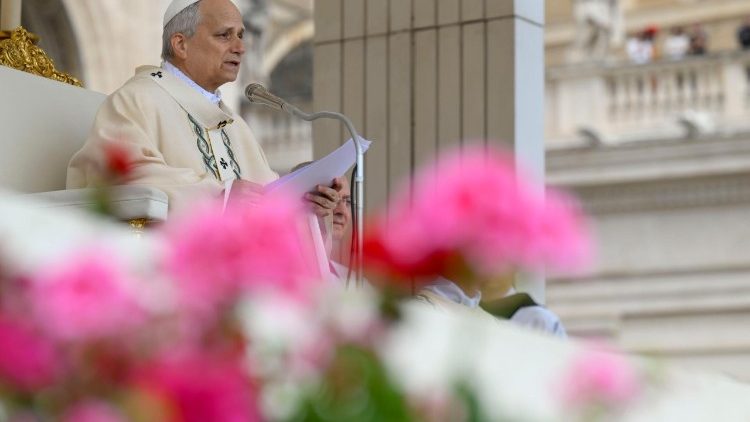

In the social encyclical Rerum Novarum (1891), Pope Leo XIII responded with the Church’s social message to the problem of the social question, that is, the conflict between the relations between workers and employers (labour and capital) amidst the lights and shadows of the industrial revolution of the time. The current political ideologies (liberalism(s) and socialism(s)) offered a diagnosis and solutions based on reductive anthropologies. With Rerum Novarum, the Church once again placed the human person at the centre of the problem, highlighting the ethical dimension of the conflict. Now, it is Pope Leo XIV who takes up the baton from his distant predecessor to offer, with the social doctrine of the Church—expert in humanity—creative proposals that respond to the challenges posed by the technological revolution of our time.
I would like to focus on an essential point about the sources of the Church’s social doctrine that the Holy Father recalled to a delegation of political figures from France (28 August). He encouraged them “to strengthen themselves in faith, to study the doctrine—especially the social doctrine—that Jesus taught the world, and to put it into practice in the exercise of their functions and in the drafting of laws” Its foundations are in accord with human nature, the natural law that all can recognize, even non-Christians and non-believers. Natural law appears as the reality that unites all, “written not by human hands, but recognized as valid in all times and places, and which finds its most plausible and convincing argument in nature itself” (Jubilee of Rulers, 21 June).
A natural law written “in the human heart, whose most intimate truths are illuminated by the Gospel of Christ.” Sophocles’ Antigone alluded to this natural law when she confronted Creon that, although he had forbidden burying her brother, she had buried him out of a fraternal duty, because she considered that the king’s decrees lack the power “to erase and invalidate divine laws, so that a mortal could break them. For they are not of today or yesterday, but have always been in force, and no one knows when they appeared. Therefore, I should not, for fear of any man’s punishment, violate them and expose myself to the punishment of the gods.”
Along with natural law is human nature, that is, the essential condition of human beings as creatures of a God who has conceived and loved us from eternity. Pope Leo XIV emphasizes the dignity to which we have been raised: we are children of God. In this sense, he says that “authentic human flourishing is seen when individuals live virtuously, when they live in prosperous communities, enjoying not only what they have, what they possess, but also what they are as children of God” (Meeting with The International Catholic Legislators Network, August 23). A human being who not only does things, solves problems, makes instruments, achieves social well-being; but also lives virtuously. Not everything is the same. Every human being is called and has the capacity to aspire to the excellence proper to the good life, associated with the cultivation of the virtues.
Natural law, Leo XIV recalls, is “universally valid beyond and above other convictions of a more debatable nature; it constitutes the compass that guides us in legislation and action, especially in the delicate and pressing ethical questions that, today more than in the past, affect the sphere of personal and private life (Jubilee of the Rulers).” Natural law thus constitutes a beacon for navigators in these waters, so often agitated by moral crises.

Francisco Bobadilla
Francisco Bobadilla es profesor principal de la Universidad de Piura, donde dicta clases para el pre-grado y posgrado. Interesado en las Humanidades y en la dimensión ética de la conducta humana. Lector habitual, de cuyas lecturas se nutre en gran parte este blog. Es autor, entre otros, de los libros “Pasión por la Excelencia”, “Empresas con alma”, «Progreso económico y desarrollo humano», «El Código da Vinci: de la ficción a la realidad»; «La disponibilidad de los derechos de la personalidad». Abogado y Master en Derecho Civil por la PUCP, doctor en Derecho por la Universidad de Zaragoza; Licenciado en Ciencias de la Información por la Universidad de Piura. Sus temas: pensamiento político y social, ética y cultura, derechos de la persona.
Related
Pope Leo XIV in Algeria: An Emotional Return to the Roots of St. Augustine
Valentina Alazraki
15 April, 2026
3 min

Desires on the Surface
Francisco Bobadilla
15 April, 2026
3 min
Peace Is Not a Utopia
Rodrigo Guerra López
14 April, 2026
2 min
Trump lashes out at the Pope like never before
Valentina Alazraki
14 April, 2026
3 min
Newsletter
Exaudi reaches millions of people every month with training, truth, and support.
Join our communication channels and share them.