 (EN)
(EN)
 (ES)
(ES)
 (IT)
(IT)

Life is also written by hand
The Secret of Kells
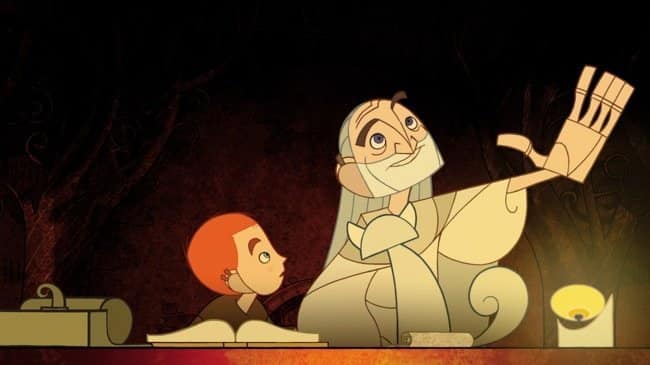

We live surrounded by screens, keyboard shortcuts, and instant results.
Everything seems designed to be done quickly, to be corrected without leaving a trace, to turn the page without looking back.
And yet, there are stories that remind us of just the opposite:
that living is a craft ,
that every stroke counts,
and that not everything should be done in haste.
The Secret of the Book of Kells is one of them.
A story that’s not about protecting a book, but about protecting meaning.
The film isn’t really about an ancient manuscript.
That book is just a metaphor.
What is at stake is something much more human:
the fear of losing who we are and the temptation to shut ourselves away so as not to change.
Brendan grows up in a world that confuses protection with confinement.
Where preservation means repetition.
Where danger is always outside.
But what happens when the real risk is not changing…
but never changing at all ?
Between origin and one’s own path
The Secret of Kells presents a very current tension, even though it is set in another time:
tradition versus creativity,
obedience versus conscience,
security versus discovery.
It’s not about breaking with the past,
but about understanding where we come from in order to decide where we are going .
Here it connects naturally with Soul :
the meaning is not only in reaching a destination,
but in how we live while we move forward .
And also with Up :
honoring what we have experienced does not mean remaining still,
but carrying it with us without it immobilizing us .
Creation as an act of courage
In the film, creating is not decorating.
It’s resisting fear.
Every illustration, every stroke, every visible mistake in the manuscript says something important:
that life is not edited without traces,
that imperfection also counts,
that the human is recognized in what is handmade .
At what point did we start thinking that everything has to be perfect?
Who convinced us that making mistakes diminishes our value?
For you, if you are building yourself up (even if you don’t call it that)
This film speaks softly, but it says big things.
Especially to those who are growing up.
It invites you to ask yourself:
- What parts of your history are you copying without question?
- What rules do you follow for fear of disappointing others?
- What talent are you holding back by not stepping outside the lines?
You are not just the heir to a world.
You are also the author of what you do with it .
For educators and families: caring without confining
The Secret of Kells sends a very clear warning:
protecting cannot mean isolating.
Accompanying is not controlling.
Educating is not shielding.
Caring is not preventing the other from exploring.
As we saw in Big Hero 6 ,
knowledge without an ethics of care loses its meaning.
Something similar happens here:
tradition without openness becomes fear.
Skills and values that run through history
Without explicitly naming them, the film works:
- personal identity
- critical thinking
- creativity with roots
- courage in the face of fear
- intergenerational responsibility
Not from discourse,
but from symbol.
And that’s why it remains.
A read for our time
In a world that automates almost everything,
The Secret of Kells reminds us of something essential:
Not everything should be optimized.
Not everything should be accelerated.
Not everything should lose the trace of the person who made it.
Because there are things—identity, meaning, life—
that can only be understood when they are written slowly .
The question that remains
If your life were a handwritten story,
what parts are you copying…
and which ones are you daring to create?

Marketing y Servicios
Ideas para mejorar el mundo . Director: José Miguel Ponce . Profesor universitario e investigador en Marketing y Gestión de Servicios, con experiencia en cinco universidades públicas y privadas. Sevillano de origen, ha vivido en varias ciudades de España y actualmente reside en Sevilla. Apasionado por la educación, la comunicación y las relaciones humanas, considera la amistad y la empatía clave en su vida y enseñanza. Ha publicado investigaciones sobre Marketing, Calidad de Servicio y organizaciones sin ánimo de lucro. Humanista y optimista, promueve el agradecimiento y la coherencia como valores fundamentales.
Related

Communication and Eye Contact in Marriage
P Angel Espinosa de los Monteros
16 February, 2026
4 min

France promotes gamete freezing in the face of demographic winter
Observatorio de Bioética UCV
13 February, 2026
6 min
When a child chooses a partner that worries us
Laetare
13 February, 2026
4 min
Doctors Convicted of Malpractice for Authorizing Her Transition While Ignoring Her Autism and Anxiety
Observatorio de Bioética UCV
12 February, 2026
4 min