 (EN)
(EN)
 (ES)
(ES)
 (IT)
(IT)

Leo XIV: How many loaves do you have? Go and see
The Pope urges cardinals to share resources and trust in Divine Providence during the Extraordinary Consistory
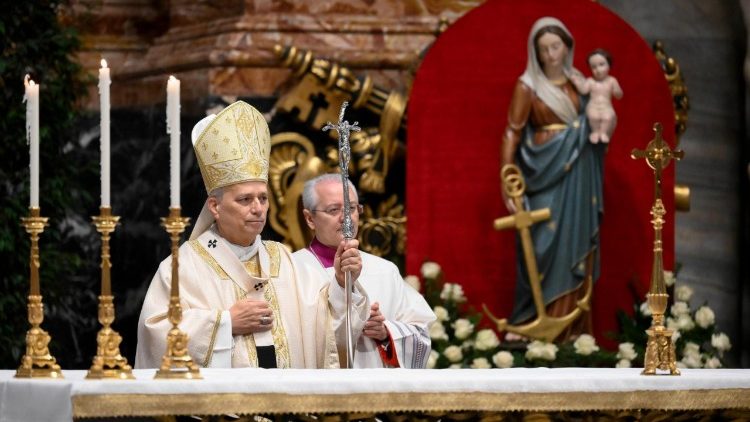

In his homily delivered this Thursday during the Holy Mass celebrated as part of the extraordinary consistory in St. Peter’s Basilica, Pope Leo XIV invited the members of the College of Cardinals to pause for prayer and joint discernment, setting aside personal agendas to put everything in God’s hands.
Taking as his starting point the Gospel account of the multiplication of the loaves and fishes (Mark 6:37-42), the Pope highlighted Jesus’ question to his disciples: “How many loaves do you have? Go and see” (Mark 6:38). This phrase, which he summarized as the core of his message, underscores the need to recognize the gifts that Providence makes available, even amidst the apparent inadequacy of these gifts in the face of the world’s great challenges.
“Faced with the ‘great multitude’ of a humanity hungry for goodness and peace,” the Pope explained, the disciples may feel inadequate, but Jesus asks them to take stock of the little they have and give it away. “We will not always be able to find immediate solutions to the problems we face. However, we can always help one another—and in particular help the Pope—to find the ‘five loaves and two fish’ that Providence never fails to provide,” he affirmed.
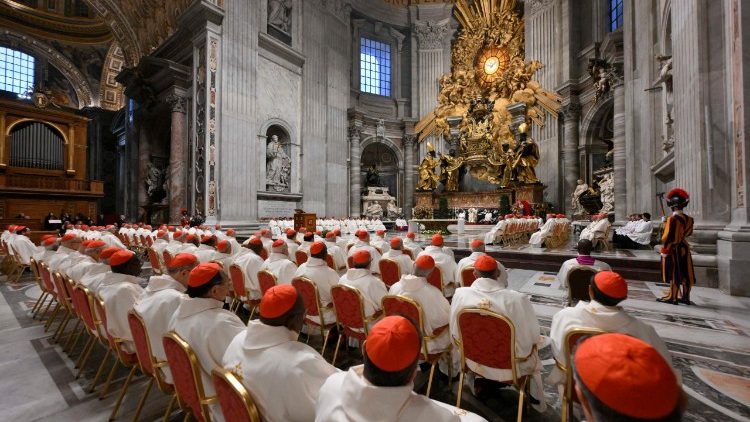
Leo XIV emphasized the etymological meaning of the consistory as a “stopping” together, a prophetic gesture in a frenetic society. “We are not here to promote ‘agendas’—personal or group—but to entrust our projects and inspirations to the scrutiny of a discernment that transcends us,” he declared, recalling that the College of Cardinals must be first and foremost a community of faith and not merely a team of experts.
The Pope also invoked the teachings of St. Leo the Great, underlining the beauty of a Church where “all ranks and all orders collaborate with one spirit,” feeding the hungry, clothing the naked, and seeking the common good above self-interest.
This extraordinary consistory, which began the previous day with an opening address, brings together the cardinals for a time of prayer, listening, and fraternal reflection, following the close of the Jubilee Year. Leo XIV concluded his homily by entrusting the mission of the Church to God with the words of Saint Augustine: “Give what you command and command what you will.”
The papal message resonates as a call to humility, generosity, and trust in divine grace to face the global challenges of peace, justice, and evangelization at the beginning of 2026.
Full text of the homily:
EXTRAORDINARY CONSISTORY
HOLY MASS
HOMILY OF POPE LEO XIV
St Peter’s Basilica
Thursday, 8 January 2026
_________________________________
“Beloved, let us love one another, because love is from God” (1 Jn 4:7). The liturgy sets this exhortation before us as we celebrate the Extraordinary Consistory, a moment of grace wherein our unity in the service of the Church finds its expression.
As we know, the word Consistory (Consistorium, or “assembly”) can be understood through the root of the verb consistere, meaning “to stand still.” Indeed, all of us have “paused” in order to be here. We have set aside our activities for a time, and even cancelled important commitments, so as to discern together what the Lord is asking of us for the good of his people. This itself is already a highly significant and prophetic gesture, particularly in the context of the frenetic society in which we live. It reminds us of the importance, in every aspect of life, of stopping to pray, listen and reflect. In doing so, we refocus our attention ever more clearly on our goal, directing every effort and resource towards it, lest we risk running blindly or “beating the air” in vain, as the Apostle Paul warns (cf. 1 Cor 9:26). We gather not to promote personal or group “agendas,” but to entrust our plans and inspirations to a discernment that transcends us – “as the heavens are higher than the earth” (Is 55:9) – and which comes only from the Lord.
For this reason, it is important that during this Eucharist, we place each of our hopes and ideas upon the altar. Together with the gift of our lives, we offer them to the Father in union with the Sacrifice of Christ, so that we may receive them back purified, enlightened, united and transformed by grace into one Bread. Indeed, only in this way will we truly know how to listen to his voice, and to welcome it through the gift that we are to one another – which is the very reason we have gathered.
Our College, while rich in many skills and remarkable gifts, is not called primarily to be a mere group of experts, but a community of faith. Only when the gifts that each person brings are offered to the Lord and returned by him, will they bear the greatest fruit according to his providence.
Moreover, God’s love, of which we are disciples and apostles, is a “Trinitarian” and “relational” love. It is the very source of that spirituality of communion, by which the Bride of Christ lives and desires to be a home and a school (cf. Apostolic Letter Novo Millennio Ineunte, 6 January 2001, 43). Expressing the hope that this spirituality would flourish at the dawn of the third millennium, Saint John Paul II described it as “the heart’s contemplation of the mystery of the Trinity dwelling in us, and whose light we must also be able to see shining on the face of the brothers and sisters around us” (ibid.).
Our “pausing,” then, is first and foremost a profound act of love for God, for the Church and for the men and women of the whole world. Through this, we allow ourselves to be formed by the Spirit: primarily in prayer and silence, but also by facing one another and listening to one another. In our sharing, we become a voice for all those whom the Lord has entrusted to our pastoral care in many different parts of the world. We must live this act with humble and generous hearts, aware that it is by grace that we are here. Moreover, we bring nothing that we have not first received as a gift or talent, which are not to be squandered, but invested with prudence and courage (cf. Mt 25:14–30).
Saint Leo the Great taught that “it is a great and very precious thing in the sight of the Lord when the whole people of Christ apply themselves together to the same duties, and all ranks and orders… cooperate with one and the same Spirit.” In this way, “the hungry are fed, the naked clothed, the sick visited, and no one seeks his or her own interests, but those of others” (Sermon 88, 4). This is the spirit in which we wish to work together: the spirit of those who desire that every member of the Mystical Body of Christ will cooperate in an orderly way for the good of all (cf. Eph 4:11–13). May we fully carry out our ministry with dignity under the guidance of the Holy Spirit, happy to offer our own labor and to see it its fruits mature. May we likewise welcome the labors of others and rejoice in seeing them flourish (cf. Saint Leo the Great, Sermon 88, 5).
For two millennia, the Church has embodied this mystery in its multifaceted beauty (cf. Francis, Encyclical Letter Fratelli Tutti, 280). This very assembly bears witness to it through the variety of our origins and ages, and in the unity of grace and faith that gathers us together and makes us brothers.
Certainly, we stand before a “great crowd” of humanity hungry for goodness and peace. In a world where satisfaction and hunger, abundance and suffering, and the struggle for survival together with a desperate existential emptiness continue to divide and wound individuals, communities and nations, we may feel inadequate. Faced with the words of the Master, “You give them something to eat” (Mk 6:37), we too might feel, like the disciples, that we lack the necessary means. Yet Jesus repeats to us once more, “How many loaves have you? Go and see” (Mk 6:38). This is something we can do together. We may not always find immediate solutions to the problems we face, yet in every place and circumstance, we will be able to help one another – and in particular, to help the Pope – to find the “five loaves and two fish” that providence never fails to provide wherever his children ask for help. When we welcome these gifts, hand them over, receive and distribute them, they are enriched by God’s blessing and by the faith and love of all, ensuring that no one lacks what is necessary (cf. Mk 6:42).
Beloved brothers, what you offer to the Church through your service, at every level, is something profound and very personal, unique to each of you and precious to all. The responsibility you share with the Successor of Peter is indeed weighty and demanding.
For this reason, I offer you my heartfelt thanks, and I wish to conclude by entrusting our work and our mission to the Lord with the words of Saint Augustine: “You give us many things when we pray, and whatever good we received before we prayed for it, we have received from you. We have also received from you the grace that later we came to realize this… Remember, Lord ‘that we are but dust.’ You have made man of the dust” (Confessions, 10, xxxi, 45). Therefore, we say to you: “Grant what you command, and command what you will” (ibid.).

Exaudi Staff
What is Exaudi News? Exaudi News is an international Catholic media outlet that informs, shapes, and transforms daily in Spanish, English, and Italian. Through news, analytical articles, and live broadcasts of the Pope's events, Exaudi seeks to strengthen Christian unity and contribute to the evangelization of the world, always guided by the Church's social doctrine. We work to bring Christian truth and values to every corner of the planet. Help us transform the world with Exaudi! At Exaudi, we believe that evangelization and quality information can change lives. To continue our mission and expand our reach, we need your help. In addition, we are looking for committed people to join our team. With your support, we will reach more people, spread the message of Christ, and strengthen Christian unity. Will you join our mission? For more information on how to collaborate, visit Exaudi.org or contact us directly: [email protected] Exaudi: Informs, educates, and transforms.
Related
Pope Leo XIV: The Church hierarchy is born of Christ to proclaim the Gospel
Exaudi Staff
25 March, 2026
8 min
Leo XIV: “Cease fire and work for peace through dialogue”
Exaudi Staff
25 March, 2026
1 min
“Airplanes must always be carriers of peace, never of war”
Exaudi Staff
24 March, 2026
5 min
Pope Leo XIV: “Come out!” from the tomb of selfishness and materialism
Exaudi Staff
22 March, 2026
6 min