(EN)
(EN)
 (ES)
(ES)
 (IT)
(IT)

Hope Never Disappoints
Catholic Leadership of Hope

X International Diploma in Social Doctrine of the Church.
“Hope does not disappoint.” This is a simple yet powerful statement by Saint Paul in his Letter to the Romans (5:5) that accurately sums up the spiritual legacy left to us by our beloved Pope Francis, may he rest in peace, when he proclaimed the Jubilee of Hope in 2025 with the papal bull “Spes non confundit.” Francis was a tireless witness to this profound certainty, rooted in the loving fidelity of God, who never abandons his people. During turbulent times marked by uncertainty, he invited us to rediscover that Christian hope is not naivety or an emotional refuge, but rather a strength anchored in God, a driving force of commitment, and a path to fulfillment.
Today, looking at the world around us, it is not difficult to feel the weight of disorientation. Protracted wars, persistent hunger, social fragmentation, and ecological and economic crises harshly challenge our consciences. It seems that our time has lost its way, locked in conflicts that tear at both institutions and the human heart. Yet it is precisely on this threshold of confusion that the serene voice of Pope Francis resonates once again: hope does not disappoint, because it is not born of us, but of the love that God has poured into our hearts.
In the face of darkness, Christian hope does not retreat; it unfolds. It is a lucid and transforming force. It does not wait for convenient miracles or immediate answers, but rather compels us to inhabit history with commitment, to weave community, to offer our own lives as a leaven of reconciliation. Hope is not the opposite of pain, but its freest response, because where the logic of fear paralyzes, active hope builds.
This is the vocation that the International Academy of Catholic Leaders has resolutely embraced. Since its inception—and with greater intensity now, under the pontificate of Pope Leo XIV—its mission is to form a new generation of Catholic leaders capable of inhabiting the world with joyful and firm faith, with an open mind and an open heart. Men and women who do not entrench themselves in dogma, but who engage in profound dialogue. Who do not impose, but inspire; who do not shy away from the challenges of this time, but face them with the light of the Gospel and the desire for justice.
Inspired by the teaching and pastoral style of Francis—who taught us to look from the peripheries to the center, and from the center to the forgotten margins—the Academy has become a living international community where young people from more than fifteen countries discover that hope can also be learned, and that leadership is not about rising, but about serving. This formation, rooted in the Social Doctrine of the Church, cultivates in each student the vocation to be a sign of a Church that journeys, listens, and builds fraternity.
This October, this shared mission will reach a pivotal moment: the 10th International Diploma in the Social Doctrine of the Church, focused precisely on the theme: Catholic Leadership of Hope. It will be held in Rome, in communion with the Jubilee convened by Pope Francis and in resonance with the new pastoral era of Pope Leo XIV, who encourages us toward a synodal, fraternal, courageous, and close Church.
During the course—divided into a virtual and an in-person phase—young political, social, academic, and ecclesial leaders will meet to reflect together on hope. Not as a vague concept, but as a concrete responsibility. Through testimonies, roundtable discussions, theological expositions, and community discernment, paths of action will be opened, the world’s wounds will be illuminated, and new horizons will be proposed. Each shared word will seek to answer a fundamental question: what does it mean today to exercise leadership as a form of embodied hope?
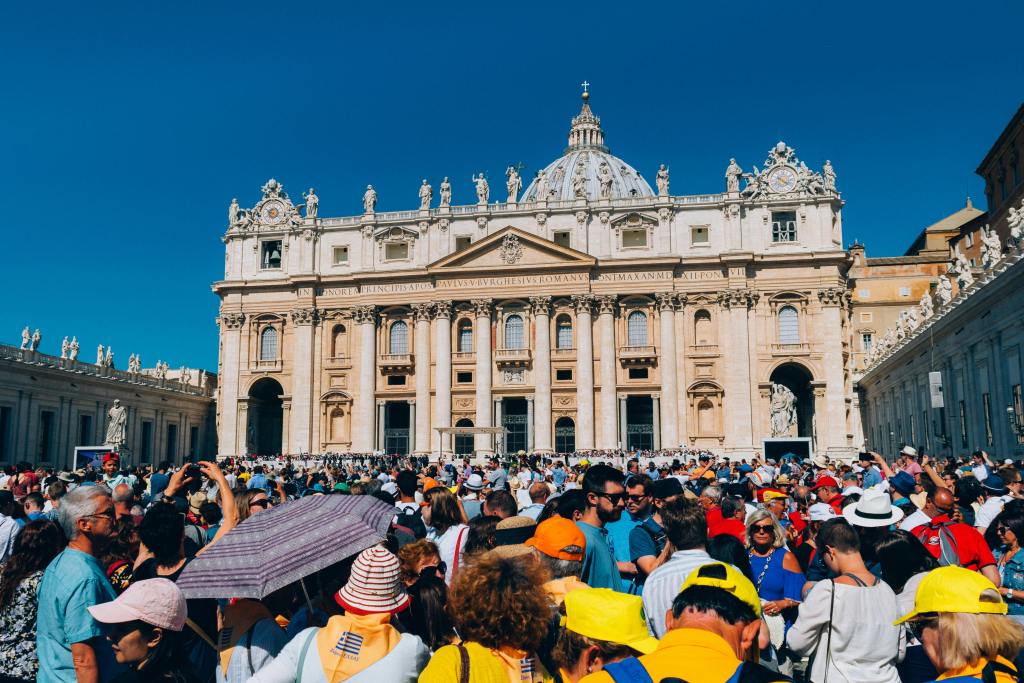
One of the most significant moments will be the pilgrimage to the Holy Door of St. Peter’s Basilica. Not as an isolated rite, but as an ecclesial gesture of passage: crossing that door will mean, for many, leaving behind the logic of disenchantment and embracing a new life, marked by reconciliation, mercy, and service. It will also be a visible sign of a Church that does not close in on itself, but opens itself to the sufferings of the world with a word of comfort and an outstretched hand.
This meeting will also be a concrete way of embodying the call of the new pontificate to assume, with responsibility and humility, the commitment to renew the Church from within, with the audacity of faith and the wisdom of love. The Academy, at this stage, feels called to offer spaces of formation where hope is not a superficial slogan, but a spiritual and civic discipline. A hope that permeates one’s entire life.
From here, sustained by the luminous certainty that “hope never disappoints,” I would like to address a few words to those who, amid the rifts of today’s world, continue to feel within themselves the silent call to service. To those who refuse to accept that things remain as they are. To those who believe—or at least sense—that the Gospel, far from being a slogan of the past, can still fertilize with its lifeblood the most arduous paths of politics, culture, education, and public life.
It’s not about conquering spaces, but about deeply inhabiting the margins; it’s not about imposing answers, but learning to listen to the questions. The Catholic leadership we need today doesn’t seek to assert itself as a closed identity, but rather to offer itself as lucid hospitality. A hope that is not propaganda or easy consolation, but a spiritual exercise of vigilance, humility, and fidelity.
For this reason, those of us who are part of the International Academy of Catholic Leaders see this International Diploma not as just another event, but as a living expression of our efforts to open spaces where hope is reflected, shared, deepened, and translated into commitment. In this sense, Rome will be more than a venue; it will be the sign and sacrament of a Church that journeys, that listens, and that responds to the call.
Today, perhaps more than ever, it remains true that hope, when it becomes a way of life—in following a living, merciful God, who calls us and reconciles us in his love—and a concrete choice—to be leaders in the service of the common good of all society—never disappoints.

Mario J. Paredes
Presidente ejecutivo de SOMOS Community Care, una red de 2,600 médicos independientes -en su mayoría de atención primaria- que atienden a cerca de un millón de los pacientes más vulnerables del Medicaid de la Ciudad de Nueva York
Related

Are you aware of the weight you carry?
Hugo Saldaña Estrada
10 March, 2026
3 min
The Church Gathers What Is Scattered
Jesús Ortiz López
10 March, 2026
6 min
In service to the poor, social care has a higher mission
Mario J. Paredes
09 March, 2026
4 min
The Word Is the Visible Face of Silence
Rosa Montenegro
09 March, 2026
4 min