 (EN)
(EN)
 (ES)
(ES)
 (IT)
(IT)

Gold, Frankincense, and Myrrh
When the Self Finds Its Star
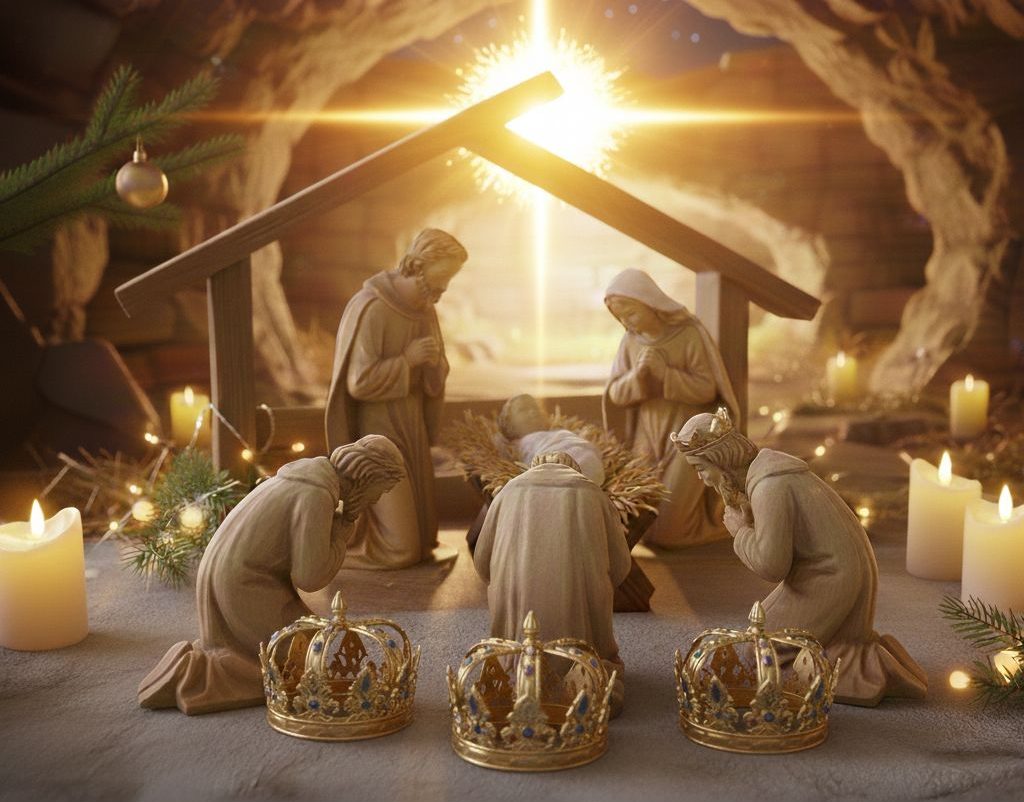

Today, January 5th, the Three Wise Men arrive, knocking on our door to illuminate our purpose. Letting ourselves be guided by “the star” gives us the assurance of reaching our destination. Each person arrives here today with their own story, but is called to decide what gold, frankincense, and myrrh they wish to place at the feet of the Child in the Nativity scene of 2026. A 12-month pilgrimage.
The Three Wise Men appear, almost silently; they are men who leave the comfort of their homeland, travel through the night, and are guided by a star to an unknown encounter they long for. They don’t travel to collect experiences, but for a discovery that, without knowing it for sure, will change their lives forever.
The comfort they enjoy because of their royalty might suggest staying in the palace, entertained by their own glitter and surrounded by mirrors. But the “self,” not their crown, is that essence that continually seeks what is genuine, dares to go out, to ask questions, to take the wrong path, and to correct its course. That is why the scene of the Magi is a mirror of our own search: each of us, with our own unique identity, is invited to ask ourselves what we hold in our hands when we come before the Mystery.
Gold: the royalty of self-government
Gold speaks of royalty, but not of one that dominates others, but of one that begins by governing itself. The Magi place the symbol of their power at the Child’s feet, as if to say: “I give my life, my Kingdom, for something greater than myself.”
In everyday life, that gold is very similar to the responsible freedom we have talked so much about: a self that learns to order its inner self, that does not let itself be carried away by haste, by constant comparison or by impulses, and that decides where it wants to steer its story.
The everyday practice : Turn off your phones during gatherings and consciously choose to listen to the other person without interrupting, even if they’ve been talking about the same thing for twenty minutes. It’s an act of self-management that unites the family around the table, without screens to fragment their attention. A good exercise for the whole year: put your phone away, and lose the fear of having it turned off.
Perhaps our first gesture of 2026 should be to examine what “gold” truly governs our daily lives. If it’s the ego that gives orders, everything becomes noise and exhaustion; if it’s the self that knows who it belongs to, life begins to sound like a coherent melody, even if it has dissonant notes.
Incense: the inhabited silence
Incense is the search for meaning, the awareness that my life is not explained only by what I do, but by the One to whom I offer myself.
The incense rises, perfuming the air. It is a gesture of acknowledging that life cannot be explained solely horizontally, that there is Someone before whom it is worthwhile to kneel. In a world that encourages us to live on autopilot, the incense recalls the question that runs through my articles: “For whom do I live? What purpose sustains what I do when no one is watching?”
The everyday : Before going to sleep, give thanks and establish the habit of reflecting on the good things you’ve received. An inner reset that, without being complicated, transforms bedtime into an act of peace.
Without that horizon, existence fragments into tasks, achievements, and screens, but remains empty inside. Incense is the decision to reclaim wonder, prayer, inhabited silence, the gaze that rises, the gaze that saves. It is allowing the self to recognize itself as a creature and not the centre of the universe, knowing that only in this way does it find its place.
Myrrh: to love without running from pain
Myrrh is perhaps the most unsettling gift: a perfume for suffering and death. It introduces, amidst the luminous scene of Bethlehem, the shadow of the cross and, with it, the truth I so often repeat: suffering is compatible with happiness when lived in love. There is no real love without risk, without worry, without sleepless nights; there are no deep bonds without wounds and forgiveness.
Everyday life : When a conflict arises, sit down and share for five minutes, without judgment, simply to listen to each other and decide “what do we do now?” It’s not good to resolve everything in the heat of the moment or in a rush, but rather to inhabit the pain with shared patience. Strive each day to pause time—for five minutes—for any anger at home.
In a time that promises effortless happiness and affection without commitment, myrrh reminds us that to love is to expose ourselves to pain, but that this shared pain is not failure, but rather a place where life becomes deeper and more authentic. Perhaps 2026 can be the year in which we dare to offer our own myrrh: our frailties, losses, and limitations, not hidden, but placed in the hands of God and those who walk beside us, so that they may be transformed into tenderness, patience, and hope.
And myrrh reminds us that truly loving will always involve brushing against pain, but a pain that is inhabited, never in solitude.
These and other examples are concrete practices that link personal and family development, are easy to maintain for three hundred and sixty-five days, and foster that “unity of life” that we seek.
We belong to each other because love unites us without confusing us.
As Luigi Maria Epicoco says:
“Love makes us feel like someone. Most of the time we live in the precariousness of constantly feeling lacking something, orphaned, vagrants. Charity makes us pilgrims, not vagrants, because God gives us a belonging: ‘You are mine’.”
Luigi Maria Epicoco, “Salt, not honey”, Chapter 3. Charity

Rosa Montenegro
Pedagoga, orientadora familiar (UNAV) y autora del libro “El yo y sus metáforas” libro de antropología para gente sencilla. Con una extensa experiencia internacional en asesoramiento, formación y coaching, acompaña procesos de reconstrucción personal y promueve el fortalecimiento de la identidad desde un enfoque humanista y transformador.
Related
Abortion: Legalizing a Crime
Isabel Orellana
10 April, 2026
5 min
Gratitude as a Spiritual Discipline: How to Transform Daily Complaints into Prayers of Thanksgiving
Patricia Jiménez Ramírez
08 April, 2026
5 min
Pope Leo XIV’s First Holy Week: A Call to Light, Hope, and Peace in a World of Darkness
Valentina Alazraki
07 April, 2026
4 min

Living with Meaning and Purpose
María José Calvo
07 April, 2026
4 min