(EN)
(EN)
 (ES)
(ES)
 (IT)
(IT)

Domine, ¿Quo Vadis?
The silent martyrdom of our time


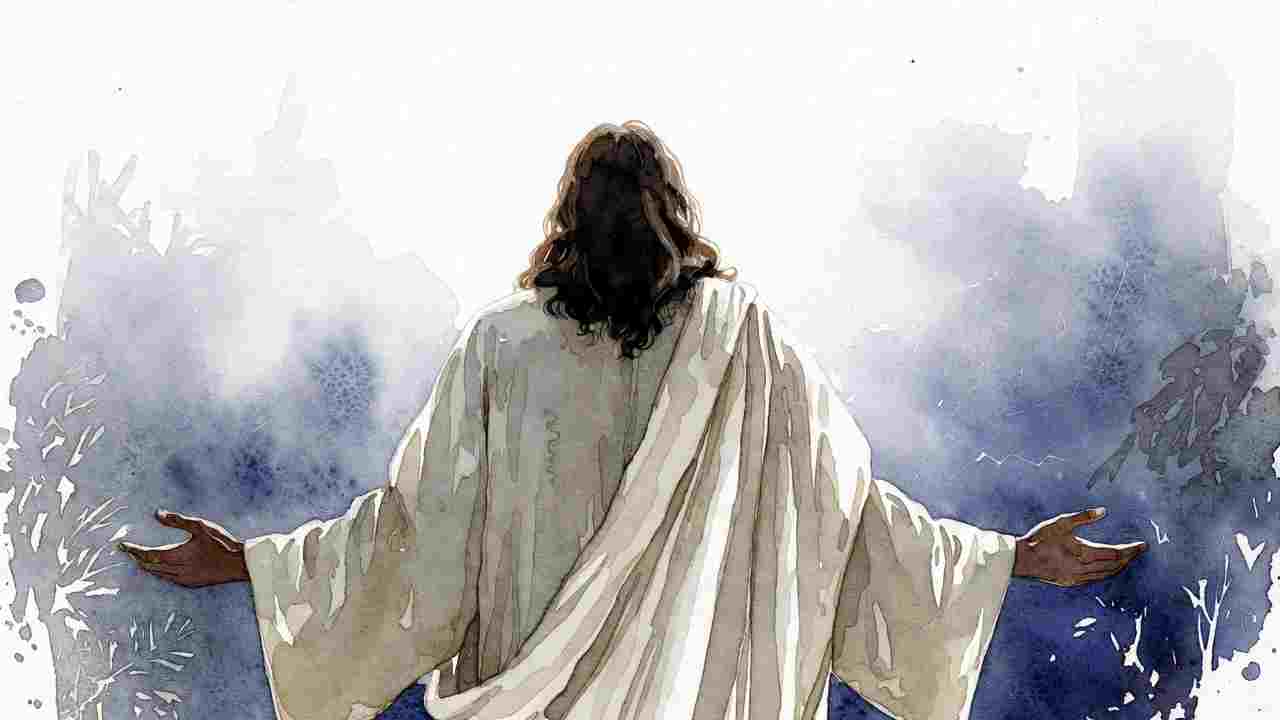
What if we ran into Him today, boarding the train, carrying His cross? In the middle of our daily routine. Maybe on a poster in the subway.
What if we asked Him the same question Peter did—not out of curiosity, but out of the unease that arises when something inside us no longer fits?
- Lord, where are you going? you ask.
- I am going back to Rome. I am going back to the cross, He answers, looking you straight in the eyes, without reproach.
In a generation that is fleeing, the one walking in the opposite direction seems to be the one running away. Because the crowd—always so reassuring—convinces us we’re on the right path simply because we’re all going together, “xuntiños” [all huddled together].
But not everything shared points the way. Not everything agreed upon is true.
The early Church suffered bloody persecution. The Church today endures something harder to detect—and therefore more dangerous: a progressive, silent spiritual sedation.
We can turn into “zombies” from an invisible “fentanyl” injected into the veins of the West.
Back then, pyres burned. Today, consciences are extinguished. Faith is not fought against; it is made irrelevant.
It is not openly persecuted. It is anesthetized. Diluted. Replaced with generic values—compatible with everything, incapable of disturbing anyone. We keep functioning, producing, opining, but we have lost interior lucidity: that clarity that lets us discern the path when everything is relativized.
Tradition tells us that Christ, carrying His cross, meets Peter who is fleeing. There is no reproach in His response. There is love. There is respect. And there is direction.
The Redemption was accomplished in a historical moment, but it is renewed every day: at every altar, in every Mass, in every freedom that chooses not to flee.
The problem is not the hostility of the world. It is forgetting the promise that confuses us. Peter cannot flee from the mission he received. “You are Peter, and on this rock I will build my Church,” he was told. And his great temptation is not persecution, but retreat, silent abandonment. Forgetting in the heart.
Today, spiritual leadership—including the Pope’s, but not only his—is exercised in a different climate: no fire, but doctrinal confusion; moral fatigue, constant noise; it doesn’t burn, it disorients. And what disorients eventually wears us down.
Here the danger is not making a mistake. It is ceasing to look at the goal. Forgetting the “for what” and the “why.” Christ is not only the way; He is also the certain destination.
When everything is relativized, we are not asked for more speed, but for more interior repose. Guarding meaning becomes an act of resistance.
Quo vadis? does not ask about strategies or tactics. It asks about fidelity. About coherence between what we say we believe and the actual direction of our lives.
We live installed in a permanent sense of crisis, absorbed by vertigo, sucked into the “social tornado.” But the most serious crisis is another one:
- Living the faith at a distance, without involving our whole life.
- Waiting for others to decide, to take risks, to pay the price.
The mission cannot be delegated. It is our time. And it is the best time, because we have no other. Every era has its way of bearing witness. Ours is not spectacular, but it is demanding.
Fidelity today is not epic. It is silent. It plays out in the small things:
- accepting unchosen limits,
- holding on to a truth that has no market value,
- renouncing a more comfortable version of ourselves.
There is no narrative for that. No applause. But that is where everything is decided.
Our time does not always produce visible martyrs. It generates a martyrdom “of daily pinpricks”:
- the coherence that is not displayed,
- the cross that is not shown,
- perseverance without recognition.
- That hurtful word you do not say.
And yet, not everything is winter. Amid the confusion, an unexpected spring is breaking through:
- Young people seeking truth without cynicism.
- Artists returning to speak of beauty, of wounds, of meaning.
- Creators who do not preach, but open cracks where light enters.
There is no nostalgia in them. There is lack. There is hunger. And where there is hunger, God passes by again.
Peter returns to Rome without guarantees. He does not return to win. He returns to surrender. Christianity is not sustained by perfect men and women, but by forgiven ones who no longer negotiate with the truth to save themselves.
Redemption does not erase the wound. It makes it fruitful. And turns it into a place of encounter.
Domine, Quo vadis?
It is not a dark question. It is a luminous and dangerous one. Because it forces us to choose.
Heaven is not conquered once and for all. It is decided every day. Almost always in silence, in the surrender of the “small stitch” in the tapestry of our life.
Returning is returning to the origin every day.
Beginning and beginning again is the style of today’s martyrs.
***
NOTES
- Painting by Annibale Carracci depicting the apparition of Christ to Saint Peter on the Appian Way.
- “xuntiños”: all together (in Galician)
- Movie Quo Vadis, 1951 version.

Rosa Montenegro
Pedagoga, orientadora familiar (UNAV) y autora del libro “El yo y sus metáforas” libro de antropología para gente sencilla. Con una extensa experiencia internacional en asesoramiento, formación y coaching, acompaña procesos de reconstrucción personal y promueve el fortalecimiento de la identidad desde un enfoque humanista y transformador.
Related

The Economy of Women’s Impact
Exaudi Staff
20 February, 2026
3 min

The Surrender, Culmination of Love
EduFamilia
20 February, 2026
13 min
Cardinal Arizmendi: We all need to be converted
Cardenal Felipe Arizmendi
19 February, 2026
5 min

Benedict XVI: A Historic Decision
Valentina Alazraki
19 February, 2026
4 min