 (EN)
(EN)
 (ES)
(ES)
 (IT)
(IT)

Do You Know How to Pray?
A Practical Guide Based on the Catechism


On several occasions people ask me: “Father, how do you pray? What do you pray?”
Look, there are usually prayer manuals from various spiritual traditions. Each founder, saint, or congregation may have left their own spirituality written down and expressed in a particular type of prayer. There are very ancient prayers, obviously the biblical prayers: the Lord’s Prayer , the Hail Mary —which is also biblical, it’s the encounter of the angel with the Blessed Virgin Mary.
But, to avoid talking about theories, I’m going to answer you with the Catechism of the Catholic Church in hand, based on my own experience. We could talk for three hours about this, but I’ll give a summary.
Vocal prayer
First, there is vocal prayer : reading pre-written prayers, prayer books. Obviously, you have to put faith into it. You can create your own, but it is still vocal prayer. For example, praying the Hail Mary or the Rosary with its mysteries in community or as a family. This is vocal prayer that involves contemplation.
Mental prayer or meditation
Then there is what some call mental prayer or meditation : taking the Bible, the Gospel, a text from a saint, or a spiritual text. It’s no longer about speaking aloud or simply reading, but about reading a phrase, a line, a verse from the Gospel or a passage from the Old Testament. Then begins the work of assimilating, meditating, and reflecting.
This is incredibly rich. Imagine meditating on the Beatitudes: “Blessed are the merciful, for they will be shown mercy.” I read it, close the Bible, and contemplate: What does it mean? Blessed are the merciful… I look at my own life, the life of Jesus, his mercy, how he treated each person, how I am behaving, and what I can do to improve.
Sometimes it’s a whole paragraph from a saint who says four or five beautiful things, and you go word by word contemplating, meditating, trying to grasp the full meaning of what that God-inspired person said.
Contemplative prayer
And then there is contemplative prayer : when it’s not a text from a saint, but the very life of Jesus, of Mary, of the Gospel. To contemplate is to enter the cave of Bethlehem, to witness Calvary, to see the apostles in Gethsemane, Judas, to see how the ten lepers arrive and how Jesus treats them—he approaches, he allows himself to be touched by one who should have been stoned.
It’s like being a film director and watching your own version of the Gospel. Everyone sees it differently. The more you know the Gospel, the better you’ll see Jesus: What would he do? How would he respond? What was his expression when he called Matthew? It’s not about inventing things, but about getting to the heart of the matter to bring out what’s most beautiful: God’s love, Jesus’ love for each one of us.
The different types of prayer according to the Catechism
When we talk about prayer, it’s not just about asking. The Catechism teaches several types:
- Prayer of Petition : Begin by praying for all humanity, for the souls in purgatory, for the Church, for the poor, the needy, and sinners. Be generous, forget yourself. I may be going through a difficult time—loneliness, rising rent, worries—but I turn on the television and see rivers sweeping away houses, earthquakes, mothers losing children… I’m in the 1% of people who are doing well. So, first I pray for our leaders, for justice, for migrants. Then, for myself: increase my faith, my hope, my love; give me strength, the gifts and fruits of the Holy Spirit. And then I pray for my important appointment, my knee pain, my boss at the office…
- Intercessory prayer : When I have someone’s name, surname, and face in mind, I know that so-and-so is about to make a life-changing decision; a friend’s children are using drugs; a beautiful marriage is falling apart… I can’t just pray for myself. We must pray for those who perform abortions (it’s a business), for those who promote euthanasia—like in that case I heard about of a brother with terminal cancer in the United States, where the doctor offered “the pill” to end his suffering, disguising it as charity. Let us pray for murderers, infidels, the unjust… If they don’t repent here, how will they fare on the day of reckoning?
- A prayer of thanksgiving : This is probably how all our prayers should begin and end. I love to start and end by giving thanks. We can never leave God’s presence without giving thanks: for life, love, health, opportunities… Even if business hasn’t gone well, even if I lack things. In reality, I only need what I have; everything else is an imagined need.
- Prayer of praise : The Psalms and other biblical texts can be helpful. Jesus himself said, “I thank you, Father…” Filled with the Holy Spirit, he praised the Father. Imagine us praising God: a mixture of gratitude, petition, praise, and contemplation.
To sum it up for you in a few words: get into the Catechism of the Catholic Church, find the section on prayer, and read four or five paragraphs every day. You’ll enrich your prayer life.
Pass this message on to all those people who don’t know how to pray or who say, “I pray, but how boring, 50 Hail Marys…” Leave the Rosary to contemplate each mystery. When you understand the Our Father, you’ll want to pray it more. It’s not repetition: it’s contemplation, praise, a call to action for life with its seven petitions.
Begin by speaking to God in your own words, using the Gospel or a good book for guidance. As you grow in your spiritual life, you will see that the Rosary is not repetition, but profound contemplation.
Pass this message on to everyone. Let’s do all the good we can.
May God always bless you.
Let’s do all the good we can!
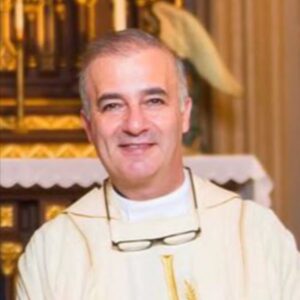
P Angel Espinosa de los Monteros
El Padre Ángel Espinosa de los Monteros ha impartido más de 4,000 conferencias sobre matrimonio, valores familiares y espiritualidad en diferentes ciudades de México, Estados Unidos, Francia, Italia, España y Sudamérica. Ha atendido a cientos de matrimonios ofreciendo consejos y programas de crecimiento conyugal y familiar. Es autor del libro «El anillo es para siempre», traducido a diferentes lenguas y a partir de las cuales ha dictado más de 20 títulos de conferencias. Actualmente se dedica de tiempo completo a impartir conferencias y renovaciones matrimoniales en 20 países del mundo.
Related
Helping Jesus
Monseñor Gilberto Gómez González
20 March, 2026
3 min

My Father: The Loving Presence That Shapes Hearts
Laetare
20 March, 2026
3 min
Saint Joseph: A Model of Fatherhood, Faith, and Protection
Patricia Jiménez Ramírez
19 March, 2026
4 min
Saint Joseph: Perpetual Smile
Luis Herrera Campo
19 March, 2026
3 min